sales@hu-steel.com
 English
 Español
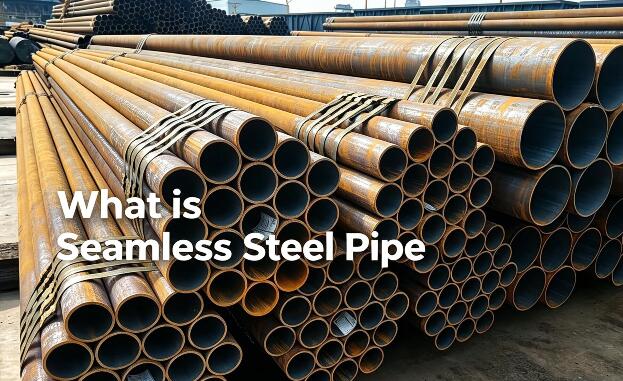
Seamless Steel Pipe Definition: A seamless steel pipe (SMLS Pipe) is a hollow cylindrical section manufactured without any weld seam or joint. Unlike welded pipe—formed by rolling steel plate and joining the edges with a weld—seamless pipe is produced by heating and piercing a solid round billet. This weld-free construction gives it inherent mechanical strength and uniform pressure resistance across the entire pipe body.
Seamless steel pipes are primarily used in industrial piping systems to transport fluids—liquids, gases, and slurries. Their main function is transport: moving oil, natural gas, water, steam, petrochemical products, and other substances from one point to another under pressure. This fundamental purpose of fluid transport is what defines a pipe and distinguishes it from tubing, which serves structural or functional roles in machinery and is measured by exact OD and wall thickness.
This guide covers the essential aspects of seamless steel pipe: key advantages, limitations, standards, classification, how it is made, pressure ratings, main applications, and how to choose the right pipe for your project.
The advantages of seamless steel pipes stem from a fundamental characteristic: no weld seams.
1. Uniform strength – The absence of heat-affected zones or weld defects ensures consistent performance under pressure, temperature, and stress. This is critical for high-pressure oil and gas pipelines, where a single weak point can lead to failure.
2. Higher pressure resistance – Burst pressure is approximately 20-30% higher than welded steel pipes of the same material and size. This makes seamless pipes suitable for high-pressure systems such as power plant boilers and offshore drilling equipment.
3. Better corrosion and fatigue resistance – Eliminating the weld seam as a failure point effectively resists localized corrosion and ensures reliable operation under cyclic loads, vibration, and thermal stress. This is essential for refineries, chemical plants, and offshore platforms.
4. Wide range of options – Available in carbon steel, alloy steel, and stainless steel, as well as various sizes and wall thicknesses to meet diverse project requirements. This allows engineers to select the right material for specific media, temperature, and pressure conditions.
These advantages make seamless steel pipes the preferred choice for critical applications in demanding industries such as oil and gas, power generation, and chemicals.
Seamless steel pipes are manufactured according to stringent industry standards, the most common being American standards (ASTM/API), such as ASTM A53, ASTM A106, and API 5L.
| Standard | Typical Applications | Key Characteristics | Common Grade |
|---|---|---|---|
| ASTM A53 | Plumbing, heating, fire sprinkler, water/steam/gas lines | Low-to-medium temperature service; most widely used for general-purpose applications | A53 Grade B (35,000 psi yield) |
| ASTM A106 | Refineries, power plants, petrochemical plants, boilers | High-temperature (up to 427°C / 800°F) and high-pressure service | A106 Grade B (240 MPa yield, 415 MPa tensile) |
| API 5L | Oil and gas transmission pipelines | Line pipe for petroleum and natural gas industries; covers both seamless and welded pipes | Grades A25 to X80+ (higher X = higher strength) |
The main differences between seamless steel pipes and welded steel pipes lie in their manufacturing processes and structural integrity. Seamless steel pipes offer higher pressure resistance and more uniform strength, while welded steel pipes are more cost-effective for general applications.
When to choose seamless: High-pressure systems (e.g., oil and gas pipelines, power plant boilers), high-temperature applications, and critical services where weld integrity is a concern.
When to choose welded: Low-to-medium pressure systems, general plumbing, structural applications, and projects where cost is the primary constraint.
▶ For a detailed comparison, please refer to our guide: [Seamless Pipes vs. Welded Pipes]
The manufacturing process of seamless steel pipe is a complex, highly controlled sequence of hot working operations:
1. Raw Material Selection – The process begins with high-quality solid round steel billets, made from carbon steel, alloy steel, or stainless steel. Billets are tested for chemical composition and internal defects.
2. Heating – Billets are heated in a rotary hearth furnace to approximately 1,200–1,300°C. This high temperature ensures the steel is soft enough to be formed without cracking.
3. Piercing – The red-hot billet is fed into a piercing mill, where it is rotated and compressed between rolls while a piercing plug forms a hollow center. This transforms the solid billet into a hollow shell.
4. Elongation and Sizing – The hollow shell undergoes elongation in a plug mill, mandrel mill, or stretch-reducing mill to achieve the desired length, diameter, and wall thickness.
5. Heat Treatment – Pipes are subjected to controlled heat treatment processes such as normalizing, quenching, and tempering to refine the microstructure and improve mechanical properties.
6. Straightening and Cutting – Pipes are straightened and cut to required lengths.
7. Surface Finishing – Pipes may be descaled, sandblasted, pickled, or coated to prevent rust and oxidation.
8. Testing and Quality Control – Each pipe undergoes rigorous testing: ultrasonic testing (UT), eddy current testing (ECT), hydrostatic testing, and dimensional and visual inspection.
▶ For a detailed comparison of hot rolling and cold drawing processes, see [Seamless Steel Pipe Manufacturing Process].
Seamless steel pipes are classified by schedule—a standard that defines wall thickness for a given nominal pipe size. Common schedules include SCH 10, SCH 40, SCH 80, SCH 160, and XXS (extra-extra strong). Higher schedule numbers indicate thicker walls and higher pressure ratings.
● For ASTM A53 Grade B seamless pipe, maximum allowable pressure at 400°F ranges from over 10,000 psi for 1/4″ NPS to approximately 1,400 psi for 8″ NPS.
● For ASTM A106 Grade B, SCH 40 is used for low-to-medium pressure, while SCH 160 is used for high-pressure systems.
▶ For detailed dimensions and pressure ratings by size and schedule, refer to our [Seamless Steel Pipe Size Chart].
Seamless steel pipes are essential across industries where pressure, temperature, and reliability are critical.
1. Oil and Gas Pipelines – Seamless pipes produced to API 5L are used in long-distance transmission pipelines, drilling equipment, casing, and tubing. Their strength and durability ensure reliable performance in high-pressure, deep-sea, and cold environments.
2. Refineries and Petrochemical Plants – ASTM A106 pressure pipes are widely used in refineries and petrochemical plants for high-temperature, high-pressure piping systems.
3. Power Generation – Seamless pipes are critical in power plants—both fossil fuel and nuclear—for boiler tubes, steam piping, and other high-temperature applications.
4. Water and Steam Systems – ASTM A53 standard pipes are used in plumbing, heating, air conditioning, and fire sprinkler systems.
5. Offshore and Marine – Seamless pipes are used in offshore oil and gas production, including seaport lines, gathering lines, and metering runs.
6. Mechanical Manufacturing and Hydraulic Systems - Seamless steel pipes are a key component in mechanical engineering and hydraulic systems.
– In hydraulic applications, cold-drawn or cold-rolled seamless pipes are used for barrel cylinders and fluid power lines, where tight dimensional tolerances and a smooth internal surface are essential for efficient sealing and low friction.
– In general machinery, seamless pipes serve as structural components, bearing sleeves, and precision shafts, where their uniform strength and fatigue resistance contribute to longer equipment life.
7. Construction Engineering - In construction and infrastructure, seamless steel pipes are used for structural and mechanical applications. They serve as load-bearing columns, foundation piles, and structural supports in high-rise buildings and bridges.
Selecting the right seamless steel pipe depends on several key factors:
| Selection Factor | Consideration |
|---|---|
| Service Conditions | Operating pressure, temperature, and fluid type |
| Standard | ASTM A53 (standard service), ASTM A106 (high-temperature/pressure), API 5L (pipeline steel) |
| Grade | Grade B is common; higher grades offer greater strength |
| Size | NPS (nominal pipe size) and schedule (wall thickness) |
| Pressure Rating | Higher schedules provide higher pressure ratings |
▶ Need help selecting the right pipe? Browse our [seamless steel pipe products] or contact us with your specifications.
Q1: What is the difference between seamless steel pipe and welded steel pipe?
Seamless pipe is manufactured from a solid billet without any weld seam, providing uniform strength and pressure capacity across the entire pipe body. Welded pipe is formed from steel plate or strip that is rolled and welded along the seam. Seamless pipes can sustain significantly higher working pressure than welded pipes of the same material and dimensions.
Q2: What is the difference between seamless pipe and seamless tubing?
Pipe is primarily designed for the conveyance of fluids under pressure and is measured by NPS and schedule. Tubing is designed for structural or functional applications in machinery and is measured by exact OD and wall thickness.
Q3: What is the most common standard for seamless steel pipe?
ASTM A53 is the most common standard for general service. For high-temperature and pressure applications, ASTM A106 is used. For oil and gas pipelines, API 5L is the standard.
Q4: What does “schedule” mean in pipe sizing?
Schedule refers to the wall thickness of a pipe for a given nominal pipe size. Higher schedule numbers (e.g., SCH 80 vs. SCH 40) indicate thicker walls and higher pressure ratings.
Q5: What pressure can seamless steel pipe withstand?
Pressure capacity depends on size, schedule, and grade. For ASTM A53 Grade B at 400°F, allowable pressures range from over 10,000 psi for small diameters to approximately 1,400 psi for 8″ pipe.
Q6: What industries use seamless steel pipe?
Seamless steel pipes are used in oil and gas pipelines, refineries, petrochemical plants, power generation, water systems, heating and cooling systems, fire protection, and offshore/marine applications.
Q7: What does SMLS stand for?
SMLS stands for Seamless. For a full definition, see [What Does SMLS Stand for in Piping?].
Read more:
● Seam Pipe and Seamless Pipe Differences
● ERW Pipe vs Seamless Pipe Cost
● Choosing Seamless Tubes: Cold Rolled vs. Hot Rolled
● Seamless Steel Pipe Size Chart: Dimensions, Wall Thickness & Weight
Related information
Copyright @2017 Hunan Standard Steel Co.,Ltd and Husteel Industry Group All Rights Reserved