sales@hu-steel.com
 English
 Español
Cold drawn seamless steel pipe & tubing (CDS) is the preferred choice for applications requiring high dimensional accuracy, superior surface finish, and reliable performance under pressure—widely used in hydraulic systems, precision machinery, automotive components, and aerospace equipment. It offers three key advantages over hot rolled alternatives: superior dimensional accuracy (tolerances as tight as ±0.05mm), a bright, smooth surface finish free from mill scale, and enhanced mechanical properties achieved through work hardening and precise heat treatment.
Manufactured by cold working hot rolled pipe at room temperature, the cold drawing process produces pipes with exceptional dimensional precision, uniform wall thickness, and consistent mechanical performance. Unlike hot rolled pipe products, cold drawn pipes provide tighter tolerances and require less machining allowance—making them the go-to solution for precision-demanding applications.
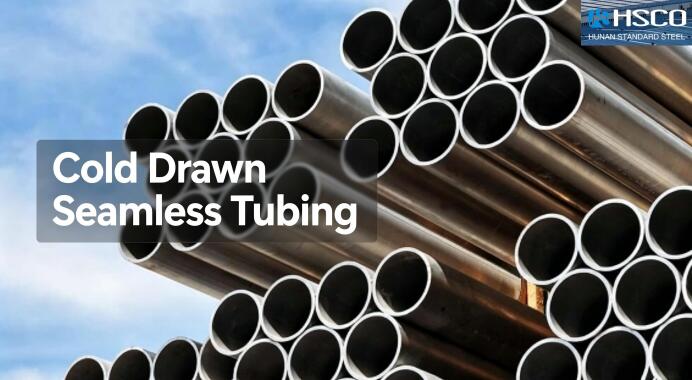
This guide covers the complete cold drawn manufacturing process, key advantages, limitations, applications, and a comparison with hot rolled seamless pipes to help you select the right product for your project.
The selection of raw materials for cold drawn seamless tubes is the most basic link in the manufacturing process. Under normal circumstances, the raw materials selected should be high-quality carbon structural steel or alloy structural steel. The quality of raw materials directly affects the quality and performance of the finished pipes, so the material selection needs to be very careful.
The image below shows the complete production flow of cold-drawn seamless tubes, from billet inspection to shipment.
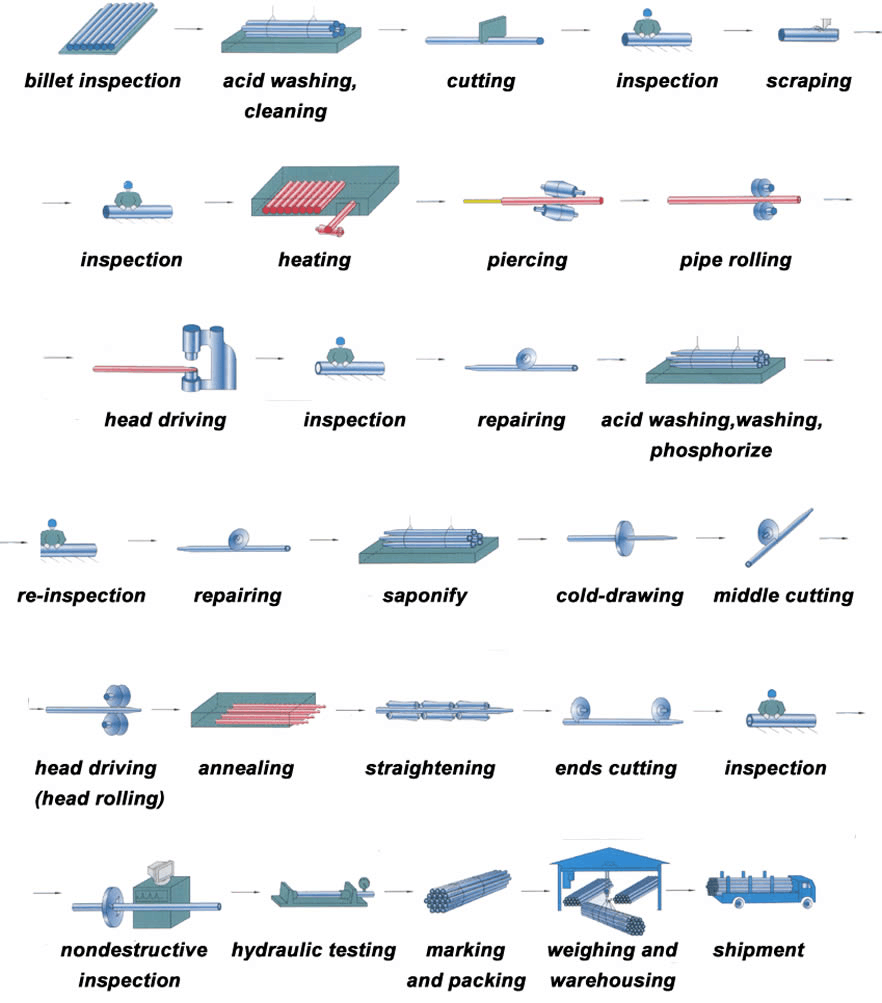
For applications requiring tighter tolerances, better surface finish, or smaller diameters, the cold drawn process is used. This method starts with a hot rolled pipe as the raw material and subjects it to a series of cold working and thermal treatments to achieve precise dimensions and enhanced surface quality.
1. Pickling – The raw material (hot rolled pipe) is immersed in an acid solution to remove surface oxide scale, rust, and other impurities, ensuring a clean surface for subsequent processing.
2. Annealing (pre-heat treatment) – The pipe is heated to a specific temperature based on the steel grade and pipe specifications, then slowly cooled to soften the material, relieve residual stresses, and prepare it for cold working.
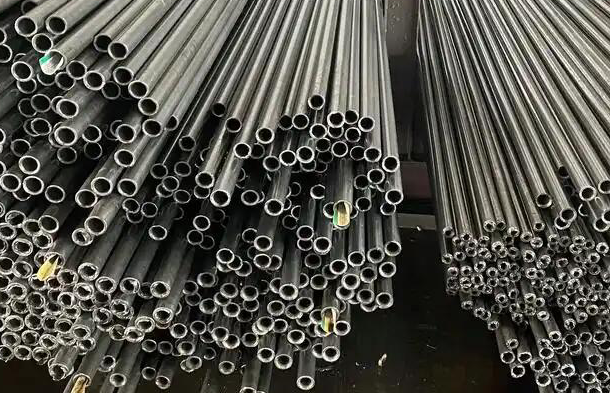
3. Cold drawing – The pipe is pulled through a die and over a mandrel at room temperature. Through multiple drawing passes, the pipe is progressively reduced in outer diameter and wall thickness to achieve precise dimensions and high quality. Intermediate annealing may be applied between passes to relieve work hardening and restore ductility.
4. Final heat treatment – To eliminate stresses generated during cold working and improve mechanical properties, the drawn pipe is heat treated. This involves heating the pipe to a specific temperature, holding it for a set period, and then gradually cooling it to achieve the desired strength, hardness, and toughness.
5. Surface treatment – Through pickling, rinsing, and other processes, the oxide layer and surface impurities are removed, resulting in a smooth, bright surface finish.
6. Testing and packaging – The finished pipes undergo dimensional inspection, mechanical property testing, and non-destructive testing (NDT) to verify quality. They are then packaged for storage and transportation.
1. High dimensional accuracy and tight tolerances – Cold drawing produces pipes with exceptionally precise outer diameter and wall thickness tolerances, typically within ±0.05mm. This makes them ideal for applications where exact fit and consistent performance are critical.
2. Smooth surface finish – The cold working process produces a bright, smooth surface free from the mill scale typical of hot rolled products. This reduces friction in hydraulic and pneumatic systems and improves corrosion resistance.
3. Enhanced mechanical properties – Cold drawing increases the yield strength and tensile strength of the pipe through work hardening, while subsequent heat treatment optimizes the final mechanical properties for specific applications.
4. Uniform wall thickness – The drawing process ensures consistent wall thickness across the entire pipe length, which is essential for high-pressure applications and precision machining.
● Higher cost – The additional processing steps—pickling, multiple drawing passes, intermediate annealing, and final heat treatment—make cold drawn pipes more expensive than hot rolled alternatives for the same material and specifications.
● Limited size range – Cold drawn seamless pipes are typically available in smaller diameters, generally up to 2″ (50.8mm) in outer diameter. Larger sizes are more economically produced by hot rolling.● Limited wall thickness range – While cold drawing can produce very thin walls (as thin as 0.25mm), it is less suitable for producing thick-walled pipes, which are better achieved through hot rolling.
To ensure the quality of cold drawn seamless tubes, strict inspection and quality control are required throughout the manufacturing process. The main inspection methods include the following:
1. Dimensional and visual inspection – The surface quality, flatness, roundness, outer diameter, and wall thickness of the pipe are thoroughly checked to ensure they meet specification requirements. Surface defects such as scratches, cracks, and pitting are also identified during this inspection.
2. Chemical composition analysis – The chemical composition of the steel pipe is analyzed to verify that it complies with relevant standards, such as ASTM A106, API 5L, or ASTM A312, depending on the material grade.
3. Mechanical property testing – The strength, toughness, hardness, and other mechanical properties of the steel pipe are tested to determine whether the pipe meets the required performance standards for its intended application.
4. Non-destructive testing (NDT) – Various NDT methods are applied to detect internal and surface defects without damaging the pipe:
● Ultrasonic testing (UT) – Detects internal flaws such as cracks, voids, and inclusions.
● Eddy current testing (ET) – Detects surface and near-surface defects.
● Magnetic particle testing (MT) – Detects surface and near-surface defects in ferromagnetic materials.
● Penetrant testing (PT) – Detects surface-breaking defects such as cracks and porosity by applying a penetrating liquid to the surface.
5. Hydrostatic testing – The pipe is subjected to internal pressure to verify its pressure integrity and ensure it can withstand the required service conditions without leakage.
Only after passing all these inspections and tests are the cold drawn seamless steel pipes approved for marking, packaging, and shipment to customers.
Cold drawn seamless steel pipes are widely used in applications that demand high precision, superior surface finish, and reliable performance under pressure:
1. Hydraulic systems – Hydraulic cylinders, hydraulic tubing, and fluid power systems where tight tolerances and smooth internal surfaces are essential.
2. Precision machinery – Shafts, rollers, and structural components in machine tools and industrial equipment.
3. Automotive components – Fuel injection systems, steering columns, and transmission parts.
4. Oil and gas – Instrumentation tubing and control lines requiring precise dimensions and corrosion resistance.
5. Aerospace – Small-diameter precision components for hydraulic and fuel systems in aircraft.
| Factor | Cold Drawn | Hot Rolled |
|---|---|---|
| Diameter Range | Smaller (typically ≤ 2″) | Larger (typically > 2″) |
| Wall Thickness | Thin walls with tight tolerances | Thicker walls |
| Surface Finish | Smooth, bright finish | Mill scale, standard finish |
| Dimensional Accuracy | High precision | Good, less precise |
| Cost | Higher cost | More cost-effective |
| Best For | Hydraulic cylinders, precision machinery | Oil/gas pipelines, general industrial |
Note: These are general ranges; actual capabilities vary by mill equipment. For a complete understanding of both manufacturing routes—from billet heating to final inspection — ▶ refer to our detailed: [Seamless Steel Pipe Manufacturing Process Guide].
Q1: What is the difference between cold drawn and hot rolled seamless steel pipes?
A: Cold drawing is performed at room temperature and produces smaller diameters with tighter tolerances and a smoother surface finish, but at a higher cost. Hot rolling is performed above the recrystallization temperature (approximately 1,200°C) and produces larger diameters with thicker walls at a lower cost.
Q2: What is the diameter range of cold-drawn seamless steel pipes?
A: Cold drawn seamless pipes can achieve very small diameters, down to 6mm or even 5mm, with wall thickness as thin as 0.25mm. This makes them ideal for precision applications where small size and tight tolerances are required.
Q3: Why is cold drawn pipe more expensive than hot rolled pipe?
A: The additional processing steps—pickling, multiple drawing passes, intermediate annealing, final heat treatment, and comprehensive inspection—add significant time and cost compared to hot rolling. However, this investment delivers superior dimensional accuracy, surface quality, and mechanical properties.
Q4: What materials are suitable for cold drawn seamless pipe manufacturing?
A: Both carbon steel and stainless steel are suitable. Common carbon steel grades include ASTM A106 and API 5L; common stainless grades include ASTM A312. The cold drawing process can be applied to most steel grades that are ductile enough for cold working.
Q5: Why does cold drawing require multiple passes with intermediate annealing?
A: Cold deformation causes work hardening—hardness increases but plasticity decreases. Intermediate annealing between passes restores ductility, relieves residual stress, and prevents cracking during subsequent drawing. This ensures consistent quality and prevents material failure during processing.
Related Resources:
● Seamless Steel Pipe Sizes and Weights Chart
● Hot Rolled Seamless Steel Tube – Advantages, Disadvantages & Selection Guide
● Seamless Steel Pipe Manufacturing Process – Carbon Steel & Stainless Steel
● Carbon Steel Tube Material Selection Guide
The following heat treatment processes may be applied to cold drawn seamless steel tubes, depending on the material grade and required mechanical properties:
| Process | Purpose |
|---|---|
| Annealing | Softens the steel, improves ductility, relieves residual stresses, and prepares the material for cold working. |
| Normalizing | Refines grain structure, eliminates internal defects, and improves machinability. |
| Quenching | Produces a martensitic structure to increase hardness, strength, and wear resistance. |
| Tempering | Applied after quenching to reduce brittleness, relieve stresses, and balance hardness with toughness. |
| Quenching + Tempering | A combined treatment that produces high strength and toughness for structural applications. |
| Case Hardening | Surface treatments such as carburizing and nitriding that improve surface hardness, wear resistance, and fatigue strength. |
| Solution Treatment | Used for certain alloys to improve ductility and toughness, or to prepare for precipitation hardening. |
The specific heat treatment applied depends on the steel grade (e.g., ASTM A106, API 5L, ASTM A312) and the final mechanical properties required.
▶ [Contact our team] for technical support and a competitive quote.
Related information
Copyright @2017 Hunan Standard Steel Co.,Ltd and Husteel Industry Group All Rights Reserved