sales@hu-steel.com
 English
 Español
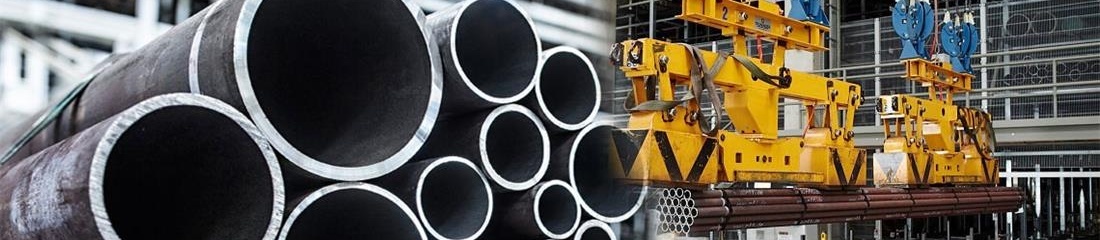
ASTM A106 — Standard Specification for Seamless Carbon Steel Pipe for High-Temperature Service
ASTM A106 pipe is produced by the seamless method and can be bent, coiled, and flanged. It is commonly used in oil and gas refineries, power plants, petrochemical plants, boilers, and ships, where pipes must transport fluids and gases at higher temperatures and pressures.
The specification includes three grades: Grade A, Grade B, and Grade C. Grade A has lower strength requirements, Grade B offers the best balance of performance and cost, and Grade C provides higher strength and toughness for more demanding high-temperature and high-pressure applications.
Sizes:
1/8" to 26" NPS, depending on OD vs Wall Ratio
| Property | Grade A | Grade B | Grade C |
|---|---|---|---|
| Tensile Strength (min) | ≥330 MPa | ≥415 MPa | ≥485 MPa |
| Yield Strength (min) | ≥205 MPa | ≥240 MPa | ≥275 MPa |
| Elongation (min) | ≥30% | ≥30% | ≥30% |
In practice: A106 Grade B covers over 90% of high-temperature piping needs, including refinery cracking units. Grade C is used in more severe environments such as supercritical pressure boilers (>22.1 MPa). Grade A is the most economical choice for non-critical low-pressure systems.
| Element | Grade A | Grade B | Grade C |
|---|---|---|---|
| C (max) | 0.25% | 0.30% | 0.35% |
| Mn | 0.27–0.93% | 0.29–1.06% | 0.29–1.06% |
| P (max) | 0.035% | 0.035% | 0.035% |
| S (max) | 0.035% | 0.035% | 0.035% |
| Si (min) | 0.10% | 0.10% | 0.10% |
What these elements do:
Carbon content increases with grade (0.25% → 0.30% → 0.35%), which directly raises strength but also increases hardening tendency. The range for each grade is strictly controlled: too low reduces strength, too high reduces toughness. Manganese refines grains and strengthens ferrite. Silicon (min 0.10%) acts as a deoxidizer, improving internal uniformity. Phosphorus and sulfur are capped at 0.035% to avoid inclusions that weaken the pipe. ▶ For the complete chemical composition requirements including Cr, Cu, Mo, Ni, and V, see our [ASTM A106 Specification].
| Working Condition | Recommended Grade |
|---|---|
| Temperature ≤450°C, pressure ≤5 MPa | Grade A (economical) |
| Temperature ≤650°C, pressure ≤15 MPa | Grade B (most common) |
| Temperature ≤700°C, ultra-high pressure | Grade C (special needs) |
Temperature limits depend on design conditions. ▶ For detailed temperature range data, see our [ASTM A106 Gr.B Seamless Pipe Guide].
● A106 Grade A is used for low-pressure fluid transportation, general industrial pipelines, low-pressure steam systems, and building structures.
● A106 Grade B is the standard choice for refinery piping, power plant steam pipes, high-pressure boiler pipes, petrochemical plants, and ships.
● A106 Grade C is used in supercritical power plants, deep-sea oil and gas extraction, and nuclear power auxiliary pipelines.
For general industries such as machinery manufacturing, automotive, and construction, A106 pipe is used where high-temperature or high-pressure service is required.
| Field | Specification |
|---|---|
| Standard | ASTM A106/A106M (ASME SA106) |
| Grades | A, B, C |
| Size Range | 1/8" to 26" NPS |
| Wall Thickness | SCH 10, SCH 40, SCH 80, SCH 160, custom |
| Length | Single random (4–7m), double random (7–12m), fixed 5.8m / 6m / 12m, custom |
| Delivery Condition | Annealed (hot-finished may be as-rolled) |
| End Finish | Plain, beveled, threaded, grooved |
Size note: For Grade B, sizes under 2" are normally delivered as cold-drawn product; 2" and above are usually hot-finished. Available in black or galvanized finish.
ASTM A106 seamless pipe can be manufactured by cold drawing or hot rolling. Cold-drawn pipes offer higher dimensional accuracy and surface finish, but are typically limited to smaller sizes. Hot-rolled is more suitable for large-scale production and larger diameters.
Heat treatment: Hot-finished pipe may be supplied as-rolled. Cold-drawn pipe is heat treated at 650°C or higher after the final draw pass.
Testing capabilities:
● Hydrostatic test or non-destructive electric test (UT/ET) as an alternative
● Tensile test
● Bending / flattening test
● Chemical composition verification per heat
Pipes not hydrostatically tested are marked "NH"; pipes tested by non-destructive electric testing (NDE, a form of NDT) are marked "NDE". "NH" means the pipe was not hydrostatically tested; "NDE" means it was tested by a non-destructive electric method instead. Both markings must appear on the mill test certificate, available as EN 10204 3.1 or 3.2.
For pipe NPS2 and under, the specification requires cold bending through 90° (or 180° for close coiling) without cracks.
| Standard | Service | Temperature | Typical Use |
|---|---|---|---|
| ASTM A106 | High-temperature, high-pressure | Up to 565°C | Refinery piping, boiler tubes |
| ASTM A53 | Low-to-medium pressure | ≤350°C | Water lines, structural pipe |
| API 5L | Long-distance oil & gas | Depends on grade | Pipeline transmission |
| ASTM A335 | Alloy steel, high temperature | >700°C | Supercritical boilers, petrochemical |
For high-temperature applications above 350°C, A106 should be specified instead of A53.
Looking for ASTM A106 pipe? Send your specifications for a quote.
● Grades: A, B, or C
● Size range: 1/8" to 26" NPS
● Wall thickness: SCH 10 to SCH 160
● Quantity and delivery requirements
Contact us with your detailed requirements, and we will respond within 24 hours.
Copyright @2017 Hunan Standard Steel Co.,Ltd and Husteel Industry Group All Rights Reserved