sales@hu-steel.com
 English
 Español
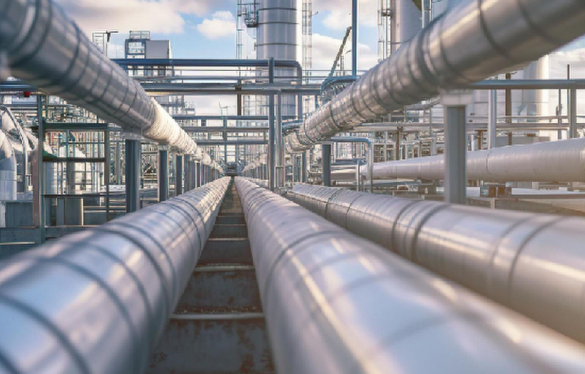
However, pipeline transportation also has clear disadvantages. These include operational limitations, safety and supply risks, and significant cost challenges. Understanding these drawbacks helps project planners decide whether a pipeline is the right solution — and what kind of steel pipe is needed.
(1) Specialized Cargo Limitations
Pipeline transportation is only suitable for a narrow range of cargo types. It is primarily designed for:
● Gaseous and liquid cargoes such as oil, natural gas, and chemicals
● Slurry products such as crushed coal slurry
It cannot transport general cargo, solid goods, or packaged products. This makes pipelines unsuitable for projects that require mixed or multi-category freight.
(2) Limited Flexibility
Pipeline transportation is far less flexible than road or rail transport.
● It is a fixed-route, one-way transport system.
● It cannot easily be rerouted if market conditions or project requirements change.
● To achieve “door-to-door” delivery, pipelines must usually be combined with railway, truck, or marine transport.
For projects that require dynamic routing or multi-point delivery, pipelines are often not the best choice.
(3) Franchise Nature
Pipeline transportation is often classified as a special or regulated form of transport.
● Production, transportation, and sales are often integrated under one operator.
● It is usually not open for use by other shippers.
● In many regions, pipeline operation is subject to government regulation or monopoly control.
This limits competition and can reduce flexibility for third-party users.
(1) High Fixed Investment
Building a pipeline requires significant upfront capital investment, including:
● Steel pipes and fittings
● Compressor stations and pump stations
● Storage depots at intermediate stations
● Control systems, valves, and monitoring equipment
● Land acquisition and construction costs
These costs must be committed before any revenue is generated, making pipeline projects capital-intensive and slow to break even.
(2) High Maintenance for Corrosion Protection
Pipelines require regular inspection and long-term maintenance, especially for corrosion protection.
● Internal and external coatings (FBE, 3LPE, epoxy)
● Cathodic protection systems
● Periodic ultrasonic or magnetic flux inspection
● Repair or replacement of corroded sections
These maintenance requirements add to the long-term operational cost of any pipeline project.
Beyond limitations and costs, pipeline projects face several operational and external risks.
(1) Corrosion and Leakage Risks
Corrosion is a primary cause of pipeline failure. Without adequate anti-corrosion coatings, cathodic protection measures, and regular inspections, pipelines may develop leaks, cracks, or ruptures, thereby posing safety and environmental risks.
(2) Route Disruption and Geopolitical Risks
Because pipelines follow a fixed route, they are vulnerable to:
● Regional conflicts and geopolitical tensions
● Trade restrictions or sanctions
● Natural disasters along the route
Any disruption can interrupt supply and cause significant financial loss.
(3) Long-Term Operational Risks
Pipeline projects are long-term commitments. Once built, they are difficult to adapt to changing market demand, energy transition policies, or new environmental regulations.
(4) Impact on Project Planning
| Disadvantage | Impact on Project Planning |
|---|---|
| Specialized cargo limitations | Pipelines only work for liquids, gases, or slurry — not general cargo. |
| Limited flexibility | Routes must be planned carefully; changes are costly. |
| High fixed investment | Requires long-term commitment and stable demand. |
| Franchise nature | May limit access for third-party shippers. |
| Corrosion maintenance | Adds ongoing inspection and repair costs. |
While these disadvantages cannot be eliminated entirely, many of them can be reduced by selecting the right steel pipe.
1. Corrosion-resistant pipes and coatings can lower maintenance costs and reduce leakage risks.
2. High-strength seamless pipes can handle higher pressure and temperature.
3. The right wall thickness and steel grade improve long-term reliability.
▶ For a full selection guide, please read: [How to Choose the Right Steel Pipe for Pipeline Transportation]
| Items | Pipeline | Truck | Rail | Marine |
|---|---|---|---|---|
| Transportation Capacity | High | Low-Medium | High | Very High |
| Long-Distance Transport | Excellent | Moderate | Good | Excellent |
| Continuous Operation | Excellent | Low | Moderate | Low |
| Route Flexibility | Low | Very High | Medium | Medium |
| Initial Infrastructure Cost | Very High | Low | High | High |
| Suitable Cargo | Liquids, gases, slurry | Various cargoes | Bulk and general cargo | Bulk and international cargo |
Q1: Is pipeline transportation suitable for small-volume transport?
A: No. Pipelines are most economical for large-volume, long-distance, continuous transport. For small volumes, truck or rail transport is usually more cost-effective.
Q2: What pipe material is best for corrosive fluids?
A: Stainless steel pipes, alloy steel pipes, or carbon steel pipes with internal coatings (FBE, 3LPE) are commonly used. The choice depends on the specific medium and operating conditions.
Q3: Can pipeline transportation be used for solid cargo?
A: Generally no. Pipelines are designed for liquids, gases, and slurry. Solid cargo requires truck, rail, or marine transport.
Q4: How can I reduce pipeline maintenance costs?
A: Choose high-quality steel pipes with proper coatings, require MTC and third-party inspection, and implement a regular inspection and corrosion protection program.
Related information
Copyright @2017 Hunan Standard Steel Co.,Ltd and Husteel Industry Group All Rights Reserved