sales@hu-steel.com
 English
 Español
If you're buying small-bore, high-pressure elbows for instrument lines, hydraulic systems, or wellhead piping, you've probably come across ASTM A105 forged elbows. A105 is the standard for forged carbon steel piping components, and it's the go-to material for socket-weld and threaded elbows in sizes from NPS 1/8″ to 4″.
This guide covers the four main decisions you'll need to make: pressure class, connection type, heat treatment, and material certification.
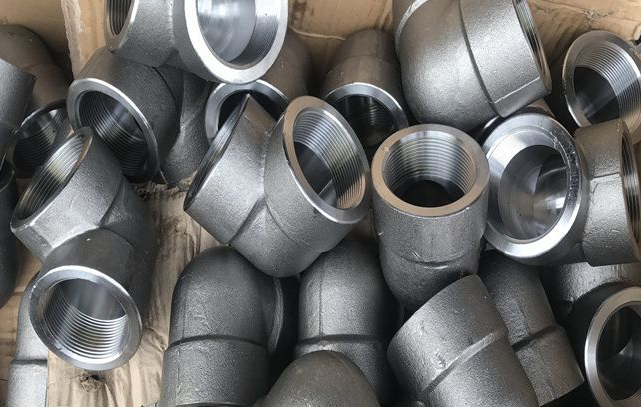
ASTM A105 forged elbows are produced in accordance with ASME B16.11. Unlike A234 WPB butt-weld elbows formed from pipe, A105 elbows are hot forged from solid steel billets. This forging process delivers dense, uniform microstructure, making them ideal for high-pressure small-bore applications.
Applicable service temperature ranges from -29°C to 425°C. For sub-zero or sour service, normalized A105N with NACE MR0175 certification is required.
A105 elbows are common in:
● Instrument lines — small-bore, high-pressure tubing connections
● Hydraulic systems — where Class 3000 or 6000 fittings are required
● Wellhead piping — surface connections on oil and gas wells
● Utility stations — steam, water, and air lines in process plants
They are not typically used for large-diameter main process piping, where butt-weld elbows (A234 WPB) are more economical.
This is one of the most common questions buyers ask. ASTM A105 and A234 WPB elbows are both made of carbon steel, but they're used for different fitting types.
| Parameter | ASTM A105 | ASTM A234 WPB |
|---|---|---|
| Manufacturing | Forged | Wrought (formed from pipe) |
| Standard | ASME B16.11 | ASME B16.9 |
| Connection | Socket weld / Threaded | Butt weld |
| Typical size | NPS 1/8″ – 4″ | NPS 1/2″ – 48″ |
| Pressure basis | Fixed class (3000# / 6000#) | Pipe schedule (Sch 80, Sch 160) |
| Typical use | Small-bore high-pressure, instrument lines | Main process piping, large diameter |
| Tensile strength | ≥ 485 MPa | ≥ 415 MPa |
| Relative cost | Higher per unit | Lower for large quantity |
Rule of thumb:
Small diameter (NPS ≤ 2), socket weld or threaded connection → A105
Large diameter (NPS ≥ 2), butt weld → A234 WPB
Common mistake: Using A105 for butt weld fittings and A234 WPB for socket weld fittings. Materials should match the connection type and size range.
A105 forged elbows come in two pressure classes under ASME B16.11: Class 3000 (3,000 psi, matches Sch 80 pipe) and Class 6000 (6,000 psi, matches Sch 160 pipe). Which one you need depends on your design pressure and pipe schedule.
One rule you can't skip:
The fitting bore has to match the pipe bore. If you put a Class 6000 elbow on Sch 80 pipe, you'll create a step at the connection. That causes turbulence and can lead to fatigue cracking.
▶ For a full comparison of pressure ratings, body dimensions, and selection rules, see our guide: [Class 3000 vs. Class 6000 Socket Weld Fittings] .
| Connection Type | Pressure Suitability | Key Characteristic | Typical Application |
|---|---|---|---|
| Socket Weld | Class 3000–9000 | Permanent connection; fillet welded; better fatigue resistance | High-pressure process piping, hydraulic systems |
| Threaded (NPT) | Class 2000–6000 | Can be taken apart; needs thread sealant | Instrumentation, utility lines, low-vibration services |
Note: Socket-weld elbows are more commonly used for high-pressure and critical service conditions, whereas threaded elbows are suitable for applications requiring pipeline disassembly but are not appropriate for environments involving vibration or high-temperature cycling.
Class 3000 elbows are widely stocked from NPS 1/8″ to 4″. Class 6000 is usually limited to NPS 2″ and below. For sizes above 2″, Class 3000 is the standard choice. If you need a larger size in a high-pressure class, look at a seamless elbow with butt-weld ends instead.
A105 and A105N have the same chemical composition and mechanical properties. The only difference is heat treatment.
Standard A105 comes in the as-forged condition. Heat treatment isn't mandatory for all sizes, though it's generally recommended. A105N is normalized — the "N" means the forging has been normalized to refine the grain structure and improve toughness.
When to specify A105N:
● Service temperatures below -29°C
● High-pressure classes (Class 300 and above)
● NACE MR0175 (sour service) applications
● Projects that require low-temperature impact testing
Note: If your project calls for NACE MR0175 or low-temperature impact testing, go with A105N. Many end users won't accept the A105 heat treatment exception for critical services.
When ordering A105 forged elbows, please request the following documents:
1. MTR (Material Test Report) – showing chemical composition and mechanical properties
2. Heat Treatment Report – confirming normalization or annealing (for A105N grade)
3. NDT Report – results of ultrasonic, magnetic particle, or liquid penetrant testing
4. NACE MR0175 Certificate – applicable for sour service conditions
Note: Always verify whether the MTR was issued by the original manufacturer or a third-party laboratory. For critical applications, MTRs issued by the original manufacturer are preferred.
Here's a quick checklist to run through before placing your order:
□ Pressure class (3000# or 6000#) matches pipe schedule
□ Connection type (socket weld or threaded)
□ Heat treatment condition (A105 or A105N)
□ Size (NPS and quantity)
□ MTR required? Original mill or third-party?
□ NACE MR0175 certification required?
□ NDT requirements (UT, MT, PT)
Q1: What's the typical lead time for A105 socket weld elbows?
A: Class 3000 elbows in common sizes (NPS 1/2″ to 2″) are usually stocked and ship in 1–2 weeks. Class 6000 and non-standard sizes may take 3–4 weeks. Always confirm with your supplier before placing a firm order.
Q2: What's the minimum order quantity?
A: It depends on size and pressure class. For standard Class 3000 sizes, we can handle small quantities. For Class 6000 or special sizes, a minimum order may apply.
Q3: Can A105 elbows be used in sour service?
A: Only if they meet NACE MR0175 requirements. Standard A105 may not meet the hardness (≤ 187 HB) and sulfur content (S ≤ 0.02%) limits. Specify A105N with NACE certification for sour service.
Q4: Do you provide test certificates with the shipment?
A: Yes. Every shipment includes the MTR, heat treatment report (if applicable), and NDT report (if specified). We can also send certificates in advance for your review.
We supply A105 forged elbows in Class 3000 and Class 6000, socket weld and threaded connections, sizes NPS 1/8″ to 4″. A105N and NACE MR0175 certified material available on request.
▶ [Request a quote or send us your specifications]
Related Resources
● ASTM A105 Carbon Steel Forgings Specification
● Class 3000 vs. Class 6000 LB Forged Fittings Pressure Rating
Related information
Copyright @2017 Hunan Standard Steel Co.,Ltd and Husteel Industry Group All Rights Reserved