sales@hu-steel.com
 English
 Español
Understanding the seamless steel pipe manufacturing process is essential for engineers, procurement professionals, and project managers involved in high-pressure, high-temperature, or critical applications. Unlike welded pipe, seamless pipe starts as a solid round billet and is formed without any weld seam, giving it uniform strength and reliable performance under extreme conditions.
This guide covers both the hot rolled and cold drawn seamless pipe production methods, from billet heating to final inspection. The processes described are applicable to both carbon steel and stainless steel seamless pipes; while specific parameters—such as heating temperature, cooling rate, and pickling solutions—may vary depending on the material grade, the fundamental production route remains the same. For a visual overview, refer to the process flow diagram included in this article.
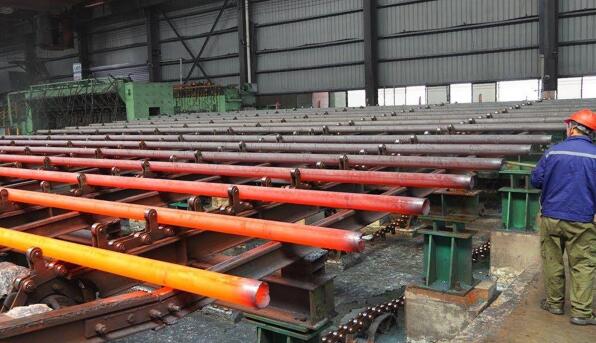
Process Flow for Hot‑rolled Seamless Pipe:
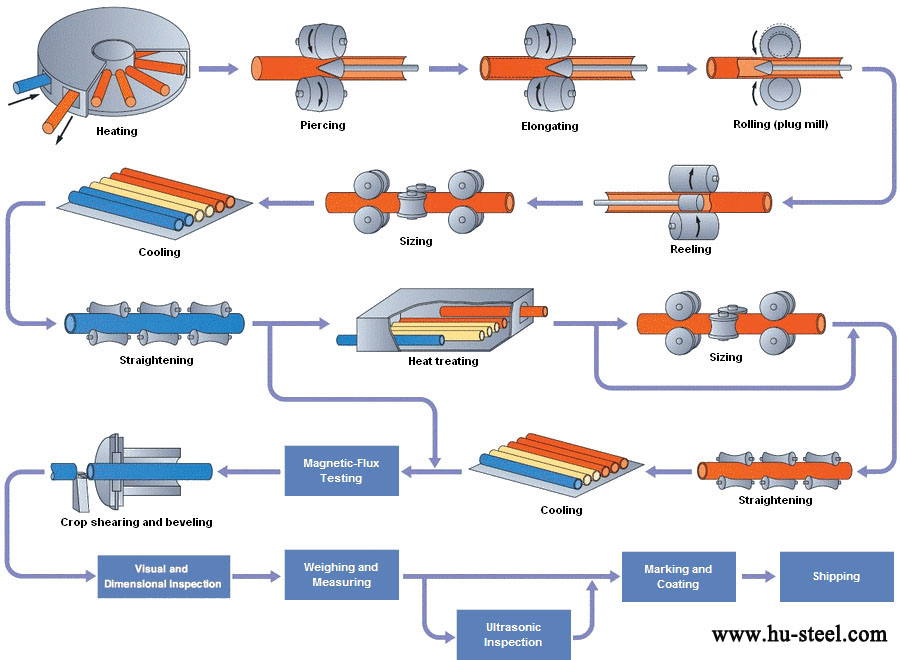
Hot rolling is the most common method for producing seamless steel pipe. The process begins with heating solid round billets in a rotary hearth furnace to approximately 1,200°C. Fuel is typically natural gas, coke oven gas, or heavy oil.
The heated billet is first pierced to form a hollow shell, then elongated and rolled through a plug mill to achieve the initial dimensional accuracy. A primary sizing step sets the outer diameter, followed by cooling to stabilize the structure.
To improve surface quality and roundness, the pipe undergoes reeling, then a preliminary straightening before heat treatment, which tailors the mechanical properties. After heat treatment, a secondary sizing ensures final dimensional precision.
For quality assurance, the pipe is subjected to magnetic‑flux leakage testing (supplemented by ultrasonic inspection) to detect surface and internal defects. A final straightening and cooling step prepares the pipe for finishing operations.
Finishing includes cropshearing and beveling of pipe ends, followed by visual and dimensional inspection, weighing and measuring, and finally marking and coating. The finished pipes are then packaged and shipped to customers.
This comprehensive route ensures that every pipe meets the stringent requirements of industries such as oil and gas, power generation, and mechanical engineering.
For applications requiring tighter tolerances, better surface finish, or smaller diameters, the cold drawn process is used. The typical production route is as follows:
△ Hot Rolled Pipe → Annealing (softening for cold working) → Pickling (scale removal) → Pointing (end reduction for die entry) → Cold Drawing (multi-pass, OD & wall reduction) → Heat Treatment (final mechanical properties) → Straightening → Inspection (dimensional + NDT) → Marking → Shipping
During cold drawing, the pipe is pulled through a die and over a mandrel to reduce its outer diameter and wall thickness with high precision. Multiple passes may be applied, with intermediate annealing between passes to relieve work hardening and restore ductility. The final heat treatment develops the required mechanical properties, followed by straightening and comprehensive inspection to ensure dimensional accuracy and quality. This route produces pipes with superior surface finish, tight tolerances, and enhanced mechanical performance, ideal for hydraulic systems, precision machinery, and high-pressure instrumentation.
● Hydrostatic Testing: Verifying pressure integrity by subjecting the pipe to internal pressure.
● Visual Inspection: Checking for surface defects such as cracks, scratches, and pitting.
Understanding how seamless steel pipe is made helps you make informed decisions when selecting pipe for your project. Here are key considerations:
| Factor | Hot Rolled Seamless Pipe | Cold Drawn Seamless Pipe |
|---|---|---|
| Diameter Range | Larger diameters (typically > 2″) | Smaller diameters (typically ≤ 2″) |
| Wall Thickness | Thicker walls available | Thinner walls with tighter tolerances |
| Surface Finish | Standard, may have scale | Smooth, bright finish |
| Dimensional Accuracy | Good, but less precise | Higher precision |
| Cost | More cost-effective for standard sizes | Higher cost due to extra processing |
| Typical Applications | General industrial, oil/gas pipelines | Hydraulic cylinders, precision machinery |
Note: These are general ranges; actual capabilities vary by mill equipment.
The short answer: no weld seam means no weld-related weak points.
That single fact gives seamless pipe several real advantages in demanding applications:
● Uniform strength throughout – no heat-affected zones or weld joints to worry about.
● Handles higher pressures – the continuous structure holds up better under high internal pressure.
● Better fatigue life – performs more reliably under cyclic loading and thermal cycling.
● No weld seam – means no localized weld-zone corrosion, which is a common failure point in welded pipes.
That's why you'll find seamless steel pipe specified for high-pressure oil and gas transmission, boiler tubes, chemical plant piping, and hydraulic systems—anywhere a weld seam is a risk you don't want to take.
Q1. What is the difference between seamless steel pipe and welded pipe?
Seamless pipe is formed from a solid billet without any weld seam, giving it uniform strength throughout. Welded pipe is formed from strip or plate that is rolled and welded along the seam. The absence of a weld seam means seamless pipe has no heat-affected zones or weld joints—common failure points under high pressure or cyclic loading.
Q2. What is the difference between hot rolled and cold drawn seamless pipes?
Hot rolling is performed above the recrystallization temperature (approximately 1,200°C) and produces larger diameters with thicker walls. Cold drawing is performed at room temperature and produces smaller diameters with tighter tolerances and smoother surface finish. Cold drawn pipes generally cost more due to the additional processing steps.
Q3. What materials are suitable for seamless pipe manufacturing?
Both carbon steel and stainless steel are suitable. Common carbon steel grades include ASTM A106 and API 5L; common stainless grades include ASTM A312. While specific parameters—such as heating temperature, cooling rate, and pickling solutions—vary by material, the fundamental production route remains the same.
Q4. What diameter range can seamless steel pipes achieve?
Hot rolled seamless pipes typically range from 32mm and above in outer diameter. Cold drawn seamless pipes can achieve much smaller diameters, down to 6mm or even 5mm, with wall thickness as thin as 0.25mm.
Q5. Why does cold drawing require multiple passes with intermediate annealing?
Cold deformation causes work hardening—hardness increases but plasticity decreases. Intermediate annealing between passes restores ductility, relieves residual stress, and prevents cracking during subsequent drawing.
HSCO Steel supplies high-quality seamless steel pipes manufactured to ASTM A106 GR.B, ASTM A312 (304/316), API 5L, and other international standards. Our seamless pipes are available in a wide range of sizes and materials to meet your project requirements. Contact our team for technical support and a competitive quote.
Read more:
● Hot Rolled Seamless Steel Pipe
● Seamless Steel Pipe Sizes and Weights Chart
● Types of Seamless Carbon Steel Pipes
● What does SMLS Stand for in Piping?
Related information
Copyright @2017 Hunan Standard Steel Co.,Ltd and Husteel Industry Group All Rights Reserved