sales@hu-steel.com
 English
 Español

Alloy seamless steel pipe is a type of seamless pipe made from alloy steel, containing elements such as chromium, nickel, molybdenum, and vanadium to improve high-temperature strength, corrosion resistance, and mechanical performance. Unlike carbon steel seamless pipe, alloy seamless pipe is designed for demanding applications in oil and gas, power generation, petrochemical, and industrial systems.
This guide covers the definition, common grades and standards, applications, hot rolled vs cold drawn processes, and how to choose the right alloy seamless pipe for your project.
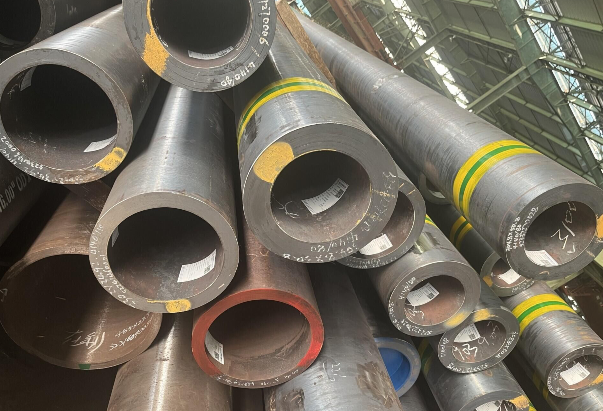
Alloy seamless steel pipe & tube is manufactured without a weld seam, using a solid round billet that is heated, pierced, and rolled or drawn into shape. The alloying elements give it better performance under high temperature, high pressure, and corrosive conditions compared with ordinary carbon steel pipe.
Key difference from carbon steel seamless pipe:
● Carbon steel seamless pipe is mainly used for general fluid transport, water, oil, and gas.
● Alloy seamless steel pipe is used where higher temperature, pressure, or corrosion resistance is required, such as boiler tubes, heat exchangers, and high-temperature pipelines.
▶ For a basic definition of seamless pipe, see [What is Seamless Steel Pipe?].
Using perforation + rolling process to form in one piece, it avoids the strength weakness and leakage risk caused by the weld, and is suitable for high pressure and high stress environments (such as oil drilling and nuclear power pipelines).
| Performance | Ordinary Carbon Steel Pipe | Seamless Alloy Steel Pipe |
|---|---|---|
| Tensile strength | 370-600 MPa | 550-1000 MPa (e.g., 42CrMo) |
| Temperature resistance limit | ≤350℃ | Up to 600℃ (e.g., 15CrMoG) |
| Corrosion resistance | Additional coating required | Self-contained anti-oxidation/acid resistance |
Alloy seamless pipes are produced to international standards. The most common materials, grades, and standards include:
| Category | Typical Grades | Common Standards |
|---|---|---|
| Chromium-molybdenum steel | 15CrMo, 12Cr1MoV, P5, P9, P11, P22, P91, P92 | ASTM A335, ASTM A213 |
| Stainless steel | 304/304L, 316/316L, 321, 347 | ASTM A312 |
| Nickel-based alloy | Inconel 625, Inconel 600, Inconel 718, Incoloy 800/825 | ASTM B444, B167, B163, B165 |
| Other alloy steel | 42CrMo, 4130, 4140, 9% Ni, A333 Gr.3, A333 Gr.6 | ASTM A519, ASTM A333 |
Other related standards:
ASTM A106 – carbon steel seamless pipe for high-temperature service
API 5L – line pipe for oil and gas transmission
ASTM A312 – stainless steel seamless pipe for corrosive applications
▶ For a detailed comparison, see [ASTM A53 vs ASTM A106 vs API 5L].
Hot rolled billet → pickling → cold deformation → annealing (high precision, thin-walled tubes).
Alloy seamless pipes are selected when carbon steel pipes cannot meet the demands of the service environment. The key requirements by industry include:
1. Oil and Gas – Resistance to high pressure and corrosive media such as H₂S and CO₂; suitable for sour service and long-distance transmission.
2. Power Generation – High-temperature strength, creep resistance, and oxidation resistance for steam cycles in fossil and nuclear plants.
3. Petrochemical and Chemical – Resistance to acids, alkalis, and high-temperature process fluids; reliable in reactors and heat exchange systems.
4. Machinery and Automotive – High fatigue strength, wear resistance, and dimensional precision for hydraulic and drive components.
5. Aerospace and New Energy – Extreme temperature capability, lightweight properties, and resistance to hydrogen embrittlement for advanced applications.
| Industry | Application | Recommended Grades / Standards |
|---|---|---|
| Oil and gas | Oil well casing & drill pipe | API 5CT L80, P110 |
| Long-distance pipeline | X80/X100 | |
| Refining equipment | 15CrMoG | |
| Chemical & energy | High-temp/high-pressure pipelines | 12Cr1MoV |
| Power plant boilers | P91/P92 (≥600℃) | |
| Nuclear power equipment | Stainless steel / Inconel 625 | |
| Machinery & automobiles | Hydraulic cylinders & drive shafts | 42CrMo |
| New energy vehicles | Lightweight alloy pipes | |
| Aerospace & military | Engine parts | Ti-6Al-4V, nickel-based alloys |
| Missile structural parts | High-strength alloy tubes | |
| New energy | Wind power tower | Q345E |
| Hydrogen storage & transportation | A333 Gr.3 |
Welded alloy steel pipes: There are welds, and the strength of the weld area is 10%~20% lower. The production process of welded steel pipes is simple, the production efficiency is high, the cost is low, and it is suitable for low-pressure/ordinary corrosion environments and suitable for large-scale purchases.
Seamless alloy steel pipes: Unlike welded steel pipes, seamless alloy pipes use seamless processes, have no weld weaknesses on the pipe wall, and have stronger mechanical properties such as compression, tension, and torsion resistance. And the production process is complex, the production cost is high, and it is suitable for high-pressure/extreme environments.
| Scenario | Recommended Pipe Type |
|---|---|
| High temperature (>350℃) | Seamless alloy pipe |
| High pressure (>10MPa) | Seamless alloy pipe |
| Strong corrosion (acid/alkali) | Seamless alloy pipe |
| High fatigue load (aviation parts) | Seamless alloy pipe |
| Limited budget, low pressure, normal temperature (such as building structures) |
Q1: What is alloy seamless steel pipe used for?
Alloy seamless steel pipe is used in high-temperature, high-pressure, and corrosive applications, including oil and gas transmission, power plant boilers, heat exchangers, petrochemical plants, and mechanical engineering.
Q2: What is the difference between alloy seamless pipe and carbon seamless pipe?
Alloy seamless pipe contains alloying elements such as chromium, nickel, and molybdenum, which improve high-temperature strength and corrosion resistance. Carbon seamless pipe is mainly used for general fluid transport and lower-temperature service.
Q3: What standards apply to alloy seamless steel pipe?
Common standards include ASTM A335, ASTM A213, and ASTM A519. ASTM A335 covers high-temperature service, ASTM A213 covers boiler and heat exchanger tubes, and ASTM A519 covers mechanical tubing.
Q4: Can alloy seamless pipe be hot rolled or cold drawn?
Yes. Hot rolled alloy seamless pipe is used for larger diameters and thicker walls, while cold drawn alloy seamless pipe is used for smaller diameters, tighter tolerances, and better surface finish.
Q5: What is the difference between alloy seamless pipe and welded pipe?
Alloy seamless pipe has no weld seam, giving it uniform strength and better performance under high pressure and high temperature. Welded pipe is made from plate or strip and has a weld seam, which can be a weak point in demanding applications.
Seamless alloy steel pipes have become the preferred pipe material in high-end industrial fields due to their reliability and high performance, but the cost needs to be weighed (the price is 2 to 5 times that of carbon steel pipes).
Read more:
● ASTM A335 Alloy Pipe Specification
● Seamless Steel Pipe Sizes and Weights Chart
● Alloy Steel vs Carbon Steel Seamless Pipe
Related information
Copyright @2017 Hunan Standard Steel Co.,Ltd and Husteel Industry Group All Rights Reserved