sales@hu-steel.com
 English
 Español
Cold rolled or hot rolled seamless tubes—which one is right for your project? The choice depends on your specific requirements for dimensional accuracy, surface quality, and budget. Cold-rolled tubes offer superior precision (tolerance ±0.05mm to ±0.2mm) and a bright, smooth surface, making them the ideal choice for hydraulic systems and precision machinery. Hot-rolled tubes, on the other hand, provide a cost-effective solution for large-diameter and thick-walled applications, and are commonly used in oil and gas pipelines and general structural applications.
This guide compares both processes—covering key differences, advantages, limitations, and selection criteria—to help you make an informed decision.

The core difference lies in the seamless tubes processing temperature and the resulting material properties.
Cold rolled seamless tubes are processed at room temperature. The cold working process increases strength through work hardening, produces a smooth, bright surface, and achieves high dimensional accuracy. However, it is limited to smaller diameters and thinner walls, and comes with a higher cost.
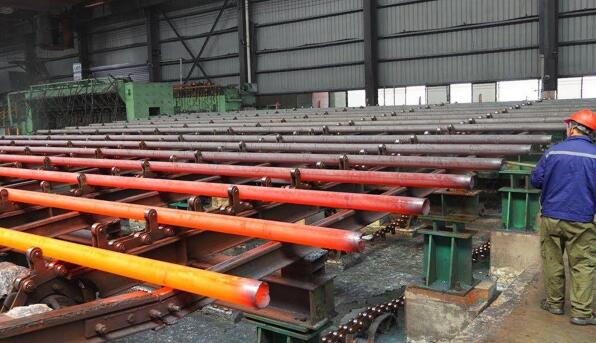
Hot rolled seamless tubes are processed above the recrystallization temperature (approximately 1,200°C). The hot working process allows for larger diameters and thicker walls, and is more cost-effective for standard applications. However, it results in a mill scale surface, looser dimensional tolerances, and less precise dimensions compared to cold rolled products.
4. Processing difficulty: Cold rolling involves more processing passes, requires higher process control, and necessitates an intermediate annealing process to address work hardening, thus increasing production costs.
Limitations:
Limited to smaller diameters (typically up to 2″) and thinner walls;
Higher cost due to additional processing steps;
Lower torsion resistance compared to hot rolled.
4. Production process: Hot rolling is one of the production methods of seamless steel tubes. The steel billet is heated and then rolled.
Limitations:
Rougher surface with mill scale (may require additional cleaning);
Looser dimensional tolerances (less precise);
Not suitable for applications requiring tight tolerances or smooth finish.
● High-precision machined parts
Cold-rolled applications: Need for small-diameter precision tubes (e.g., hydraulic systems, diesel engine high-pressure oil pipes); need for high dimensional accuracy and surface finish; need for higher strength and hardness.
△ As a general rule of thumb: diameters above 32mm are more commonly hot-rolled, while diameters below 32mm are typically cold-rolled. However, this is not an absolute rule—always check with the manufacturer for specific capabilities and requirements.
Q1: What is the core difference between hot-rolled and cold-rolled seamless pipes?
A: Hot rolling is done above the recrystallization temperature, while cold rolling is done at room temperature.
|
Comparison Dimensions |
Hot-rolled seamless tube |
Cold-rolled seamless tube |
|
Processing Temperature |
Above 1200℃ |
Room temperature |
|
Specification Range |
Outer diameter ≥32mm, wall thickness 2.5-75mm |
Outer diameter as small as 6mm, wall thickness as thin as 0.25mm |
|
Dimensional Accuracy |
Lower, outer diameter deviation approximately ±0.5mm |
Higher, outer diameter deviation approximately ±0.05mm to ±0.2mm |
|
Surface Quality |
Oxide scale present, relatively rough |
Bright surface, high smoothness |
|
Price |
Lower |
Higher |
a. Check the diameter: Diameter greater than 32mm is usually hot-rolled, less than 32mm is usually cold-rolled.
b. Check the surface: A rough surface with oxide scale indicates hot-rolled, a smooth and shiny surface indicates cold-rolled.
c. Check the wall thickness: Uneven wall thickness or large deviations indicate hot-rolled.
The choice of seamless tube should be determined based on specific application requirements. If the requirements for precision, surface, etc. are higher, it is recommended to choose cold-rolled seamless steel tubes; and if the requirements for toughness are higher, it is recommended to choose hot-rolled seamless steel tubes.
ASTM A53 vs. ASTM A106: The ASTM A53 standard includes welded pipes and seamless steel pipes, and ASTM A106 is only seamless steel pipes. ASTM A106 is specifically designed for high-temperature environments, with stricter regulations on chemical composition and heat treatment; while ASTM A53 is more geared towards general fluid transport. The two cannot be interchanged arbitrarily in high-temperature applications.
Read more:
● Seamless Steel Pipe Sizes and Weights
Related information
Copyright @2017 Hunan Standard Steel Co.,Ltd and Husteel Industry Group All Rights Reserved