sales@hu-steel.com
 English
 Español
API 5L Standard covers seamless steel pipe and welded steel pipe for use in conveying gas, water, and oil in the petroleum and natural gas industries. It includes various grades from Grade B to X70, with different product specification levels (PSL1 and PSL2) to meet different service requirements.
This guide provides a complete overview of the API 5L specification, including PSL1 vs PSL2 differences, material grades, and key selection criteria to help you choose the right line pipe for your project.
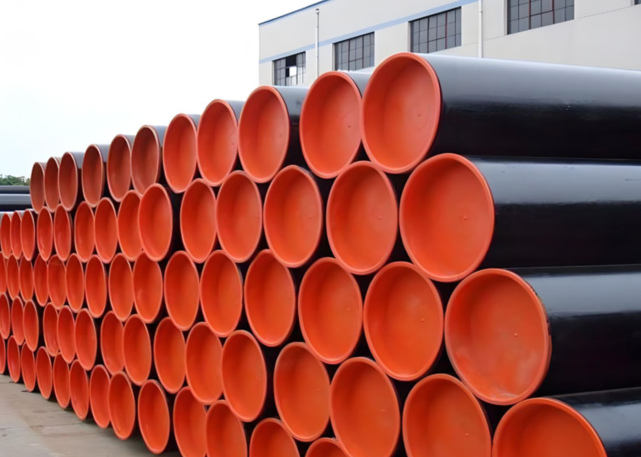
API 5L Standard covers a range of steel grades with increasing strength levels. The most common grades include Grade B, X42, X46, X52, X56, X60, X65, and X70.
Higher X grades indicate higher strength and are typically specified for higher-pressure, long-distance pipelines. For example, Grade B is the most basic strength level, while X70 offers significantly higher strength for demanding long-distance transmission lines.
Beyond selecting the right grade, understanding the manufacturing process is also critical for your application.
● Seamless pipe: produced by hot rolling or cold drawing process, suitable for high pressure and small diameter pipes, but the cost is higher.
● Welded pipe: including high frequency electric resistance welding (ERW) and submerged arc welding (SAW), which dominates the field of large diameter (such as ≥24 inches) and has lower cost.
Once the grade and manufacturing type are determined, the next step is to choose the appropriate product specification level (PSL). Both PSL1 and PSL2 apply to all grades and manufacturing types listed above, but their requirements differ. The following section explains these differences.
Understanding the difference between PSL1 and PSL2 is critical for proper material selection. The table below summarizes the core requirements:
| Comparison Item | PSL1 | PSL2 |
| Quality Level | Standard quality for general applications | Higher quality for sour service, high-pressure, offshore, and other critical applications |
| Chemical Composition | Less restrictive | Stricter limits on carbon, sulfur, phosphorus, and other elements |
| Mechanical Properties | Only minimum yield and tensile strength | Minimum and maximum yield/tensile strength, with yield-to-tensile ratio ≤ 0.93 |
| Impact Toughness (CVN) | Not required | Mandatory (Charpy V-notch impact test at 0°C) |
| Non-Destructive Testing (NDT) | Not required | Mandatory (ultrasonic or eddy current testing) |
| Carbon Equivalent (CE) | Not controlled | Strictly limited (CEIIW ≤ 0.43%, CEPcm ≤ 0.25%) |
| Hardness Requirements | Not required | Required for sour service (maximum hardness limits) |
| Hydrostatic Test | Performed (may be substituted by NDT per standard) | Performed on each pipe (cannot be substituted by NDT) |
| Typical Applications | General onshore pipelines, low-pressure transmission | High-pressure long-distance pipelines, sour service (H₂S), offshore, low-temperature service |
Quick Selection Tip:
Choose PSL1 (Grade B-X52) for general, lower-risk applications such as standard onshore pipelines.
Choose PSL2 (X60-X80) for projects requiring higher toughness, stricter testing, and enhanced reliability, such as offshore pipelines, sour service (H₂S), and high-pressure applications.
The following table provides a summary of the mechanical property requirements for API 5L line pipe under both PSL1 and PSL2.
For PSL1, the standard specifies minimum yield and tensile strength values for each grade. For PSL2, the requirements are more stringent, specifying both minimum and maximum limits for yield and tensile strength, along with a maximum yield-to-tensile ratio of 0.93. These stricter mechanical property controls ensure the higher reliability and toughness required for critical service applications such as sour service, offshore, and high-pressure long-distance pipelines.
Standard
Steel Grade
Yield Strength(MPa)
Tensile Strength(MPa)
API 5L
PSL1
A25
172
310
A
207
331
B
241
414
X42
290
414
X46
317
434
X52
359
455
X56
386
490
X60
414
517
X65
448
531
X70
483
565
PSL2
241-448
414-758
B
290-496
414-758
X42
317-524
434-758
X46
359-531
455-758
X52
386-544
490-758
X56
414-565
517-758
X60
448-600
531-758
X65
483-621
565-758
X70
552-690
621-827
Note: PSL2 grades have a maximum yield strength limit, which is not specified for PSL1. PSL2 also requires CVN impact testing.
Choosing the right API 5L line pipe for your project requires a clear understanding of your operating conditions. The following guidelines will help you make a practical decision based on pressure, environment, and budget.
Step 1: Select the Grade Based on Pressure and Distance
| Comparison Item | PSL1 | PSL2 |
| Quality Level | Standard quality for general applications | Higher quality for sour service, high-pressure, offshore, and other critical applications |
| Chemical Composition | Less restrictive | Stricter limits on carbon, sulfur, phosphorus, and other elements |
| Mechanical Properties | Only minimum yield and tensile strength | Minimum and maximum yield/tensile strength, with yield-to-tensile ratio ≤ 0.93 |
| Impact Toughness (CVN) | Not required | Mandatory (Charpy V-notch impact test at 0°C) |
| Non-Destructive Testing (NDT) | Not required | Mandatory (ultrasonic or eddy current testing) |
| Carbon Equivalent (CE) | Not controlled | Strictly limited (CEIIW ≤ 0.43%, CEPcm ≤ 0.25%) |
| Hardness Requirements | Not required | Required for sour service (maximum hardness limits) |
| Hydrostatic Test | Performed (may be substituted by NDT per standard) | Performed on each pipe (cannot be substituted by NDT) |
| Typical Applications | General onshore pipelines, low-pressure transmission | High-pressure long-distance pipelines, sour service (H₂S), offshore, low-temperature service |
Step 2: Choose PSL1 or PSL2 Based on Service Conditions
| Pressure Level | Pipeline Length | Recommended Grade | Reason |
| Low Pressure (e.g., ≤ 5 MPa) | Short to Medium | Grade B | Sufficient strength for basic applications; most economical. |
| Medium Pressure (e.g., 5 – 10 MPa) | Medium to Long | X42 – X52 | Good balance of strength and cost; suitable for most onshore pipelines. |
| High Pressure (> 10 MPa) | Long Distance | X60 – X70 | High strength reduces wall thickness and weight, saving material and transportation costs. |
| Ultra-High Pressure (e.g., > 15 MPa) | Ultra-Long Distance | X80 steel | Maximum strength for extreme conditions; requires careful welding and material handling. |
Step 3: Select Pipe Type Based on Diameter and Application
| Service Condition | Recommended PSL | Key Requirements |
| General onshore pipelines, standard temperature and pressure | PSL1 | Meets basic mechanical and chemical requirements; lower cost and faster delivery. |
| High-pressure, long-distance, or safety-critical lines | PSL2 | Stricter mechanical properties, mandatory impact testing, and tighter chemical composition controls. |
| Sour service (H₂S environment) | PSL2 (Sour Service) | Requires specific hardness limits and resistance to sulfide stress cracking (SSC); must comply with NACE MR0175. |
| Offshore or low-temperature environments | PSL2 | Requires low-temperature impact toughness testing and stricter NDT for enhanced reliability. |
Quick Selection Checklist:
Use this checklist to quickly define your project requirements before consulting a supplier:
Design Pressure: ______ MPa
Design Temperature: ______ °C
Pipeline Length: ______ km
Diameter: ______ mm (NPS)
Environment: Onshore / Offshore / Sour Service / Low Temperature
Grade Preference: B / X42 / X52 / X60 / X65 / X70 / X80
PSL Preference: PSL1 / PSL2
Pipe Type: Seamless / ERW / LSAW / SSAW
| PSL | Delivery Condition | Pipe Grade |
|---|---|---|
| PSL1 | As-rolled, normalized, normalizing formed | A |
| As-rolled, normalizing rolled, thermomechanical rolled, thermo-mechanical formed, normalizing formed, normalized, normalized and tempered or if agreed Q&T SMLS only | B | |
| As-rolled, normalizing rolled, thermomechanical rolled, thermo-mechanical formed, normalizing formed, normalized, normalized and tempered | X42, X46, X52, X56, X60, X65, X70 | |
| PSL 2 | As-rolled | BR, X42R |
| Normalizing rolled, normalizing formed, normalized or normalized and tempered | BN, X42N, X46N, X52N, X56N, X60N | |
| Quenched and tempered | BQ, X42Q, X46Q, X56Q, X60Q, X65Q, X70Q, X80Q, X90Q, X100Q | |
| Thermomechanical rolled or thermomechanical formed | BM, X42M, X46M, X56M, X60M, X65M, X70M, X80M | |
| Thermomechanical rolled | X90M, X100M, X120M | |
| The suffice (R, N, Q or M) for PSL2 grades, belongs to the steel grade |
For detailed chemical composition limits for PSL1 and PSL2, please refer to the full API 5L specification below. Key requirements include:
Chemical Composition Highlights – PSL1 (t ≤ 0.984″):
● Carbon content: ≤ 0.28% (seamless) / ≤ 0.26% (welded) for Grade B-X70.
● Manganese content up to 1.65% (depending on grade).
● Phosphorus and sulfur limited to ≤ 0.030%.
Chemical Composition Highlights – PSL2 (t ≤ 0.984″):
● Stricter limits on carbon, phosphorus, and sulfur.
● Carbon equivalent (CEIIW) ≤ 0.43% (max) and CEPcm ≤ 0.25% (max) for most grades.
● No intentional addition of boron (B) is permitted, with residual B ≤ 0.001%.
Chemical Composition for PSL 1 pipe with t ≤ 0.984”
| Steel Grade | Mass fraction, % based on heat and product analyses a,g | ||||||
|---|---|---|---|---|---|---|---|
| C | Mn | P | S | V | Nb | Ti | |
| max b | max b | max | max | max | max | max | |
| Seamless Pipe | |||||||
| A | 0.22 | 0.9 | 0.3 | 0.3 | – | – | – |
| B | 0.28 | 1.2 | 0.3 | 0.3 | c,d | c,d | d |
| X42 | 0.28 | 1.3 | 0.3 | 0.3 | d | d | d |
| X46 | 0.28 | 1.4 | 0.3 | 0.3 | d | d | d |
| X52 | 0.28 | 1.4 | 0.3 | 0.3 | d | d | d |
| X56 | 0.28 | 1.4 | 0.3 | 0.3 | d | d | d |
| X60 | 0.28 e | 1.40 e | 0.3 | 0.3 | f | f | f |
| X65 | 0.28 e | 1.40 e | 0.3 | 0.3 | f | f | f |
| X70 | 0.28 e | 1.40 e | 0.3 | 0.3 | f | f | f |
| Welded Pipe | |||||||
| A | 0.22 | 0.9 | 0.3 | 0.3 | – | – | – |
| B | 0.26 | 1.2 | 0.3 | 0.3 | c,d | c,d | d |
| X42 | 0.26 | 1.3 | 0.3 | 0.3 | d | d | d |
| X46 | 0.26 | 1.4 | 0.3 | 0.3 | d | d | d |
| X52 | 0.26 | 1.4 | 0.3 | 0.3 | d | d | d |
| X56 | 0.26 | 1.4 | 0.3 | 0.3 | d | d | d |
| X60 | 0.26 e | 1.40 e | 0.3 | 0.3 | f | f | f |
| X65 | 0.26 e | 1.45 e | 0.3 | 0.3 | f | f | f |
| X70 | 0.26e | 1.65 e | 0.3 | 0.3 | f | f | f |
|
a. Cu ≤ = 0.50% Ni; ≤ 0.50%; Cr ≤ 0.50%; and Mo ≤ 0.15%, b. For each reduction of 0.01% below the specified maximum concentration for carbon, an increase of 0.05% above the specified maximum concentration for Mn is permissible, up to a maximum of 1.65% for grades ≥ L245 or B, but ≤ L360 or X52; up to a maximum of 1.75% for grades > L360 or X52, but < L485 or X70; and up to a maximum of 2.00% for grade L485 or X70., c. Unless otherwise agreed NB + V ≤ 0.06%, d. Nb + V + TI ≤ 0.15%, e. Unless otherwise agreed., f. Unless otherwise agreed, NB + V = Ti ≤ 0.15%, g. No deliberate addition of B is permitted and the residual B ≤ 0.001% |
|||||||
Chemical Composition for PSL 2 pipe with t ≤ 0.984”
| Steel Grade | Mass fraction, % based on heat and product analyses | Carbon Equiv a | |||||||||||||||||||
|---|---|---|---|---|---|---|---|---|---|---|---|---|---|---|---|---|---|---|---|---|---|
| C | Si | Mn | P | S | V | Nb | Ti | Other | CE IIW | CE Pcm | |||||||||||
| max b | max | max b | max | max | max | max | max | max | max | ||||||||||||
| Seamless and Welded Pipe | |||||||||||||||||||||
| BR | 0.24 | 0.4 | 1.2 | 0.025 | 0.015 | c | c | 0.04 | e,l | 0.43 | 0.25 | ||||||||||
| X42R | 0.24 | 0.4 | 1.2 | 0.025 | 0.015 | 0.06 | 0.05 | 0.04 | e,l | 0.43 | 0.25 | ||||||||||
| BN | 0.24 | 0.4 | 1.2 | 0.025 | 0.015 | c | c | 0.04 | e,l | 0.43 | 0.25 | ||||||||||
| X42N | 0.24 | 0.4 | 1.2 | 0.025 | 0.015 | 0.06 | 0.05 | 0.04 | e,l | 0.43 | 0.25 | ||||||||||
| X46N | 0.24 | 0.4 | 1.4 | 0.025 | 0.015 | 0.07 | 0.05 | 0.04 | d,e,l | 0.43 | 0.25 | ||||||||||
| X52N | 0.24 | 0.45 | 1.4 | 0.025 | 0.015 | 0.1 | 0.05 | 0.04 | d,e,l | 0.43 | 0.25 | ||||||||||
| X56N | 0.24 | 0.45 | 1.4 | 0.025 | 0.015 | 0.10f | 0.05 | 0.04 | d,e,l | 0.43 | 0.25 | ||||||||||
| X60N | 0.24f | 0.45f | 1.40f | 0.025 | 0.015 | 0.10f | 0.05f | 0.04f | g,h,l | As agreed | |||||||||||
| BQ | 0.18 | 0.45 | 1.4 | 0.025 | 0.015 | 0.05 | 0.05 | 0.04 | e,l | 0.43 | 0.25 | ||||||||||
| X42Q | 0.18 | 0.45 | 1.4 | 0.025 | 0.015 | 0.05 | 0.05 | 0.04 | e,l | 0.43 | 0.25 | ||||||||||
| X46Q | 0.18 | 0.45 | 1.4 | 0.025 | 0.015 | 0.05 | 0.05 | 0.04 | e,l | 0.43 | 0.25 | ||||||||||
| X52Q | 0.18 | 0.45 | 1.5 | 0.025 | 0.015 | 0.05 | 0.05 | 0.04 | e,l | 0.43 | 0.25 | ||||||||||
| X56Q | 0.18 | 0.45f | 1.5 | 0.025 | 0.015 | 0.07 | 0.05 | 0.04 | e,l | 0.43 | 0.25 | ||||||||||
| X60Q | 0.18f | 0.45f | 1.70f | 0.025 | 0.015 | g | g | g | h,l | 0.43 | 0.25 | ||||||||||
| X65Q | 0.18f | 0.45f | 1.70f | 0.025 | 0.015 | g | g | g | h,l | 0.43 | 0.25 | ||||||||||
| X70Q | 0.18f | 0.45f | 1.80f | 0.025 | 0.015 | g | g | g | h,l | 0.43 | 0.25 | ||||||||||
| X80Q | 0.18f | 0.45f | 1.90f | 0.025 | 0.015 | g | g | g | i,j | As agreed | |||||||||||
| X90Q | 0.16f | 0.45f | 1.9 | 0.02 | 0.01 | g | g | g | j,k | As agreed | |||||||||||
| X100Q | 0.16f | 0.45f | 1.9 | 0.02 | 0.01 | g | g | g | j,k | As agreed | |||||||||||
| Welded Pipe | |||||||||||||||||||||
| BM | 0.22 | 0.45 | 1.2 | 0.025 | 0.015 | 0.05 | 0.05 | 0.04 | e,l | 0.43 | 0.25 | ||||||||||
| X42M | 0.22 | 0.45 | 1.3 | 0.025 | 0.015 | 0.05 | 0.05 | 0.04 | e,l | 0.43 | 0.25 | ||||||||||
| X46M | 0.22 | 0.45 | 1.3 | 0.025 | 0.015 | 0.05 | 0.05 | 0.04 | e,l | 0.43 | 0.25 | ||||||||||
| X52M | 0.22 | 0.45 | 1.4 | 0.025 | 0.015 | d | d | d | e,l | 0.43 | 0.25 | ||||||||||
| X56M | 0.22 | 0.45f | 1.4 | 0.025 | 0.015 | d | d | d | e,l | 0.43 | 0.25 | ||||||||||
| X60M | 0.12f | 0.45f | 1.60f | 0.025 | 0.015 | g | g | g | h,l | 0.43 | 0.25 | ||||||||||
| X65M | 0.12f | 0.45f | 1.60f | 0.025 | 0.015 | g | g | g | h,l | 0.43 | 0.25 | ||||||||||
| X70M | 0.12f | 0.45f | 1.70f | 0.025 | 0.015 | g | g | g | h,l | 0.43 | 0.25 | ||||||||||
| X80M | 0.12f | 0.45f | 1.85f | 0.025 | 0.015 | g | g | g | i,j | .043f | 0.25 | ||||||||||
| X90M | 0.1 | 0.55f | 2.10f | 0.02 | 0.01 | g | g | g | i,j | – | 0.25 | ||||||||||
| X100M | 0.1 | 0.55f | 2.10f | 0.02 | 0.01 | g | g | g | i,j | – | 0.25 | ||||||||||
|
a. SMLS t>0.787”, CE limits shall be as agreed. The CEIIW limits applied fi C > 0.12% and the CEPcm limits apply if C ≤ 0.12%, b. For each reduction of 0.01% below the specified maximum for C, an increase of 0.05% above the specified maximum for Mn is permissible, up to a maximum of 1.65% for grades ≥ L245 or B, but ≤ L360 or X52; up to a maximum of 1.75% for grades > L360 or X52, but < L485 or X70; up to a maximum of 2.00% for grades ≥ L485 or X70, but ≤ L555 or X80; and up to a maximum of 2.20% for grades > L555 or X80., c. Unless otherwise agreed Nb = V ≤ 0.06%, d. Nb = V = Ti ≤ 0.15%, e. Unless otherwise agreed, Cu ≤ 0.50%; Ni ≤ 0.30% Cr ≤ 0.30% and Mo ≤ 0.15%, f. Unless otherwise agreed, g. Unless otherwise agreed, Nb + V + Ti ≤ 0.15%, h. Unless otherwise agreed, Cu ≤ 0.50% Ni ≤ 0.50% Cr ≤ 0.50% and MO ≤ 0.50%, i. Unless otherwise agreed, Cu ≤ 0.50% Ni ≤ 1.00% Cr ≤ 0.50% and MO ≤ 0.50%, j. B ≤ 0.004%, k. Unless otherwise agreed, Cu ≤ 0.50% Ni ≤ 1.00% Cr ≤ 0.55% and MO ≤ 0.80%, l. For all PSL 2 pipe grades except those grades with footnotes j noted, the following applies. Unless otherwise agreed no intentional addition of B is permitted and residual B ≤ 0.001%.
API 5L Pipe Mechanical Properties (Seamless and Welded): |
|||||||||||||||||||||
| Pipe Grade | Tensile Properties – Pipe Body of SMLS and Welded Pipes PSL 1 | Seam of Welded Pipe | ||
|---|---|---|---|---|
| Yield Strength a | Tensile Strength a | Elongation | Tensile Strength b | |
| Rt0,5 PSI Min | Rm PSI Min | (in 2in Af % min) | Rm PSI Min | |
| A | 30,500 | 48,600 | c | 48,600 |
| B | 35,500 | 60,200 | c | 60,200 |
| X42 | 42,100 | 60,200 | c | 60,200 |
| X46 | 46,400 | 63,100 | c | 63,100 |
| X52 | 52,200 | 66,700 | c | 66,700 |
| X56 | 56,600 | 71,100 | c | 71,100 |
| X60 | 60,200 | 75,400 | c | 75,400 |
| X65 | 65,300 | 77,500 | c | 77,500 |
| X70 | 70,300 | 82,700 | c | 82,700 |
| a. For intermediate grade, the difference between the specified minimum tensile strength and the specified minimum yield for the pipe body shall be as given for the next higher grade. | ||||
| b. For the intermediate grades, the specified minimum tensile strength for the weld seam shall be the same as determined for the body using foot note a. | ||||
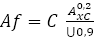
| c. The specified minimum elongation, Af, expressed in percent and rounded to the nearest percent, shall be determined using the following equation: | ||||
|
||||
| Where C is 1 940 for calculation using Si units and 625 000 for calculation using USC units | ||||
| Axc is the applicable tensile test piece cross-sectional area, expressed in square millimeters (square inches) , as follows | ||||
| – For circular cross-section test pieces, 130mm2 (0.20 in2) for 12.7 mm (0.500 in) and 8.9 mm (.350 in) diameter test pieces; and 65 mm2 (0.10 in2) for 6.4 mm (0.250in) diameter test pieces. | ||||
| – For full-section test pieces, the lesser of a) 485 mm2 (0.75 in2) and b) the cross-sectional area of the test piece, derived using the specified outside diameter and the specified wall thickness of the pipe, rounded to the nearest 10 mm2 (0.10in2) | ||||
| – For strip test pieces, the lesser of a) 485 mm2 (0.75 in2) and b) the cross-sectional area of the test piece, derived using the specified width of the test piece and the specified wall thickness of the pipe, rounded to the nearest 10 mm2 (0.10in2) | ||||
|
U is the specified minimum tensile strength, expressed in megapascals (pounds per square inch)
|
||||
| Pipe Grade | Tensile Properties – Pipe Body of SMLS and Welded Pipes PSL 2 | Seam of Welded Pipe | |||||
|---|---|---|---|---|---|---|---|
| Yield Strength a | Tensile Strength a | Ratio a,c | Elongation | Tensile Strength d | |||
| Rt0,5 PSI Min | Rm PSI Min | R10,5IRm | (in 2in) | Rm (psi) | |||
| Af % | |||||||
| Minimum | Maximum | Minimum | Maximum | Maximum | Minimum | Minimum | |
| BR, BN,BQ,BM | 35,500 | 65,300 | 60,200 | 95,000 | 0.93 | f | 60,200 |
| X42,X42R,X2Q,X42M | 42,100 | 71,800 | 60,200 | 95,000 | 0.93 | f | 60,200 |
| X46N,X46Q,X46M | 46,400 | 76,100 | 63,100 | 95,000 | 0.93 | f | 63,100 |
| X52N,X52Q,X52M | 52,200 | 76,900 | 66,700 | 110,200 | 0.93 | f | 66,700 |
| X56N,X56Q,X56M | 56,600 | 79,000 | 71,100 | 110,200 | 0.93 | f | 71,100 |
| X60N,X60Q,S60M | 60,200 | 81,900 | 75,400 | 110,200 | 0.93 | f | 75,400 |
| X65Q,X65M | 65,300 | 87,000 | 77,600 | 110,200 | 0.93 | f | 76,600 |
| X70Q,X65M | 70,300 | 92,100 | 82,700 | 110,200 | 0.93 | f | 82,700 |
| X80Q,X80M | 80,.500 | 102,300 | 90,600 | 119,700 | 0.93 | f | 90,600 |
| a. For intermediate grade, refer to the full API5L specification. | |||||||
| b. for grades > X90 refer to the full API5L specification. | |||||||
| c. This limit applies for pies with D> 12.750 in | |||||||
| d. For intermediate grades, the specified minimum tensile strength for the weld seam shall be the same value as was determined for the pipe body using foot a. | |||||||
| e. for pipe requiring longitudinal testing, the maximum yield strength shall be ≤ 71,800 psi | |||||||
| f. The specified minimum elongation, Af, expressed in percent and rounded to the nearest percent, shall be determined using the following equation: | |||||||
|
|
|||||||
| Where C is 1 940 for calculation using Si units and 625 000 for calculation using USC units | |||||||
| Axc is the applicable tensile test piece cross-sectional area, expressed in square millimeters (square inches) , as follows | |||||||
| – For circular cross-section test pieces, 130mm2 (0.20 in2) for 12.7 mm (0.500 in) and 8.9 mm (.350 in) diameter test pieces; and 65 mm2 (0.10 in2) for 6.4 mm (0.250in) diameter test pieces. | |||||||
| – For full-section test pieces, the lesser of a) 485 mm2 (0.75 in2) and b) the cross-sectional area of the test piece, derived using the specified outside diameter and the specified wall thickness of the pipe, rounded to the nearest 10 mm2 (0.10in2) | |||||||
| – For strip test pieces, the lesser of a) 485 mm2 (0.75 in2) and b) the cross-sectional area of the test piece, derived using the specified width of the test piece and the specified wall thickness of the pipe, rounded to the nearest 10 mm2 (0.10in2) | |||||||
| U is the specified minimum tensile strength, expressed in megapascals (pounds per square inch | |||||||
| g. Lower values fo R10,5IRm may be specified by agreement | |||||||
|
h. for grades > x90 refer to the full API5L specification. |
|||||||
Hydrostatic Test:
Each pipe shall be subjected to a hydrostatic test with no leakage. No leakage in the weld or pipe body is permitted.
Bend Test:
No cracks shall be present in any part of the test piece, and no openings shall be present in the weld.
Flattening Test:
Acceptance criteria vary by pipe diameter-to-thickness ratio (D/t) and grade. For example, for ERW pipe with D<12.750 inches, the weld shall not open until the distance between the plates is less than 66% of the original outside diameter (for grades ≤ X60, t ≤ 0.500 inches).
CVN Impact Test (PSL2):
Mandatory for PSL2 pipe. Seamless pipe is tested on the pipe body; welded pipe is tested on the pipe body, weld, and heat-affected zone (HAZ). Refer to the full API 5L specification for sizes and grades and a chart of required absorbed energy values.
1. How do I choose between PSL1 and PSL2?
A: Choose PSL1 for general onshore pipelines with standard pressure and temperature conditions. Choose PSL2 for critical applications requiring higher toughness, stricter testing, and enhanced reliability, such as offshore pipelines, sour service (H₂S), high-pressure, or low-temperature environments.
2. What is the difference between API 5L Grade B and X70?
A: Grade B has a minimum yield strength of 241 MPa, suitable for low-pressure, short-distance pipelines. X70 has a minimum yield strength of 483 MPa, offering nearly double the strength, making it ideal for high-pressure, long-distance transmission lines. Higher X grades provide higher strength but may also require stricter welding procedures and higher material costs.
3. Which pipe type is better for API 5L pipelines: seamless or welded?
A: Seamless pipes are preferred for high-pressure, small-diameter, or critical applications where safety and reliability are paramount. Welded pipes (ERW, LSAW, SSAW) are more cost-effective and suitable for large-diameter, moderate-pressure applications such as gathering lines and distribution networks.
4. What are the key mechanical property differences between PSL1 and PSL2?
A: PSL1 specifies only minimum yield and tensile strength values. PSL2 specifies both minimum and maximum limits for yield and tensile strength, with a maximum yield-to-tensile ratio of 0.93. PSL2 also requires mandatory impact testing (CVN) and stricter control of chemical composition and carbon equivalent.
5. What factors should I consider when selecting API 5L pipe grades?
A: Key factors include: design pressure (higher pressure → higher grade like X60-X70), pipeline length (longer distance → higher grade for cost efficiency), environmental conditions (sour service → PSL2 with hardness limits; low temperature → impact-tested PSL2), and budget (standard grades like B or X42 are more economical).
Read more:
● American Standard Seamless Steel Pipe
● API 5L ERW Standard line Pipe
Related information
Copyright @2017 Hunan Standard Steel Co.,Ltd and Husteel Industry Group All Rights Reserved