sales@hu-steel.com
 English
 Español
This guide covers S460MH under EN 10219-1, as well as S460NH and S460NLH under EN 10210. You will find material data, size ranges, selection logic, driving suitability, and certification requirements.
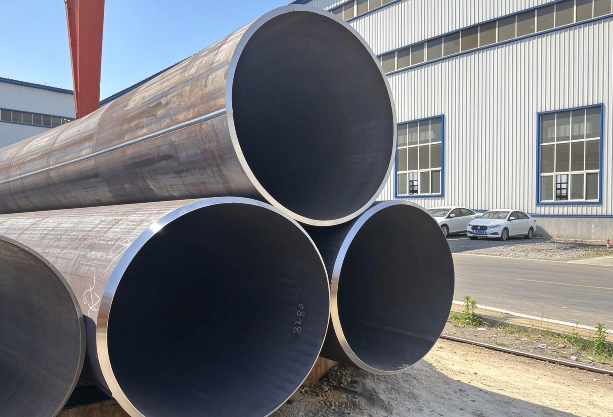
EN 10219 covers S460MH, while EN 10210 covers S460NH and S460NLH.
S460MH, S460NH, and S460NLH differ significantly in chemical composition, mechanical properties, size range, and application scenarios. The table below systematically compares key dimensions.
| Item | S460MH (EN 10219) | S460NH (EN 10210) | S460NLH (EN 10210) |
|---|---|---|---|
| Forming method | Cold-formed + welded | Hot-rolled / normalized | Hot-rolled / normalized |
| Delivery condition | Thermomechanical rolling (TMCP) | Normalized | Normalized |
| Impact temperature | -40°C | -20°C | -50°C |
| Impact energy requirement | 27J (guaranteed by some European mills) | 40J | 27J |
| Wall thickness range | Typically ≤25mm | Up to 120mm | Up to 120mm |
| Dimensional accuracy | Tighter | Wider | Wider |
| Residual stress | Higher | Lower | Lower |
| CEV (max) | ≤0.46 | ≤0.53 | ≤0.53 |
| Typical applications | Conventional piling, thin-wall large-diameter | Thick-wall piles, general low temperature | Extreme cold, fatigue-sensitive structures |
Key point: S460MH has a carbon equivalent CEV ≤ 0.46%, providing good weldability. S460NH/NLH, due to normalization, has lower residual stress and better weldability, making them particularly suitable for on-site welding of thick-wall piles and fatigue-sensitive structures.
| Grade | C | Si | Mn | P | S | N | CEV (t ≤ 20mm) |
|---|---|---|---|---|---|---|---|
| S460MH | ≤0.16 | ≤0.60 | ≤1.70 | ≤0.035 | ≤0.030 | ≤0.025 | ≤0.46 |
| S460NH | ≤0.20 | ≤0.60 | ≤1.70 | ≤0.035 | ≤0.030 | ≤0.025 | ≤0.53 |
| S460NLH | ≤0.20 | ≤0.60 | ≤1.70 | ≤0.035 | ≤0.030 | ≤0.025 | ≤0.53 |
Data source: EN 10219-1, EN 10210-1, and publicly available product data from European steel mills.
| Grade | Wall Thickness t (mm) | Min Yield Strength ReH (MPa) | Tensile Strength Rm (MPa) | Min Elongation A₅ (%) | Impact Temperature (°C) | Impact Energy (J) |
|---|---|---|---|---|---|---|
| S460MH | ≤16 | 460 | 530–720 | 17 | -40 | 27 |
| S460NH | ≤16 | 460 | 540–720 | 17 | -20 | 40 |
| S460NLH | ≤16 | 460 | 540–720 | 17 | -50 | 27 |
Note: For circular tubes, when the diameter-to-thickness ratio d/t < 15, the minimum elongation is reduced by 2 percentage points.
S460MH piling pipes are available in circular, square, and rectangular sections, with circular tubes being the most common. The typical standard product range for cold-formed S460MH pipes is as follows:
| Parameter | Range |
|---|---|
| Outer diameter (OD) | 42.4 – 323.9 mm (standard product) |
| Wall thickness (WT) | 2.0 – 12.5 mm (standard product) |
| Fixed length | 6,000 – 12,000 mm (conventional) |
Custom engineering ranges can reach outer diameter 1220 mm and above, with wall thickness 25 mm and above. For example, a deep-water wharf project in the Middle East used EN 10219 S460MH spiral welded pipe with specifications of φ1220/1420 × 25 mm, pipe length 44–52 m, and a total weight of approximately 68,000 tons.
For piling projects requiring thick walls (>25mm) or extra-large diameters, EN 10210 S460NH/NLH hot-formed pipes are recommended, with wall thickness up to 120 mm.
Dimensional Tolerances and Execution Class:
Dimensional tolerances for cold-formed S460MH pipes are in accordance with EN 10219-2, which are tighter than those for hot-formed pipes. Piling projects are typically delivered under EN 1090-2 execution class EXC2 or EXC3, requiring corresponding welding procedure qualifications and inspection documents.
S460MH piling pipes can be used with either mechanical connections (friction sleeves/threaded) or on-site welded connections. Selection should consider the following factors:
| Decision Factor | Prefer S355J2H | Prefer S460MH |
|---|---|---|
| Load requirement | Medium load, wall thickness not restricted | High load, need to reduce wall thickness or diameter |
| Driving depth | Medium depth | Deep driving, need higher resistance to hammer stress |
| Transport/lifting restrictions | No special restrictions | Need to reduce single pile weight |
| Carbon emission target | Conventional projects | Projects with carbon reduction targets or life-cycle cost sensitivity |
| Low-temperature environment | Above -20°C | -40°C (MH) or -50°C (NLH) |
| Thick-wall requirement | Wall thickness ≤25mm | Wall thickness >25mm, select NH/NLH |
Key Principle: S460MH is a logical choice when pipe diameter or wall thickness is constrained by the capabilities of transport and piling equipment, or when the project has carbon reduction targets. However, if local buckling of large-diameter piles governs the design, the weight-saving benefits of upgrading the steel grade will be diminished. Selection should begin with load-bearing requirements, integrating buckling analysis and construction equipment capabilities to determine the optimal combination of pipe diameter, wall thickness, and steel grade. Compared to S355J2H, S460MH can reduce steel consumption by approximately 20–30% for the same load-bearing capacity (depending on buckling conditions).
S460MH has a carbon equivalent CEV ≤ 0.46%, providing good weldability. On-site butt welding should use filler metals matching the base material; E55 series filler metals are recommended. Welding procedure qualification should be performed in accordance with EN 1090-2. For wall thickness ≥20mm, preheating to 100–150°C is recommended.
S460MH piling pipes are typically driven with an open end; particularly in rocky strata, the open-ended design reduces end resistance and facilitates hole cleaning, allowing the high-strength steel to support substantial concentrated end loads. Its high yield strength enables it to withstand higher driving stresses, making it suitable for installation using diesel or hydraulic hammers. The driving energy must be matched to the yield strength of the S460MH steel to avoid pile-head damage caused by excessive energy or failure to penetrate hard layers due to insufficient energy. Pile shoe designs must also account for the local bearing capacity of the high-strength steel. S460NH/NLH grades, having undergone normalizing treatment, exhibit lower residual stresses and superior weldability, making them particularly suitable for the on-site welding of thick-walled piles and for fatigue-sensitive structures.
Fatigue Design: For pile foundations subjected to cyclic loading (such as offshore platforms or bridge foundations), fatigue design should be carried out in accordance with EN 1993-1-9. S460NLH should be selected where necessary to leverage its superior low-temperature toughness and residual stress characteristics.
When procuring S460MH piling pipes, the following items should be verified:
1. CE Marking: Compliance with the Construction Products Regulation (CPR) in accordance with EN 10219-1.
2. Inspection Documentation: 3.1 Certificate (EN 10204); mandatory for structural steels of grade S275 and higher.
3. Weld NDT: Records of full-length weld Non-Destructive Testing (NDT) included in the 3.1 Certificate.
4. Impact Testing: Conducted at -40°C with a minimum energy of 27J (a guaranteed value offered by some European steel mills).
5. Anti-corrosion Scheme: Epoxy glass flake coating or 3PE is recommended for marine environments. For soil environments, the anti-corrosion grade should be selected based on soil resistivity.
6. Third-party Inspection: Third-party inspections (e.g., SGS, BV) can be arranged upon request.
EN 10219 S460MH piling tubes represent the trend toward high strength, lightweight design, and low carbon emissions in steel pipe pile materials. Provided that buckling constraints and driving conditions are properly assessed, S460MH can significantly reduce steel consumption and carbon emissions, making it particularly suitable for large-diameter deep foundation piles and micropile projects. For projects involving extreme cold environments or requirements for heavy wall thicknesses, EN 10210 S460NH/NLH offers a more comprehensive solution. When selecting materials, it is recommended to start with load-bearing requirements and determine the optimal combination of pipe diameter, wall thickness, and steel grade by considering buckling analysis, low-temperature performance, and the capabilities of construction equipment.
▶ [Request a Quote]
Related Resources
● ASTM A252 Piling Pipe: Standards & Sizes
● SSAW Piling Pipe Sizes Chart
● Corrosion Protection for Steel Pipe Piles
● S235JRH and S355J2H Structural Steel
● ERW vs. LSAW vs. SSAW: Which One to Choose?
● What is Steel Pipe Pile? Types, Sizes, Standards & Applications
Related information
Copyright @2017 Hunan Standard Steel Co.,Ltd and Husteel Industry Group All Rights Reserved