sales@hu-steel.com
 English
 Español

As a purchaser, you don't need to master the physics of ultrasound. Your focus should be on two practical questions: Does the supplier's testing protocol cover the core risks? And how do you verify that an NDT report is actually trustworthy?
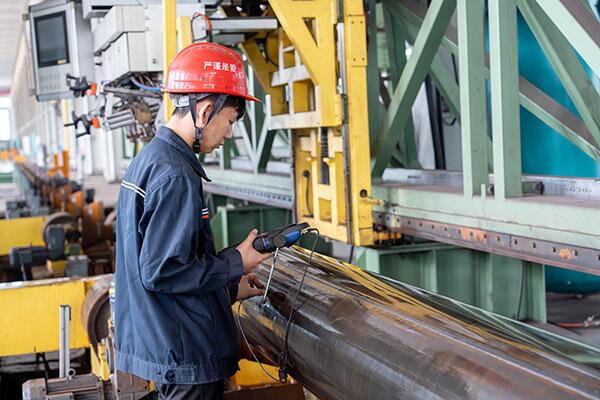
The ERW process relies on solid-state forging rather than melting. This determines the types of defects you need to watch for:
● Lack of Fusion: The atoms at the bond line fail to fully diffuse, creating a planar discontinuity. This is the most critical hidden risk in ERW welds.
● Flash/Trim Steps: Improper removal of internal and external weld flash creates geometric irregularities that interfere with NDT signal interpretation.
● Grooving Corrosion: Differences in composition or microstructure near the weld lead to selective corrosion.
These defects are highly directional, microscopic, and invisible to the naked eye. Standards such as API 5L mandate that ERW weld seams undergo 100% full-length, full-thickness non-destructive testing. If a supplier’s NDT protocol only includes spot checks or partial coverage, it falls short of standard requirements.
Ultrasonic Testing (UT) is the primary method for detecting internal weld defects. For planar defects like lack of fusion and cracks, UT offers significantly higher detection sensitivity than volumetric methods. In standard practice, ERW weld UT is performed per ISO 10893-11 or ASTM E213, covering the entire weld length and HAZ.
Eddy Current Testing (ECT) has its limits and cannot be the sole guarantee of internal quality. ECT is highly sensitive to surface and near-surface cracks, making it fast and effective for online screening. However, its penetration depth is limited, and its sensitivity to deep internal lack of fusion drops off significantly. ECT should be used to screen for surface defects; it cannot replace UT for evaluating internal weld integrity. If a supplier provides only an ECT report to prove internal weld quality, purchasers should ask: What method was used to detect internal lack of fusion?
For higher steel grades, thick walls, or critical service applications, Phased Array Ultrasonic Testing (PAUT) is becoming the preferred upgrade. It allows for multi-angle, multi-depth scanning of the weld, offering better defect detection and sizing than conventional UT.
A valid NDT deliverable is more than a certificate stating "Pass." Purchasers should verify the following four aspects:
1. Coverage and Standard Reference
Require the supplier to specify the UT standard used (e.g., ISO 10893-11) and confirm 100% full-length, full-thickness coverage. For pipe ends not fully covered by the automated UT system, manual UT or Magnetic Particle Testing (MT) must be performed as a supplement.
2. Transparent Acceptance Criteria
Standards typically do not accept harmful defects like cracks and lack of fusion. Purchasers should require the supplier to specify the acceptance criteria and rejection thresholds in the NDT procedure, rather than just claiming "compliance with standards." Acceptance levels (such as U2/C or U4/F4) should be agreed upon in the technical contract to avoid disputes later.
3. Personnel Qualifications and Equipment Verification
UT operators should hold traceable certifications (e.g., ASNT Level II or equivalent). The manufacturer should also retain records of NDT system capability verification, including responses to artificial defects in reference standards, coverage calculations, probe orientations, and repeatability tests. These records prove whether the system can actually find the defects.
4. Final Reports Must Include Results
The purchase contract should require the manufacturer to submit the actual NDT results (including any failure records) in the final documentation, not just a "pass" summary. If a supplier only provides a conclusion page, the purchaser cannot verify whether the critical areas were inspected with validated sensitivity settings.
Misconception 1: "A hydrostatic test means we don't need weld UT."
Hydrostatic testing verifies overall pressure containment and leak tightness. It has limited capability in detecting planar defects like lack of fusion. API 5L mandates ERW weld UT as an independent requirement from hydrostatic testing.
Misconception2: "The eddy current report passed, so the internal weld is fine."
As noted, ECT lacks the penetration depth for deep internal lack of fusion. For medium-to-high pressure or critical pipeline applications, a UT report is irreplaceable.
Misconception 3: "NDT is the supplier's responsibility; we just need the final certificate."
The NDT protocol itself (coverage, acceptance criteria, personnel, equipment verification) should be specified in the contract or technical agreement phase. Don't passively accept a compliant-looking certificate at delivery.
Q1: Does API 5L require 100% or spot testing for ERW weld NDT?
A: For ERW (HFW) pipe welds, API 5L and its supplementary requirements typically mandate 100% full-length ultrasonic testing covering the weld and HAZ. Spot testing is generally not acceptable for high-pressure or critical applications unless specifically justified and agreed upon.
Q2: Is an eddy current test report acceptable?
A: ECT is suitable for surface defect screening. If the application involves medium-to-high pressure or is sensitive to internal lack of fusion, a UT report must be supplemented. ECT alone is insufficient to prove internal weld quality.
Q3: Are pipe ends easily overlooked in NDT?
A: Yes. Automated online UT systems often do not fully cover the pipe ends. Standards usually require supplementary inspection (manual UT or MT) for any uncovered end sections. The NDT procedure should explicitly address pipe-end testing.
Q4: What NDT documents should the purchaser retain?
A: The documentation shall include: NDT procedures, personnel qualification records, equipment capability verification records, inspection results for each batch/item (including records of any failures), and the final NDT report. These documents serve as essential evidence for quality traceability and third-party audits.
Related topics
● Hydrostatic Test of ERW Pipe
● ERW Steel Pipe Production Line
● ERW Steel Pipe Quality Control & Inspection Methods
Related information
Copyright @2017 Hunan Standard Steel Co.,Ltd and Husteel Industry Group All Rights Reserved