sales@hu-steel.com
 English
 Español
There are two main categories of steel pipes on the market: seamed (welded) pipes and seamless pipes. Understanding the differences between them is essential for selecting the right product for your project. This guide compares the two types across manufacturing, appearance, pressure capacity, cost, and applications to help you make an informed decision.
Choose Welded (Seam) Pipe for general structural, low-pressure, and standard fluid transport applications where cost-effectiveness is the priority (e.g., building structures, water/gas pipelines).

A seamed steel pipe, also known as a welded steel pipe, is a type of pipe made from hot-rolled steel strip or plate as raw material, cold-bent, and then welded. Based on the welding method, it is mainly divided into:
● ERW (Electrical Resistance Welded Pipe): High-frequency resistance welding, high efficiency, suitable for small and medium diameters.
● LSAW (Straight Seam Submerged Arc Welded Pipe): Steel plate is formed and then submerged arc welded, suitable for large diameters and thick walls.
● SSAW (Spiral Submerged Arc Welded Pipe): Steel strip is spirally formed and then submerged arc welded; large diameter pipes can be produced using narrow steel strips.
Maximum nominal diameter: Up to DN4000 (160 inches) and above (e.g., large-diameter spiral welded pipe)
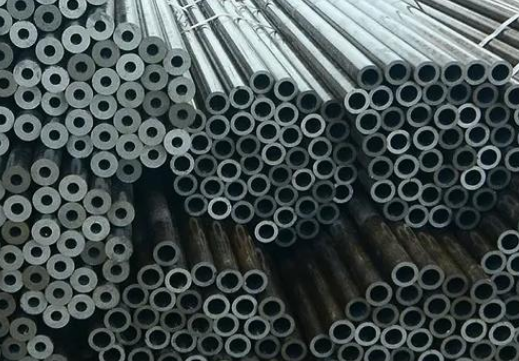
Seamless steel pipes are steel pipes made from solid round steel billets through processes such as piercing, hot rolling, cold drawing, or extrusion, resulting in a pipe body without any weld seams.
Specification Range:
Seamless steel pipes have an extremely wide specification range, with a minimum outer diameter of 1.6mm (precision capillary tube) and a maximum outer diameter of 1620mm; wall thicknesses range from 0.25mm to over 150mm.
| Comparison Feature | Seamless Pipe | Seamed (Welded) Pipe |
|---|---|---|
| Manufacturing Process | Solid billet pierced and rolled; no weld seam | Steel strip/plate cold-bent and welded |
| Appearance (Inner Wall) | Smooth, continuous, no weld marks | Noticeable weld reinforcement (smooth for ERW, prominent for LSAW) |
| Pressure Resistance | Higher; uniform structure, excellent for high-pressure, high-temperature, alternating loads | Good; modern ERW/LSAW can meet medium-high pressure requirements with strict QC |
| Cost | 30%-100% higher than welded pipe of same spec | Lower, due to simpler process and wider application |
| Typical Applications | High-pressure boilers, petrochemicals, hydraulic systems, precision machinery | Low-pressure fluid transport, building structures, general engineering |
| Specification Range | Very wide (OD 1.6mm – 1620mm; WT 0.25mm – 150mm+) | Common DN15~DN600; max up to DN4000+ |
| Choose Seamless Pipe If... | Choose Seamed (Welded) Pipe If... |
|---|---|
| High pressure (> 2.5 MPa) or high temperature (> 350°C) is involved | Low to medium pressure (≤ 2.5 MPa) and standard temperature |
| Application is safety-critical (e.g., boilers, hydraulic systems, oil/gas well casing) | General structural, building, or low-risk fluid transport |
| Uniform strength and no weld seam are mandatory | Cost savings and faster delivery are priorities |
| Precision or thin-wall/high-strength ratio is required | Large diameters (> 24″) are needed, where welded pipe is more economical |
Q1: What is the main difference between seamless and seamed (welded) pipe?
A: The fundamental difference lies in the manufacturing method. Seamless pipe is formed from a solid billet without any weld seam, providing uniform strength and higher pressure resistance. Seamed (welded) pipe is formed from steel strip or plate and welded, which is more cost-effective but has a weld seam that can be a potential weak point.
Q2: Which is more expensive, seamless or welded pipe?
A: Seamless pipe is typically 30% to 100% more expensive than welded pipe of the same specifications. The cost difference is due to the more complex manufacturing process, lower yield, and stricter quality control required for seamless pipe.
Q3: Can welded pipe be used for high-pressure applications?
A: Yes, modern high-quality welded pipes (such as ERW and LSAW) can be used for medium and high-pressure applications with strict quality control. However, seamless pipe remains the preferred choice for the highest pressure and critical safety applications due to its uniform, weld-free structure.
Q4: How can I tell if a pipe is seamless or welded just by looking at it?
A: The most reliable visual indicator is the inner wall. Seamless pipes have a smooth, continuous inner surface without any weld marks. Welded pipes typically show a noticeable weld seam or reinforcement on the inner wall (though this may be smooth in ERW pipes).
Q5: Which type of pipe is better for structural applications?
A: For general structural applications such as building frames, scaffolding, and supports, welded pipe is often the more economical and sufficient choice. Seamless pipe is preferred for structural applications under high stress, high pressure, or where safety factors are critical.
Read more:
● What does schedule 40 seamless pipe mean?
Related information
Copyright @2017 Hunan Standard Steel Co.,Ltd and Husteel Industry Group All Rights Reserved