sales@hu-steel.com
 English
 Español
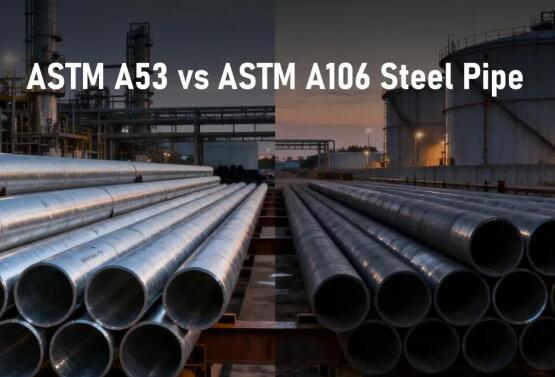
When selecting carbon steel pipes, ASTM A53, ASTM A106, and API 5L are three of the most frequently mentioned standards, but their positioning is completely different:
ASTM A53: A general-purpose carbon steel pipe standard, covering three manufacturing processes: seamless, electric resistance welded (ERW), and furnace-welded. It is suitable for operating conditions ≤340°C, including water supply systems, fire sprinkler systems, structural supports, and HVAC piping. A53 is also the standard specification for galvanized steel pipes.
ASTM A106: A high-temperature-specific seamless carbon steel pipe standard, limited to seamless pipes only. It is suitable for high-temperature operating conditions ≤540°C, such as oil refining, boilers, and steam pipelines. It is the preferred specification for oil refinery piping, boiler tubes, power plant steam pipelines, and heat exchanger piping. A106 has stricter control over chemical composition and mandates heat treatment.
API 5L: A standard specifically for oil and gas transportation, covering multiple strength grades from Gr.B to X80, and divided into two quality grades, PSL1 and PSL2. PSL2 has mandatory requirements for impurity control, impact toughness, and non-destructive testing.
|
Comparison Items |
ASTM A53 Gr.B |
ASTM A106 Gr.B |
|
Manufacturing Type |
Seamless / ERW / Furnace Welded Tube |
Seamless Tube Only |
|
Maximum Applicable Temperature |
340°C |
540°C |
|
Silicon (Si) Content Requirement |
None |
≥0.10% (High-Temperature Oxidation Resistance) |
|
Heat Treatment Requirements |
No mandatory requirement for seamless tubes |
Mandatory heat treatment (normalizing or normalizing + tempering) |
|
Zincable Available |
Supported |
Not Supported |
|
Applications |
Firefighting, Water Supply and Drainage, Structural |
Boilers, Oil Refining, Steam Pipelines |
|
Cost |
Baseline (Lowest) |
Approximately 30–50% higher |
a. Manufacturing Process Comparison (Seamless vs. Welded)
|
Manufacturing Type |
ASTM A53 |
ASTM A106 |
|
Seamless Tube (SMLS) |
Type S |
Unique Type |
| Electric Resistance Welded Tube (ERW) |
Type E |
Not Included |
|
Furnace Welded Tube |
Type F, Grade A only |
Not Included |
△ Explanation: A53 Type E resistance welded pipe is the most commonly used specification in fire sprinkler systems, with a significantly lower cost than seamless pipe. A106 is only available in seamless form, which is the basis for its ability to guarantee high-temperature performance—eliminating the risk of the weld becoming a weak point under thermal stress.
b. Chemical Composition Comparison
|
Element |
ASTM A53 Gr.B |
ASTM A106 Gr.B |
|
Carbon (C) max |
0.30% |
0.30% |
|
Manganese (Mn) |
≤1.20% |
0.29–1.06% |
|
Phosphorus (P) max |
0.050% |
0.035% |
|
Sulfur (S) max |
0.045% |
0.035% |
|
Silicon (Si) min |
No |
requirement ≥0.10% |
Silicon reacts with oxygen at high temperatures to form a dense oxide layer (SiO₂), which adheres to the steel pipe surface and prevents further oxidation. This is one of the core reasons why A106 can be used in high-temperature environments up to 540°C while A53 cannot.
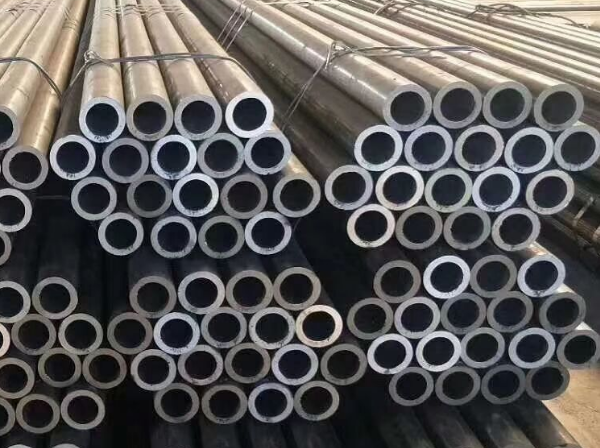
c. Comparison of Mechanical Properties and Temperature
|
Performance Indicators |
ASTM A53 Gr.B |
ASTM A106 Gr.B |
|
Yield Strength (min) |
240 MPa |
240 MPa |
|
Tensile Strength (min) |
≥415 MPa |
415–585 MPa |
|
Elongation (min) |
Calculated by formula |
30% (longitudinal) |
|
Maximum Applicable Temperature |
340°C |
540°C |
|
High-Temperature Performance Guarantee |
None |
Yes (≥80% strength retained at 480°C) |
△ Key Note: Although A53 and A106 have the same strength at room temperature, A106's performance retention is far superior to A53 at high temperatures. ASME B31.3 explicitly limits A53 to use below 340°C.
d. Comparison of Heat Treatment Requirements
|
Heat Treatment Requirements |
ASTM A53 |
ASTM A106 |
|
Seamless Pipe |
No mandatory requirement |
Must undergo heat treatment (normalizing or normalizing + tempering) |
|
Resistance Welded Pipe |
Gr.B Must undergo post-weld heat treatment (≥540°C) |
— |
|
Furnace Welded Pipe |
Gr.B Must undergo post-weld heat treatment (≥540°C) |
— |
Interpretation: The mandatory heat treatment requirement of A106 ensures uniform microstructure and refined grains, which is the guarantee of creep resistance at high temperatures. Although A53 seamless pipe allows for no heat treatment, its performance is only suitable for mild operating conditions ≤340°C.
● Not designed for high-temperature conditions (typical upper limit only 120°C).
|
Comparison Items |
ASTM A53 Gr.B |
ASTM A106 Gr.B |
API 5L Gr.B PSL2 |
|
Main Applications |
General fluids, structures, fire protection |
High-temperature processes, boilers, steam |
Long-distance oil and gas pipelines |
|
Manufacturing Type |
Seamless / ERW / Furnace welded |
Seamless only |
Seamless / Welded |
|
Maximum Applicable Temperature: |
340°C |
540°C |
≤120°C |
|
Yield Strength (min) |
240 MPa |
240 MPa |
245 MPa |
|
Phosphorus (P) max |
0.050% |
0.035% |
0.030% |
|
Sulfur (S) max |
0.045% |
0.035% |
0.030% |
|
Silicon (Si) min |
No requirement |
≥0.10% |
No mandatory |
|
Impact toughness requirement |
No requirement |
Gr.C mandatory |
PSL2 mandatory |
Choosing the right standard isn't complicated; it boils down to three key questions:
● What temperature range?
● What will it be used for?
● Does it need galvanizing?
Finally, consider galvanizing. If your pipelines require hot-dip galvanizing—such as fire sprinkler systems or outdoor water pipes—then A53 is the only option. While A106 is seamless and high-strength, it doesn't require galvanizing (because the galvanized layer will peel off at high temperatures) and is technically unsuitable for galvanizing (forced silicon content leads to an excessively thick coating and poor adhesion). When galvanizing is required, A53 Type E resistance welded pipe is the most mature and economical choice.
|
Application Scenario |
Recommended Standard |
Key Reason |
|
Refinery heating furnace pipelines (medium temperature >340°C) |
A106 Gr.B or Gr.C |
High-temperature performance guaranteed; silicon content improves oxidation resistance |
|
Main steam piping for power plant boilers |
A106 Gr.B or Gr.C |
Creep resistance from mandatory heat treatment is crucial |
|
Fire sprinkler systems (requiring galvanization) |
A53 Type E Gr.B |
Low cost, galvanizable, ERW welded pipe is adequate |
|
Building structural supports and railings |
A53 Type S or Type E |
No high temperature involved; A53 is economical |
|
City water pipes and low-pressure gas lines |
A53 Type E or Type F |
A53 fully meets low-pressure requirements |
|
Long-distance oil and gas pipelines |
API 5L X42 to X70, PSL2 preferred |
PSL2 requires impact toughness and 100% NDT |
|
Acidic environments (H₂S-containing pipelines) |
API 5L PSL2 + NACE MR0175 |
Strictest S/P control; resistance to sulfide stress corrosion |
Note: If you are unsure whether future operating conditions will change, or want to have some margin of safety, you may consider purchasing dual-certified tubing (A53/A106). This type of tubing meets both standards simultaneously, is less expensive than pure A106, but performs as well as A106.
Q1: Can A53 and A106 be used interchangeably?
It depends. For non-critical applications ≤340°C, they can be used interchangeably (especially dual-certified pipes). However, for steam lines or furnace systems with temperatures exceeding 340°C, A106 must be used. One project experienced creep rupture failure after 18 months due to the incorrect use of A53 in a 380°C steam line.Q2: What is "dual-certified pipe"?
Because A53 Type S seamless pipe and A106 Gr.B have almost identical chemical composition and room temperature strength requirements, many steel mills produce pipes that meet both standards. The MTR of such pipes will be marked "ASTM A53/A106 Gr.B". Purchasing dual-certified pipes allows for simultaneous compliance with both specifications, offering the greatest flexibility.Q3: Does A53 include seamless tubing?
Yes. A53 Type S is seamless tubing. However, A53 seamless tubing does not require mandatory heat treatment and does not guarantee high-temperature performance; therefore, it cannot replace A106 in high-temperature applications.
Q4: Can API 5L be used in ASME B31.3 process piping?
Requires engineer approval. API 5L Gr.B is chemically similar to A106, but the ASME B31.3 standard generally recommends A106. If API 5L is used as a substitute, it must be confirmed that it meets the design temperature, pressure, and impact toughness requirements.
Q5: Why can't A106 be galvanized?
A106 is designed for high-temperature environments (up to 540°C), while the safe operating temperature of hot-dip galvanized coatings is only ≤200°C. When A106 is used in its design target conditions, the galvanized coating will rapidly oxidize and peel off. Furthermore, the mandatory silicon content requirement (≥0.10%) of A106 can cause the Sandelin effect during hot-dip galvanizing, resulting in an excessively thick coating and poor adhesion.
Q6: ASTM A106 and ASTM A53: Which is better?
It depends on their purpose.
ASTM A106 is chosen for the following applications:
Transporting steam and superheated steam.
Used in high-temperature pressure pipelines in boilers, heat exchangers, oil refineries, and power plants.
The medium temperature continuously or periodically exceeds 200°C.
Project specifications (such as ASME B31.1 Power Piping Specification) mandate the use of high-temperature materials.
ASTM A53 is chosen for the following applications:
Transporting water, oil, gas, and air at normal or low temperatures.
Used in fire sprinkler systems and building water supply and drainage.
As structural support components that do not withstand high-temperature pressure.
Cost is a primary consideration, and the operating conditions are mild.
Read more:
Related information
Copyright @2017 Hunan Standard Steel Co.,Ltd and Husteel Industry Group All Rights Reserved