sales@hu-steel.com
 English
 Español
This page provides a complete seamless steel pipe size chart with dimensions, weight, and wall thickness in mm. Find standard sizes for SCH 40 and SCH 80, including weight per meter.
The following table provides dimensions, wall thickness, and weight per meter for seamless steel pipes in SCH 40 and SCH 80, two of the most commonly used schedules. Data is based on ASME/ANSI B36.10 standards for carbon steel pipes. All weights are theoretical and for reference only.
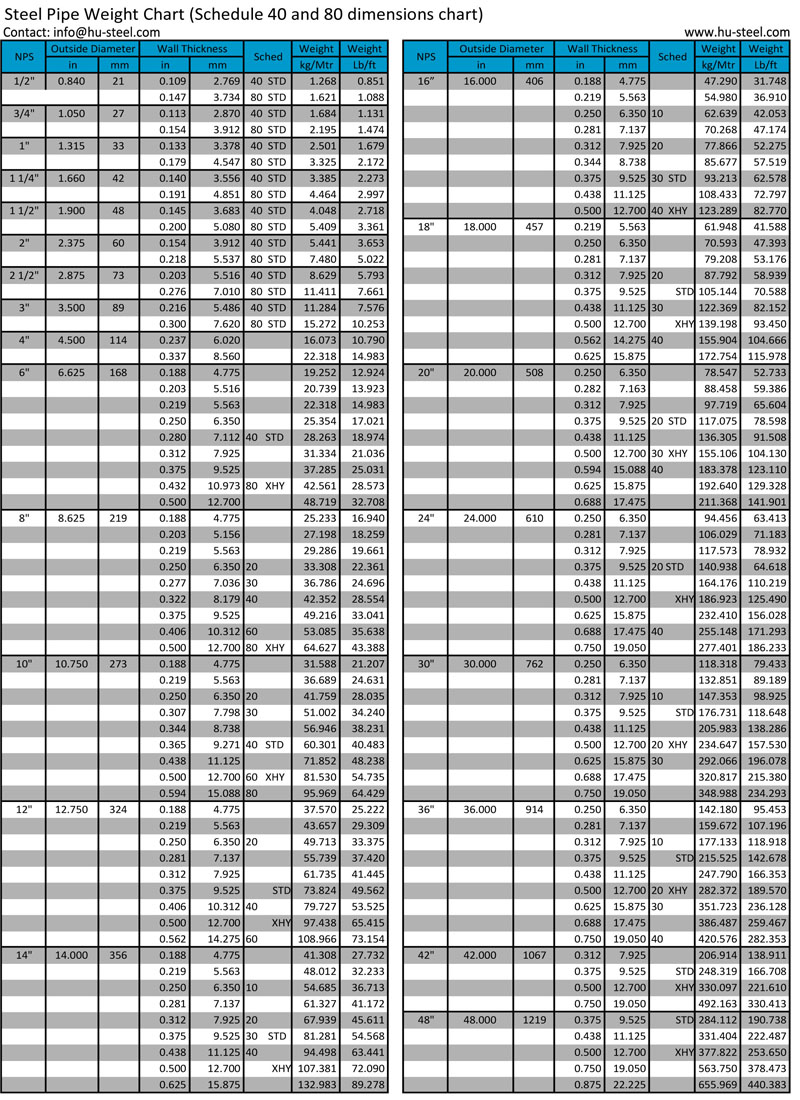
Note: The above data applies to carbon steel pipes (density ~7.85 g/cm³) and is based on ASME/ANSI B36.10 standards. For other materials (e.g., stainless steel), weight will vary slightly.
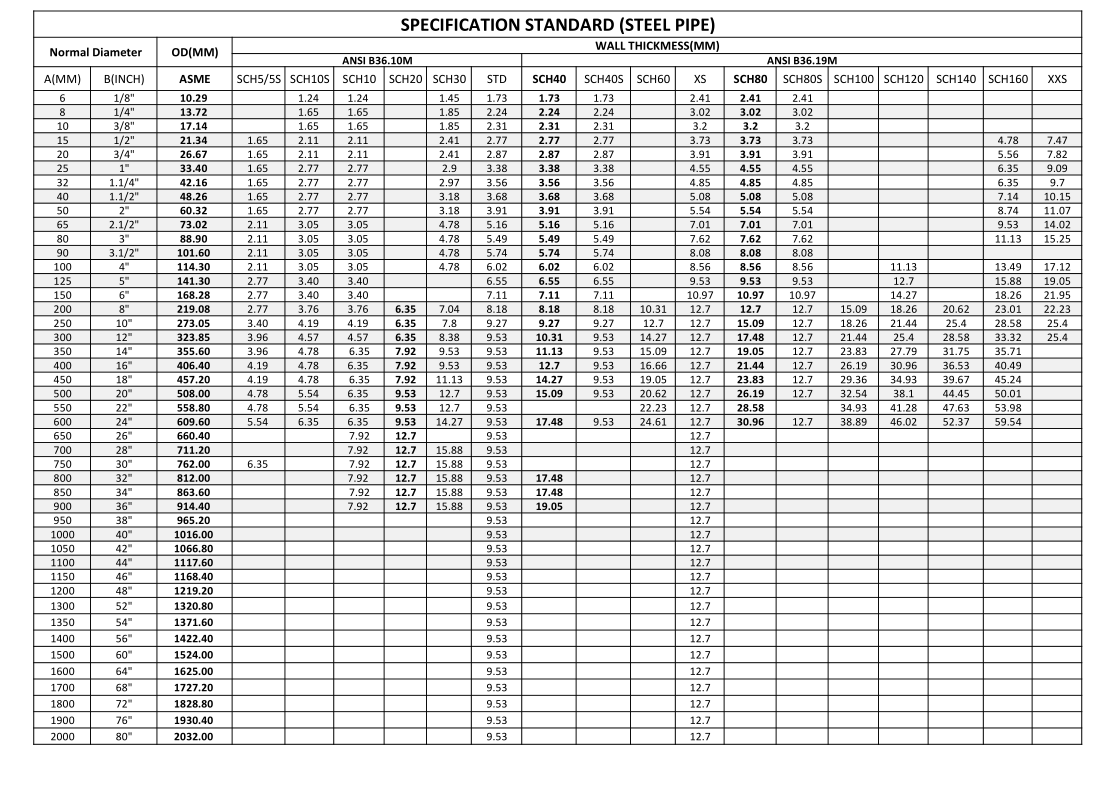
This comprehensive table provides wall thickness data for seamless steel pipes across a wide range of schedules, from SCH 5S to XXS, covering NPS 1/8" to 48". It is compiled according to ASME/ANSI B36.10 (carbon/alloy steel) and B36.19 (stainless steel) standards. All measurements are in millimeters (mm). Use this table for reference when you need wall thickness data for schedules other than SCH 40 and SCH 80.
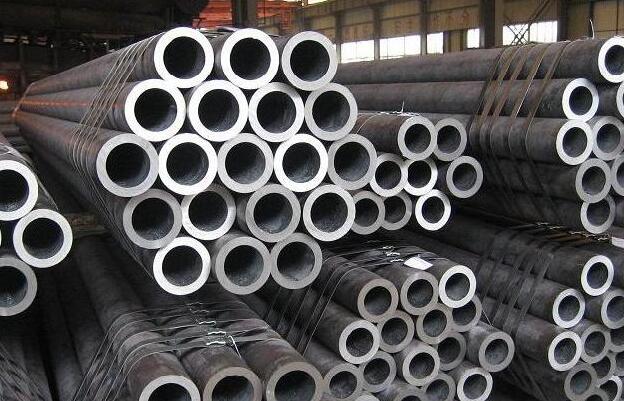
Seamless steel pipe (SMLS pipe) is a type of steel pipe with no seams along its entire length. It is a hollow tube manufactured directly from a single solid steel billet through a complete industrial forming process.
Outer Diameter: 1/2 inch - 36 inch (21.3mm-914.4mm)
Wall Thickness: 2.11mm-60mm ( SCH10, SCH20, SCH40, SCH80, STD, SCH120, SCH160, XXS)
Solid round billet → Heating in a furnace → Perforating in a piercing mill → Rolling in a pipe mill → Sizing in a sizing mill → Cooling → Straightening.
Features: Primarily produces large-diameter, thick-walled seamless steel pipes with high production efficiency.
● Cold Drawing/Cold Rolling:
Process: Using a hot-rolled tube as the base tube, cold drawing or cold rolling is performed at room temperature.
Features: Produces precision seamless steel pipes with small diameters, thin walls, high precision, and excellent surface quality.
1. Outer Diameter Range
Process Characteristics: Cold rolling, cold drawing, or extrusion are often used, making it suitable for applications such as precision machinery components and oil drilling.
b) Medium Diameter Seamless Steel Pipe: The outer diameter is typically 89mm-219mm.
Process Characteristics: Hot rolling is the primary method, with some cold rolling or cold drawing also used. It is used for pipelines, chemical equipment, and other applications.
Conventional wall thicknesses are divided into three categories:
Standard wall thickness series: SCH 5S to SCH 160
Extra-heavy weight series: XS/XXS
SCH 40 (STD): Standard weight, most commonly used. SCH 40 is commonly referred to as standard weight (STD) for sizes up to NPS 10.
SCH 80 (XS): Extra-heavy weight, used for higher pressures.
SCH 160 (XXS): Extra-heavy weight, used for high-pressure pipes.
This is the most commonly used international method for indicating pressure ratings, designated as SCH. For the same outer diameter, the larger the number after the Sch, the thicker the wall thickness and the higher the pressure capacity. Common series: SCH 10, SCH 20, SCH 40, SCH 80, SCH 120, SCH 160.
Special wall thickness series:
Thin-wall seamless steel pipe: Wall thickness typically ranges from 0.25 mm to 6 mm.
Thick-wall seamless steel pipe: Wall thickness typically ranges from 6 mm or greater, with some reaching 50 mm or greater.
3. Length Range
Fixed Length: Three standard lengths are commonly available: 6 meters, 9 meters, and 12 meters.
Multiple Lengths: Specific multiple lengths are produced to order.
Special Lengths: Determined based on production conditions, typically ranging from 4 meters to 12 meters, or custom lengths can be made upon agreement.
4. Common Specifications
Small Diameter: Examples include Φ25×2.5, Φ32×3, and Φ57×3.5.
Medium Diameter: Examples include Φ89×4, Φ108×4.5, and Φ159×6.
Large Diameter: Examples include Φ219×8, Φ273×10, and Φ325×12.
5. Standards
International Standards: ASTM A106, ASTM A53, API 5L, etc.
Chinese Standards: GB/T 8162, GB/T 8163, GB/T 3087, GB/T 5310, etc.
Seamless Stainless Steel Tube Outer Diameter Range: 1/8" - 24" (10.29mm - 609.6mm)
Seamless Stainless Steel Tube Wall Thickness Range: Sch5S, Sch10S, Sch20S, Sch40S, Sch80S, Sch120, Sch160, XXS
Material Steel Grades: TP 304L/H, 316L/H, 309/S, 310/S, 317/L, 321/H, 347/H, 904L, 2205, 2507
Standards: ASTM A312, ASTM A213, ASTM A358, ASTM A813, ASTM A814
3. Seamless Boiler Tube
Seamless Boiler Tube Outer Diameter (OD) Range: 10mm to 510mm
Seamless Boiler Tube Wall Thickness (WT) Range: 1.5mm to 26mm
Common Standards: ASTM A106, ASTM 179, ASTM A192, ASTM A213, ASTM A333, ASTM A335
4. Seamless Mechanical Tube
Seamless Mechanical Tubing OD Range: 6mm-350mm
Seamless Mechanical Tubing Wall Thickness Range: 0.5mm-25mm
Length: High-precision cut-to-length, commonly 1-8 meters, or precision cut-to-length.
Process: High-precision, primarily cold drawing/cold rolling.
Used for manufacturing mechanical parts, emphasizing precision, performance, and processability.
Common Standards: ASTM A519, DIN 2391, GB/T 3639
5. Seamless Structural Tube
Seamless Structural Tubing OD Range: 35mm-1060mm
Seamless Structural Tubing Wall Thickness Range: 3mm-120mm
Length: Cut-to-length or multiple lengths, commonly 6 meters, 9 meters, and 12 meters.
Process: Standard precision, primarily hot rolling. As a component of architectural/engineering structures, it emphasizes overall strength and stability.
Common standards: ASTM A500, ASTM A501, GB/T 8162
| Seamless Steel Pipe Sizes |
Seamless Steel Pipe Schedule (inch) |
|||||||||||||
| INCH |
5S |
5 | 10S | 10 | 20 | 30 | 40 | STD | 60 | 80 | 100 | 120 | 140 | 160 |
|
1/8 |
|
0.035 | 0.049 | 0.049 |
|
|
0.068 | 0.068 |
|
0.095 |
|
|
|
|
| 1/4 |
|
0.049 | 0.065 | 0.065 |
|
|
0.2447 | 0.2447 |
|
0.3145 |
|
|
|
|
| 3/8 |
|
0.048 | 0.065 | 0.065 |
|
|
0.091 | 0.091 |
|
0.126 |
|
|
|
|
| 1/2 | 0.065 | 0.065 | 0.083 | 0.083 |
|
|
0.109 | 0.109 |
|
0.147 |
|
|
|
0.187 |
| 3/4 | 0.065 | 0.065 | 0.083 | 0.083 |
|
|
0.113 | 0.113 |
|
0.154 |
|
|
|
0.218 |
| 1 | 0.065 | 0.065 | 0.109 | 0.109 |
|
|
0.133 | 0.133 |
|
0.179 |
|
|
|
0.250 |
| 1 1/4 | 0.065 | 0.065 | 0.109 | 0.109 |
|
|
0.140 | 0.140 |
|
0.191 |
|
|
|
0.250 |
| 1 1/2 | 0.065 | 0.065 | 0.109 | 0.109 |
|
|
0.145 | 0.145 |
|
0.200 |
|
|
|
0.281 |
| 2 | 0.065 | 0.065 | 0.109 | 0.109 |
|
|
0.154 | 0.154 |
|
0.218 |
|
|
|
0.344 |
| 2 1/2 | 0.083 | 0.083 | 0.120 | 0.120 |
|
|
0.203 | 0.203 |
|
0.276 |
|
|
|
0.375 |
| 3 | 0.083 | 0.083 | 0.120 | 0.120 |
|
|
0.216 | 0.216 |
|
0.300 |
|
|
|
0.438 |
| 3 1/2 | 0.083 | 0.083 | 0.120 | 0.120 |
|
|
0.226 | 0.226 |
|
0.318 |
|
|
|
|
| 4 | 0.083 | 0.083 | 0.120 | 0.120 |
|
|
0.237 | 0.237 |
|
0.337 |
|
0.438 |
|
0.531 |
| 4 1/2 |
|
|
|
|
|
|
|
0.247 |
|
|
|
|
|
|
| 5 | 0.109 | 0.109 | 0.134 | 0.134 |
|
|
0.258 | 0.258 |
|
0.375 |
|
0.500 |
|
0.625 |
| 6 | 0.109 | 0.109 | 0.134 | 0.134 |
|
|
0.280 | 0.280 |
|
0.432 |
|
0.562 |
|
0.719 |
| 7 |
|
|
|
|
|
|
|
0.301 |
|
|
|
|
|
|
| 8 | 0.109 | 0.109 | 0.148 | 0.148 | 0.250 | 0.277 | 0.322 | 0.322 |
|
0.500 | 0.594 | 0.719 | 0.812 | 0.916 |
|
9 |
|
|
|
|
|
|
|
|
|
|
|
|
|
|
| 10 | 0.134 | 0.134 | 0.165 | 0.165 | 0.250 | 0.307 | 0.365 | 0.365 |
|
0.594 | 0.719 | 0.844 | 1.000 | 1.125 |
| 11 |
|
|
|
|
|
|
|
|
|
|
|
|
|
|
| 12 | 0.156 | 0.156 | 0.180 | 0.180 | 0.250 | 0.330 | 0.406 | 0.375 | 0.562 | 0.688 | 0.844 | 1.000 | 1.125 | 1.312 |
| 14 | 0.156 |
|
0.188 | 0.250 | 0.312 | 0.375 | 0.437 | 0.375 | 0.594 | 0.750 | 0.938 | 1.094 | 1.250 | 1.406 |
|
16 |
0.165 |
|
0.188 | 0.250 | 0.312 | 0.375 | 0.500 | 0.375 | 0.656 | 0.844 | 0.1031 | 1.219 | 1.438 | 1.593 |
|
18 |
0.165 |
|
0.188 | 0.250 | 0.312 | 0.437 | 0.562 | 0.375 | 0.750 | 0.938 | 1.156 | 1.375 | 1.562 | 1.781 |
| 20 | 0.188 |
|
0.218 | 0.250 | 0.375 | 0.500 | 0.594 | 0.375 | 0.812 | 1.031 | 1.281 | 1.500 | 1.750 | 1.968 |
| 22 |
|
|
|
0.250 | 0.375 | 0.500 |
|
0.375 | 0.875 | 1.125 | 1.357 | 1.625 | 1.875 | 2.215 |
|
24 |
0.218 |
|
0.250 | 0.250 | 0.375 | 0.562 | 0.687 | 0.375 | 0.969 | 1.219 | 1.531 | 1.812 | 2.062 | 2.343 |
| 30 |
|
|
|
0.312 |
|
|
|
|
|
|
|
|
|
|
ASTM A53/A53M: This is a standard specification for pipe, steel, black and hot-dipped, zinc-coated, welded and seamless, used for general purposes, including galvanized and ungalvanized steel pipes.
ASTM A106/A106M: This is a standard specification for seamless carbon steel pipe for high-temperature or pressure service, typically used for applications above 350°C.
ASTM A312/A312M: This is a standard specification for seamless and welded austenitic stainless steel pipes, suitable for heavily cold-worked austenitic stainless steel tubes.
ASTM A269: This is a standard specification for seamless and welded austenitic stainless steel tubes for general corrosion-resistant and low- or high-temperature service applications.
ASTM A500/A500M: This is a standard specification for cold-formed welded and seamless carbon steel round, square, rectangular, or special shape structural tubes, used for welded, riveted, or bolted structures of bridges and buildings.
ASTM A209: This is a standard specification for seamless carbon steel and alloy steel tubes for use in boiler and superheater applications, suitable for high-temperature and pressure services.
ASTM A213/A213M: This is a standard specification for seamless ferritic and austenitic alloy steel tubes for boiler, superheater, and heat exchanger applications.
ASTM A335/A335M: This is a standard specification for seamless ferritic and austenitic alloy steel tubes for high-temperature service.
Q1: What is the difference between SCH 40 and SCH 80 seamless pipe?
A: The key difference is wall thickness. SCH 80 has a thicker wall than SCH 40 for the same pipe size, making it stronger, heavier, and able to withstand higher pressures. SCH 40 is lighter, more economical, and suitable for low-pressure applications.A: "Schedule" refers to the wall thickness series of the pipe. A higher schedule number (e.g., SCH 160) indicates a thicker wall and higher pressure rating, while a lower number (e.g., SCH 10) indicates a thinner wall. The outer diameter remains constant for a given pipe size across different schedules.
● [Seamless Pipe Manufacturing Process]
Related information
Copyright @2017 Hunan Standard Steel Co.,Ltd and Husteel Industry Group All Rights Reserved