sales@hu-steel.com
 English
 Español
P110, L80, and T95 Casing Pipes are often compared for sour service. P110 offers the highest strength but no H₂S resistance. L80 is SSC resistant but limited in strength. T95 sits between them — combining higher strength than L80 with sour service resistance. This guide explains which grade to choose for your well.
● P110 Casing: A high-strength carbon steel designed for deep wells and high-pressure environments. It is chemically a 30CrMo alloy steel (0.80–1.10% Cr, 0.15–0.25% Mo), which gives it higher strength but also higher cost. P110 does not have controlled hardness or SSC resistance, so it cannot be used in H₂S-containing wells without testing.
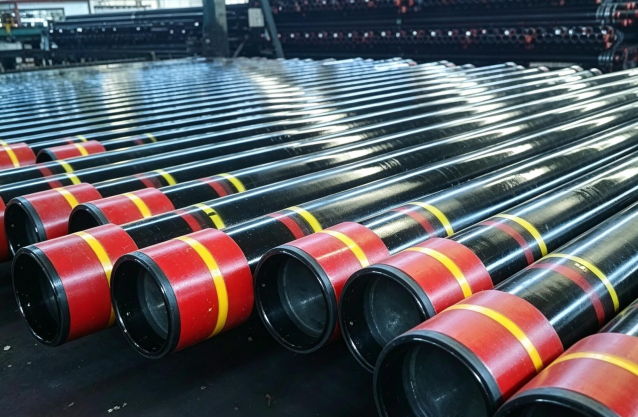
● L80 Casing: A sour service grade with a yield strength of 80,000–95,000 psi. Its key feature is controlled hardness (≤23 HRC), which provides resistance to sulfide stress cracking. L80 is available in three types: L80-1 (standard), L80-9Cr, and L80-13Cr. The 9Cr and 13Cr versions offer higher corrosion resistance for severely corrosive wells, but they are more expensive and harder to produce.
The table below summarizes the key performance differences. Use it as a quick reference for initial grade screening.
| Property | P110 | L80 | T95 |
|---|---|---|---|
| Yield Strength | 110,000–140,000 psi | 80,000–95,000 psi | 95,000–110,000 psi |
| Tensile Strength | ≥125,000 psi | ≥95,000 psi | ≥105,000 psi |
| Heat Treatment | Quenched & Tempered | Quenched & Tempered | Quenched & Tempered |
| Hardness Limit | Not specified for SSC | ≤23 HRC | ≤25.4 HRC |
| H₂S Resistance | No | Yes (SSC resistant) | Yes (SSC resistant) |
| Typical Application | Deep wells, high pressure, no H₂S | Sour wells with H₂S | Deep, high-pressure sour wells |
| Cost | Higher | Moderate | Moderate to high |
● The well is deep and requires higher collapse or tensile strength than L80 can provide.
● No H₂S is present, so L80's sour service advantage is not needed.
● Higher strength allows thinner wall or smaller OD, saving cost on pipe and installation.
In short: P110 is for strength, L80 is for corrosion resistance.
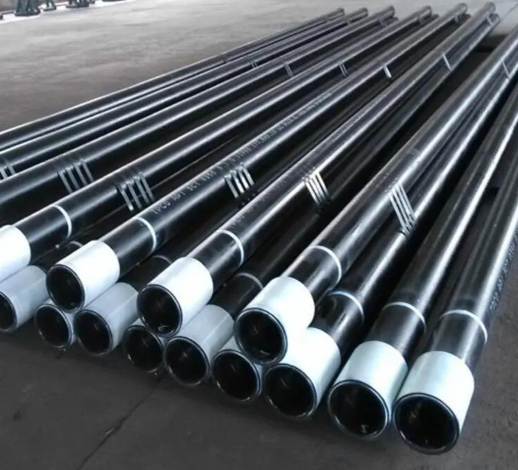
Note: In H₂S environments, never substitute P110 for L80 without testing.
The strength of T95 casing falls between that of L80 and P110, while retaining the excellent sour service (sulfide-resistant) performance of L80. For deep, high-pressure wells containing H₂S, T95 is the standard choice when L80 lacks sufficient strength and P110 cannot be used safely. If your well is both deep and located in a sour environment, T95 is often the ideal solution.
| Well Condition | Recommended Grade |
|---|---|
| Shallow, low pressure, no H₂S | J55 / K55 |
| Medium depth, conventional pressure, no H₂S | N80 |
| Medium depth, H₂S present | L80 |
| Deep, high pressure, no H₂S | P110 |
| Deep, high pressure, H₂S present | T95 or L80 |
Q1: Can T95 replace P110?
A: Not in non-sour wells where P110's higher strength is needed. But in sour wells, T95 is preferred over P110 because P110 lacks H₂S resistance.
Q2: What is the difference between T95 and L80?
A: T95 has higher yield strength (95,000–110,000 psi vs 80,000–95,000 psi) but similar sour service resistance. T95 is used when L80 strength is insufficient for deep, high-pressure sour wells.
Q3: What is the maximum well depth for L80?
A: L80 is typically used up to about 4,000–5,000 m, depending on wall thickness and safety factors. Beyond that, T95 or P110 may be required.
Q4: Can T95 be used in non-sour wells?
A: Yes, but it is usually not cost-effective. In non-sour wells, P110 offers higher strength at similar or lower cost.
Q5: What is NACE MR0175?
A: NACE MR0175 is the standard that defines requirements for sulfide stress cracking-resistant materials used in H₂S-containing oil and gas wells. L80 and T95 are compliant with this standard.
Related articles:
● Drilling Casing Pipe Specifications and Dimensions
● Casing Pipe vs. Drill Pipe Differences
● API 5CT Casing Grades: Full Comparison
● API 5CT Casing & Tubing – Grades, Connections, and Dimensions
Related information
Copyright @2017 Hunan Standard Steel Co.,Ltd and Husteel Industry Group All Rights Reserved