sales@hu-steel.com
 English
 Español

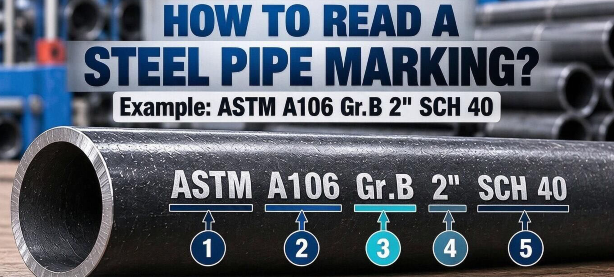
Take a look at this common example: ASTM A106 Gr.B 2" SCH 40. It look likes a random string of letters and numbers, but every character conveys critical information.
The markings stenciled onto the surface of a steel pipe serve as its "ID card." These markings are not applied arbitrarily; rather, they contain critical information, including the manufacturer, material grade, applicable standards, dimensions, and the heat/batch number. Failure to interpret or verify these markings could expose you to the risk of accepting non-compliant materials.
Below, we break down the most common steel pipe markings and show you exactly how to verify them against your paperwork before accepting delivery.
A typical steel pipe marking looks like this: ASTM A106 Gr.B 2" SCH 40. Let's explain what each component means:
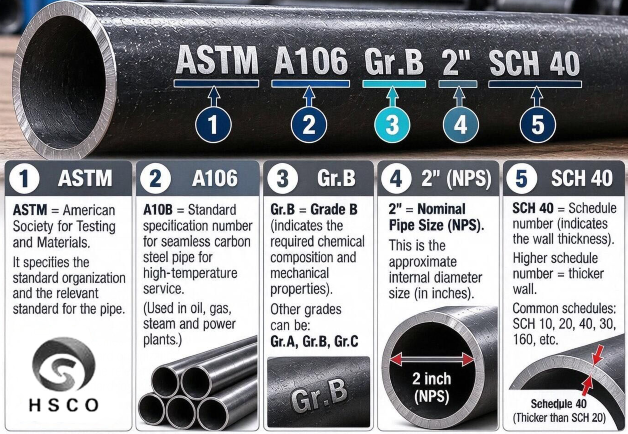
Here is what each section means:
| The Code | What It Means | Why You Should Care |
|---|---|---|
| ASTM | American Society for Testing and Materials. | Tells you which rulebook the mill was following. |
| A106 | The specific standard for seamless carbon steel pipe for high-temperature service. | Proves it's designed for high-heat environments (like boilers), unlike standard A53. |
| Gr.B | The material grade. | Grade B dictates the exact chemical makeup and pressure limits. |
| 2" | Nominal Pipe Size (NPS). | The rough internal diameter. Make sure it fits your system. |
| SCH 40 | The wall thickness schedule. | SCH 40 is standard thickness. Seeing SCH 40 here instead of SCH 80 means immediate rejection for high-pressure jobs. |
Beyond the basic size and grade, a compliant pipe must carry traceability codes. Here is what else you will see:
● Manufacturer's Logo/Name: Identifies the mill that produced the pipe (e.g., HSCO).
● Heat Number (e.g., HEAT NO. 3510103791): It is the sequence number of the furnace during smelting. It allows you to trace the precise chemical composition and mechanical property test results for that specific heat.
● Lot Number / Batch Number: Used for logistics and shipping bundles. (Do not confuse this with the Heat Number!)
● Special Markings:
PSL1 / PSL2: In API 5L, PSL2 requires stricter testing and chemistry limits than PSL1.
NACE MR0175: Indicates the pipe is suitable for sour service (H₂S environments).
Heat Treatment (N, Q, T): Indicates Normalizing, Quenching, or Tempering.
Q1: What if the markings are missing or unreadable?
A: Do not accept the material. If you cannot trace the heat number, the pipe is essentially scrap. You must contact the supplier immediately to resolve the issue before installation.
Q2: Are all these markings spray-painted?
A: Not necessarily. While most size and standard markings are spray-painted (inkjet), critical identifiers like the Heat Number and Manufacturer's Logo are often hard-stamped (engraved) into the steel to ensure they cannot be easily erased.
Q3: Can I paint over the pipe markings?
A: You can apply anti-corrosion paint over the pipe, but you must photograph and record all existing markings before doing so. Ensure that your records allow for the original markings to remain traceable.
▶ Email: sales@hu-steel.com (Subject: Steel Pipe Inquiry)
Related information
Copyright @2017 Hunan Standard Steel Co.,Ltd and Husteel Industry Group All Rights Reserved