sales@hu-steel.com
 English
 Español


Rectangular tube sizes are defined by three primary dimensions: outside height (A or H) × outside width (B) × wall thickness (t). These profiles are available in both metric (mm) and imperial (inch/gauge) standards to meet different global project requirements.
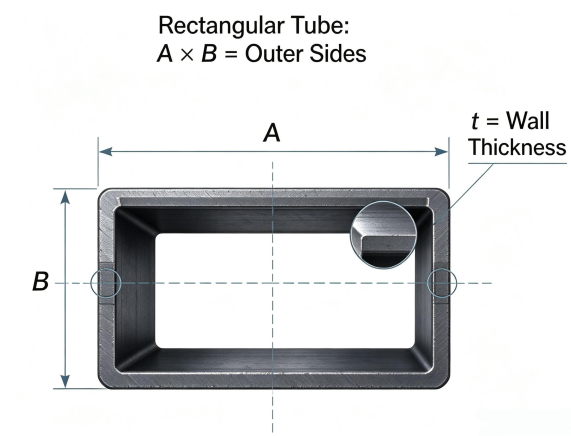
As a global supplier, this guide covers standard dimensions, wall thickness ranges, nominal weights, gauge conversions, and recommended sizes for various applications to help engineers, fabricators, and purchasers select the right product efficiently.
Depending on the destination market, rectangular tubes are manufactured and specified under different international standards. The table below summarizes the typical size ranges for the most common global standards:
| Standard System | Typical Size Range | Typical Wall Thickness | Primary Market |
|---|---|---|---|
| Metric (EN 10219 / EN 10210) | 40×20 mm – 400×200 mm | 1.5 mm – 16.0 mm | Europe, Middle East, Asia, Africa, South America |
| Metric (GB/T 6728) | 40×20 mm – 400×200 mm | 1.5 mm – 16.0 mm | China and global projects |
| Imperial (ASTM A500) | 1" × 2" – 12" × 8" | 0.065" – 0.625" | North America, Australia |
Note: The metric system uses standard millimeter sizing, while the ASTM A500 system uses inch fractions and gauge numbers. The most common sizes globally include 50×25, 60×40, 80×40, and 100×50 mm.
Below are the standard rectangular tube dimensions, their nominal theoretical weights, and the estimated weight per 6-meter bar. All weights are calculated based on carbon steel density (7.85 g/cm³).
| Size (mm) | Wall Thickness (mm) | Weight (kg/m) | Weight per 6m Bar (kg) | Approx. Gauge |
|---|---|---|---|---|
| 40 × 20 | 2.0 | 1.68 | 10.08 | 14 Gauge |
| 40 × 20 | 3.0 | 2.36 | 14.16 | 11 Gauge |
| 50 × 25 | 2.0 | 2.21 | 13.26 | 14 Gauge |
| 50 × 25 | 3.0 | 3.22 | 19.32 | 11 Gauge |
| 50 × 30 | 2.5 | 2.92 | 17.52 | 13 Gauge |
| 60 × 40 | 2.5 | 3.71 | 22.26 | 13 Gauge |
| 60 × 40 | 3.0 | 4.39 | 26.34 | 11 Gauge |
| 60 × 40 | 4.0 | 5.72 | 34.32 | 7 Gauge |
| 80 × 40 | 3.0 | 5.34 | 32.04 | 11 Gauge |
| 80 × 40 | 4.0 | 6.97 | 41.82 | 7 Gauge |
| 80 × 40 | 5.0 | 8.54 | 51.24 | - |
| 100 × 50 | 3.0 | 6.75 | 40.50 | 11 Gauge |
| 100 × 50 | 4.0 | 8.86 | 53.16 | 7 Gauge |
| 100 × 50 | 5.0 | 10.90 | 65.40 | - |
| 120 × 60 | 4.0 | 10.69 | 64.14 | 7 Gauge |
| 120 × 60 | 5.0 | 13.18 | 79.08 | - |
| 120 × 80 | 5.0 | 14.80 | 88.80 | - |
| 150 × 100 | 6.0 | 22.30 | 133.80 | - |
| 200 × 100 | 6.0 | 27.00 | 162.00 | - |
| 200 × 100 | 8.0 | 35.40 | 212.40 | - |
| 300 × 200 | 10.0 | 75.00 | 450.00 | - |
| 400 × 200 | 12.0 | 105.00 | 630.00 | - |
(Note: The "Approx. Gauge" column is for quick reference only. Custom sizes and special wall thicknesses are available upon request.)
For North American projects that specify rectangular tubing in inches or gauge numbers, the following tables provide quick equivalents.
| Metric Size (mm) | Approximate Inch Size (in) | Common Imperial Designation |
|---|---|---|
| 40 × 20 | 1.57" × 0.79" | 1.5" × 0.75" |
| 50 × 25 | 2" × 1" | 2" × 1" |
| 60 × 40 | 2.36" × 1.57" | 2.5" × 1.5" |
| 80 × 40 | 3" × 1.5" | 3" × 1.5" |
| 100 × 50 | 4" × 2" | 4" × 2" |
| 120 × 60 | 5" × 2.5" | 5" × 2.5" |
| 150 × 100 | 6" × 4" | 6" × 4" |
| 200 × 100 | 8" × 4" | 8" × 4" |
| Gauge | Wall Thickness (mm) | Wall Thickness (inch) |
|---|---|---|
| 16 Gauge | 1.52 | 0.06 |
| 14 Gauge | 1.90 | 0.075 |
| 13 Gauge | 2.28 | 0.09 |
| 11 Gauge | 3.05 | 0.12 |
| 10 Gauge | 3.40 | 0.134 |
| 7 Gauge | 4.55 | 0.179 |
11
Related information
Copyright @2017 Hunan Standard Steel Co.,Ltd and Husteel Industry Group All Rights Reserved