sales@hu-steel.com
 English
 Español

Choosing the wrong pipe material for a critical project can lead to premature failure, safety risks, or unnecessary cost overruns. This article helps you understand the essential differences between seamless alloy steel pipes and seamless carbon steel pipes, so you can make an accurate decision. The two differ significantly in material composition, mechanical properties, manufacturing processes, applications, and cost.
Seamless alloy steel pipe: A small amount of alloying elements such as chromium, nickel, tungsten, molybdenum, etc. are added to carbon steel to improve its performance. The content and proportion of these alloying elements can be adjusted according to specific uses and requirements. Alloying elements are added in varying proportions depending on the application. Typical materials include low-alloy steels such as 15CrMo and 12Cr1MoV, as well as high-alloy steels such as P91/P92, 304/316 stainless steel, and ASTM A333 Gr.6.
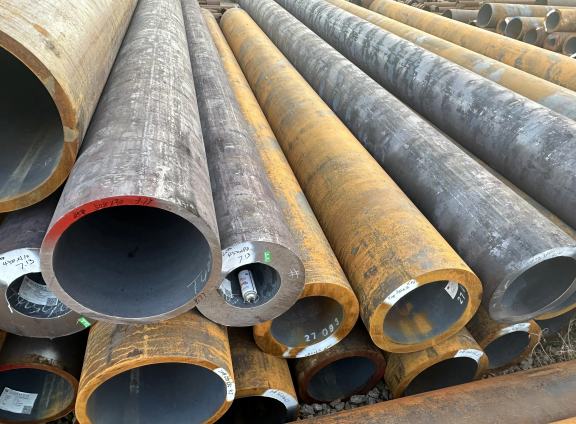
Seamless carbon steel pipe: Mainly composed of carbon and iron, its carbon content will affect its mechanical properties and processing properties. According to the different carbon content, carbon steel seamless steel pipes can be divided into low carbon steel, medium carbon steel and high carbon steel. Carbon steel contains only trace amounts of alloying elements such as Mn and Si, and typical materials are: 20#, 45#, Q235, ASTM A106, ASTM A53, etc.
The table below summarizes the key performance differences. Alloy steel pipes offer clear advantages in strength, temperature resistance, and corrosion resistance, but at a higher cost.
| Property | Seamless Alloy Steel Pipe | Seamless Carbon Steel Pipe |
|---|---|---|
| Yield Strength | ≥ 300 MPa (up to 415+ MPa for P91) | 235 ~ 355 MPa |
| Tensile Strength | 550 ~ 1000 MPa (or higher) | 370 ~ 600 MPa |
| Temperature Resistance | Up to 600°C+ (Cr-Mo steel); down to -196°C (9Ni) | ≤ 350°C for long-term service |
| Corrosion Resistance | Excellent (especially stainless & Cr-Mo) | Poor; requires galvanizing or coating |
| Cost (Reference) | High (approx. 2-4x carbon steel) | Economical (bulk commodity pricing) |
Seamless alloy steel pipe: The manufacturing process involves hot rolling (extruded seamless steel pipe) and cold drawing (rolling) seamless steel pipe. The required performance is obtained by adding alloy elements and corresponding heat treatment processes. The heat treatment process is complex, such as quenching + tempering, solution treatment, etc. During smelting, the alloy composition needs to be precisely controlled (such as vacuum degassing). Key standards include ASTM A335, A213, A312, and GB5310.
Seamless carbon steel pipe: Mainly manufactured by perforated hot rolling method. Sometimes the hot-processed pipe needs to be further cold-processed (cold-rolled/cold-drawn) to obtain the corresponding shape and size. The heat treatment process is simple, such as normalizing, annealing, etc. During smelting, ordinary converter/electric furnace smelting is sufficient. Key standards include ASTM A106, A53, and GB3087.
The table below highlights the typical application differences between seamless alloy steel pipes and seamless carbon steel pipes.
| Industry | Seamless Alloy Steel Pipe | Seamless Carbon Steel Pipe |
|---|---|---|
| Oil & Gas | High-pressure, corrosive media (H₂S), drilling pipelines | General fluid transport (water, oil, gas) |
| Power Plants | Boiler tubes, superheaters (15CrMoG, P91) | Low-pressure HVAC pipelines |
| Chemical | Reactors, heat exchangers (316L) | Non-critical structural supports |
| Aerospace | Hydraulic pipes, gun barrels, engine components | Building scaffolding, mechanical frames |
| Low Temperature | LNG storage and transport (9Ni, A333 Gr.6) | Not suitable |
In short, alloy steel pipes are preferred for extreme conditions (high temperature, high pressure, corrosion), while carbon steel pipes are the economical choice for general service.
Seamless alloy steel pipe:
Raw material cost is high, and alloying elements such as nickel and molybdenum are expensive. Processing costs are also high, requiring special heat treatment and testing. The market price is typically 2–4 times that of carbon steel pipes, depending on the alloy composition.
Seamless carbon steel pipe:
Carbon steel is a bulk commodity with a stable market price. Processing costs are low, the process is mature, and production efficiency is high. It is the most economical choice for standard applications.
| Scenario | Recommended Pipe Type |
|---|---|
| High temperature (>350°C) | Seamless alloy steel pipe (such as petrochemical, electric power, aerospace) |
| High pressure (>10MPa) | Seamless alloy steel pipe |
| Strong corrosion (acid/alkali/H₂S) | Seamless alloy steel pipe |
| Extreme low temperature (LNG) | Seamless alloy steel pipe |
| Normal pressure/temperature, limited budget | Seamless carbon steel pipe (such as construction and general machinery) |
| General fluid transport, structural support | Seamless carbon steel pipe |
Seamless alloy steel pipes have obvious advantages in performance and adaptability to special environments, but the cost is relatively high; seamless carbon steel pipes are economical and practical and suitable for normal needs. When choosing, it is necessary to comprehensively evaluate the working conditions, life requirements and budget.
Hunan Standard Steel Co., Ltd. (HSCO) provides a full-process service for steel pipe products, from material selection and technical consultation to on-stock shipping.
Need help choosing between alloy and carbon steel pipes? Contact our technical team for customized solutions within 24 hours.
Email: sales@hu-steel.com
Read more:
● Introduction to Alloy Steel Pipe
● ASTM A335/A335M Seamless Alloy Steel Pipe
● Seamless Steel Pipe Sizes and Weights Chart
● Alloy Seamless Steel Pipe: Grades, Standards & Applications
● Carbon steel tube vs Stainless steel tube: Which One to Choose?
Related information
Copyright @2017 Hunan Standard Steel Co.,Ltd and Husteel Industry Group All Rights Reserved