sales@hu-steel.com
 English
 Español

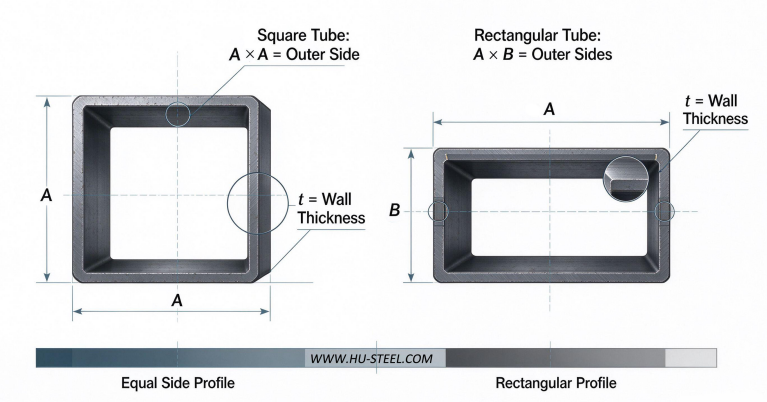
Square tube sizes are defined by three primary dimensions: outside width/height (A × A), wall thickness, and length. These profiles are available in both metric (mm) and imperial (inch) standards to meet different global project requirements.
As a global supplier, this guide covers standard dimensions, wall thickness ranges, nominal weights, dimensional tolerances, and recommended sizes for various applications to help engineers, fabricators, and purchasers compare options and select the right product efficiently. Actual availability and load capacity depend on the applicable standard (e.g., ASTM A500, EN 10219), material grade, and specific design requirements.
Depending on the destination market, square tubes are manufactured and specified under different international standards. The table below summarizes the typical size ranges for the most common global standards:
| Standard System | Typical Sizes | Typical Wall Thickness | Primary Market |
|---|---|---|---|
| Metric (EN 10219 / EN 10210) | 20×20 mm – 500×500 mm | 1.2 mm – 20.0 mm | Europe, Middle East, Asia, Africa, South America |
| Metric (GB/T 6728) | 20×20 mm – 500×500 mm | 1.0 mm – 20.0 mm | China and global projects |
| Imperial (ASTM A500) | 1/2" × 1/2" – 20" × 20" | 0.065" – 0.625" | North America, Australia |
Note: 500×500 mm is the standard upper limit for cold-formed metric SHS. In the ASTM A500 system, the maximum square dimension is 20" × 20" (approx. 508 mm), which corresponds closely to the 500 mm metric size.
Metric sizes are widely used in Europe, Asia, Australia, and international engineering projects. The table below provides commonly available metric sizes.
To help you locate sizes faster, we have grouped them into Small, Medium, and Large classes in the left-hand column. Weights are calculated based on standard section geometry, accounting for corner radii, with a steel density of 7.85 g/cm³.
| Size Class | Size (mm) | Wall Thickness (mm) | Nominal Weight (kg/m) |
|---|---|---|---|
| Small Sizes | 20 × 20 | 1.6 | 0.89 |
| 20 × 20 | 2.0 | 1.12 | |
| 25 × 25 | 1.5 | 1.06 | |
| 25 × 25 | 2.0 | 1.43 | |
| 30 × 30 | 2.0 | 1.68 | |
| 30 × 30 | 3.0 | 2.51 | |
| 40 × 40 | 1.6 | 1.94 | |
| 40 × 40 | 2.0 | 2.40 | |
| Medium Sizes | 50 × 50 | 2.0 | 3.03 |
| 50 × 50 | 3.0 | 4.47 | |
| 60 × 60 | 3.0 | 5.40 | |
| 60 × 60 | 4.0 | 7.10 | |
| 75 × 75 | 3.0 | 6.80 | |
| 80 × 80 | 4.0 | 9.61 | |
| 100 × 100 | 4.0 | 12.12 | |
| 100 × 100 | 6.0 | 17.89 | |
| Large Sizes | 120 × 120 | 5.0 | 18.16 |
| 150 × 150 | 6.0 | 27.40 | |
| 150 × 150 | 10.0 | 44.80 | |
| 200 × 200 | 8.0 | 48.88 | |
| 250 × 250 | 10.0 | 76.80 | |
| 300 × 300 | 10.0 | 92.82 | |
| 400 × 400 | 16.0 | 196.20 | |
| 500 × 500 | 12.5 | 193.50 | |
| 500 × 500 | 16.0 | 246.20 |
(Note: Custom cut lengths and special wall thicknesses are available upon request. The weights listed above are nominal and may vary slightly due to manufacturing tolerances.)
👉 Looking for the official SABS/SANS 657 Part 1 standard dimensions?
[Download the complete SANS 657 Square Tube Size Chart (PDF)] for exact South African standard specifications.
Imperial sizes are standard in North America. The most common grades are ASTM A500 Grade B and Grade C. Weights are theoretical and calculated based on standard corner radii.
| Size (in) | Wall Thickness (in) | Nominal Weight (lbs/ft) | Standard Length (ft) |
|---|---|---|---|
| 1" × 1" | 0.065 | 0.83 | 20 / 24 |
| 1" × 1" | 0.120 | 1.44 | 20 / 24 |
| 1-1/2" × 1-1/2" | 0.065 | 1.27 | 20 / 24 |
| 1-1/2" × 1-1/2" | 0.120 | 2.25 | 20 / 24 |
| 2" × 2" | 0.065 | 1.71 | 20 / 24 / 40 |
| 2" × 2" | 0.120 | 3.07 | 20 / 24 / 40 |
| 2" × 2" | 0.188 | 4.64 | 20 / 24 / 40 |
| 3" × 3" | 0.120 | 4.70 | 20 / 24 / 40 |
| 3" × 3" | 0.188 | 7.20 | 20 / 24 / 40 |
| 3" × 3" | 0.250 | 9.36 | 20 / 24 / 40 |
| 4" × 4" | 0.120 | 6.75 | 20 / 24 / 40 / 48 |
| 4" × 4" | 0.188 | 9.76 | 20 / 24 / 40 / 48 |
| 4" × 4" | 0.250 | 12.76 | 20 / 24 / 40 / 48 |
| 4" × 4" | 0.375 | 18.50 | 20 / 24 / 40 / 48 |
| 6" × 6" | 0.188 | 14.87 | 20 / 24 / 40 / 48 |
| 6" × 6" | 0.250 | 19.57 | 20 / 24 / 40 / 48 |
| 6" × 6" | 0.375 | 28.71 | 20 / 24 / 40 / 48 |
| 8" × 8" | 0.250 | 26.37 | 20 to 48 |
| 8" × 8" | 0.375 | 38.92 | 20 to 48 |
| 8" × 8" | 0.500 | 51.05 | 20 to 48 |
| 10" × 10" | 0.250 | 33.18 | 20 to 48 |
| 10" × 10" | 0.375 | 49.13 | 20 to 48 |
| 10" × 10" | 0.500 | 64.66 | 20 to 48 |
| 12" × 12" | 0.250 | 39.99 | 20 to 48 |
| 12" × 12" | 0.375 | 59.34 | 20 to 48 |
| 12" × 12" | 0.500 | 78.27 | 20 to 48 |
Dimensional tolerances ensure interchangeability and fabrication accuracy. The applicable standard dictates the allowable deviation.
| Item | ASTM A500 | EN 10219 |
|---|---|---|
| Outside Dimensions | ±1% (or ±0.020", whichever is greater) | ±1% |
| Wall Thickness | ±10% | ±10% |
| Straightness | 1/8 in per 5 ft | 0.2% of total length |
| Squareness (Corners) | 90° ± 1.5° | 90° ± 1.5° |
| Mass Tolerance | -3.5% | -3.5% |
Note: EN 10219 also specifies a local straightness limit of max 3 mm over any 1 m length.
Square tubes (SHS) have equal side lengths (such as 50 × 50 mm), providing balanced strength in both directions, making them ideal for general structural applications. In contrast, rectangular tubes (RHS) have different width and height dimensions (such as 50 × 100 mm), offering greater flexibility in directional load-bearing, especially where higher stiffness is required along one axis (e.g., beams). 👉 Read our full engineering comparison: [Square vs. Rectangular Tube for Load-Bearing].
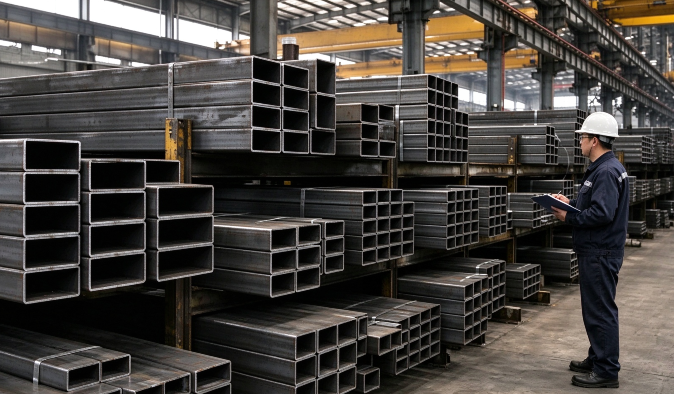
The most suitable square tubing size depends on the finished product's geometry, required stiffness, applied loads, and fabrication method. Here is a detailed guide to help you select the right size:
● 1" × 1" Square Tubing (25×25 mm)
A compact profile commonly used for furniture frames, display structures, small equipment supports, and light fabrication. When selecting this size, compare the wall thickness and material grade instead of relying on the outside dimensions alone. Thin-wall tubing is appropriate for lightweight assemblies, while more demanding applications may require a thicker wall.
● 2" × 2" Square Tubing (50×50 mm)
Commonly used in equipment frames, racks, fabricated supports, and general industrial assemblies. Its suitability depends on the unsupported length, applied load, and acceptable deflection. For load-bearing applications, verify the relevant section properties and structural design requirements before finalizing the specification.
● 3" × 3" and 4" × 4" Square Tubing (75×75 mm to 100×100 mm)
Used for larger equipment frames, support assemblies, platforms, and structural fabrication. Larger outside dimensions can improve section stiffness, but final performance depends on the material grade, wall thickness, and connection details. A larger tube is not automatically the most economical choice for every project.
● Large Square Tubing (≥200×200 mm)
Specified for industrial facilities, building frames, and heavy infrastructure. Do not select large sections based solely on outside dimensions. Structural members must be checked for strength, stability, and serviceability by a qualified engineer.
The table below provides general recommendations for commonly used square tube sizes in different applications. Final dimensions should always be determined by project requirements and applicable design standards.
| Application | Recommended Size Range | Typical Wall Thickness |
|---|---|---|
| Furniture & Decorative Frames |
20×20 – 40×40 mm (3/4" – 1-1/2") |
1.2 – 2.0 mm (0.065" – 0.083") |
| Handrails, Fences & Guardrails |
30×30 – 50×50 mm (1-1/4" – 2") |
1.5 – 3.0 mm (0.065" – 0.120") |
| Light Machinery Frames & Supports |
50×50 – 100×100 mm (2" – 4") |
3.0 – 6.0 mm (0.120" – 0.250") |
| Structural Columns & Heavy Equipment |
100×100 – 200×200 mm (4" – 8") |
4.0 – 10.0 mm (0.188" – 0.375") |
| Heavy Civil Structures & Bridges |
≥200×200 mm (≥8") |
≥8.0 mm (≥0.375") |
(👉 For our full range of rectangular tube (RHS) dimensions, please refer to our RHS size chart or contact our technical team.)
Q1: What is the largest standard size for a square tube?
A: In the metric system (EN 10219), the largest standard cold-formed size is 500×500 mm. In the imperial system (ASTM A500), the maximum standard size is 20"×20" (approx. 508 mm). Larger custom sizes can be manufactured upon request.
Q2: Can you supply custom lengths and wall thicknesses?
A: Yes. We offer standard lengths of 6m, 9m, or 12m (20ft, 24ft, 40ft, 48ft), and custom cutting services. We can also produce non-standard wall thicknesses subject to minimum order quantities.
Q3: What materials and grades do you offer?
A: We supply carbon steel square tubes in grades such as Q235B, Q355B, S235JRH, S355J2H, and ASTM A500 Grade B/C. Stainless steel and other alloy grades are available upon request.
Q4: How do I choose between metric and imperial sizes?
A: Choose metric sizes if your project is in Europe, Asia, or follows EN/GB standards. Choose imperial sizes if your project is in North America or follows ASTM standards. If you are unsure, contact our technical team with your project location and requirements.
Further Reading:
● Steel Hollow Sections: What are HSS, SHS, RHS, and CHS?
● Square and Rectangular Tubes Thickness Selection
● Square & Rectangular Tube HS Code
● Difference between Square Tube and Rectangular Tube
We supply square tubes worldwide, meeting the requirements of EN 10219, ASTM A500, GB/T 6728, and JIS G3466.
To get a fast quote, please provide:
1. Size: Side length × Side length (e.g., 100×100 mm or 4"×4")
2. Wall Thickness: (e.g., 5 mm or 0.250")
3. Material Grade: (e.g., S355J2H or A500 Gr.B)
4. Length: (e.g., 6m or 20ft)
5. Quantity: (e.g., 50 tons or 1000 pieces)
Contact us now:
📧 Email: sales@hu-steel.com
🌐 Website: [www.hu-steel.com]
Our technical team will respond within 24 hours with pricing, availability, and shipping solutions.
Related information
Copyright @2017 Hunan Standard Steel Co.,Ltd and Husteel Industry Group All Rights Reserved