sales@hu-steel.com
 English
 Español
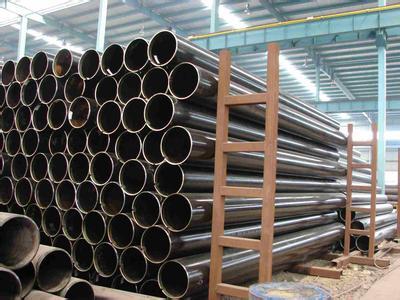
ERW pipe (short for Electric Resistance Welded Pipe) is also known as straight seam resistance welded steel pipe, commonly called resistance welded pipe or high-frequency straight seam welded pipe.
It is a steel pipe made by rolling hot-rolled or cold-rolled steel strip into shape, using high-frequency current resistance heating to heat the edges of the steel strip to the welding temperature, and then applying pressure through extrusion rollers to form the weld seam. Its weld seam is parallel to the pipe body, therefore it belongs to straight seam welded pipe.
Simply put: ERW = Resistance heating + Pressure welding + No filler metal.
|
Item |
ERW |
HFW | LSAW | SMLS |
|
Full Name |
Electric Resistance Welding |
High Frequency Welding |
Longitudinal Submerged Arc Welding |
Seamless Steel Pipe |
|
Weld Type |
Straight seam, no filler metal |
Straight seam, no filler metal |
Straight seam, with welding wire/flux |
No weld seam |
|
Welding Frequency |
Low frequency to high frequency (typically <10kHz) |
High frequency (100~800kHz) |
Low frequency AC |
— |
|
Outer Diameter Range |
21.3~610 mm |
21.3~610 mm |
406~1524 mm |
6~1200 mm |
|
Wall Thickness Range |
1.0~20 mm |
1.0~16 mm |
6~175 mm |
1~200 mm |
|
Applicable Pressure |
Medium and Low Pressure |
Medium and Low Pressure |
High Pressure |
Ultra-High Pressure |
|
Typical Standards |
ASTM A53, API 5L |
API 5L PSL2 |
API 5L, ASTM A381 |
ASTM A106, API 5L |
|
Cost |
Low |
Medium |
High |
Very High |
|
Applications |
Water, Gas, Structural Pipes |
Oil and Gas, Structural Pipes |
Oil and Gas Trunk Lines, Offshore Platforms |
High Temperature and High Pressure Pipelines, Boilers |
△ Key Point: HFW is a special high-frequency form of ERW, but with higher weld quality.
The production process of high-quality ERW steel pipes is strict and highly automated. A typical process is as follows:
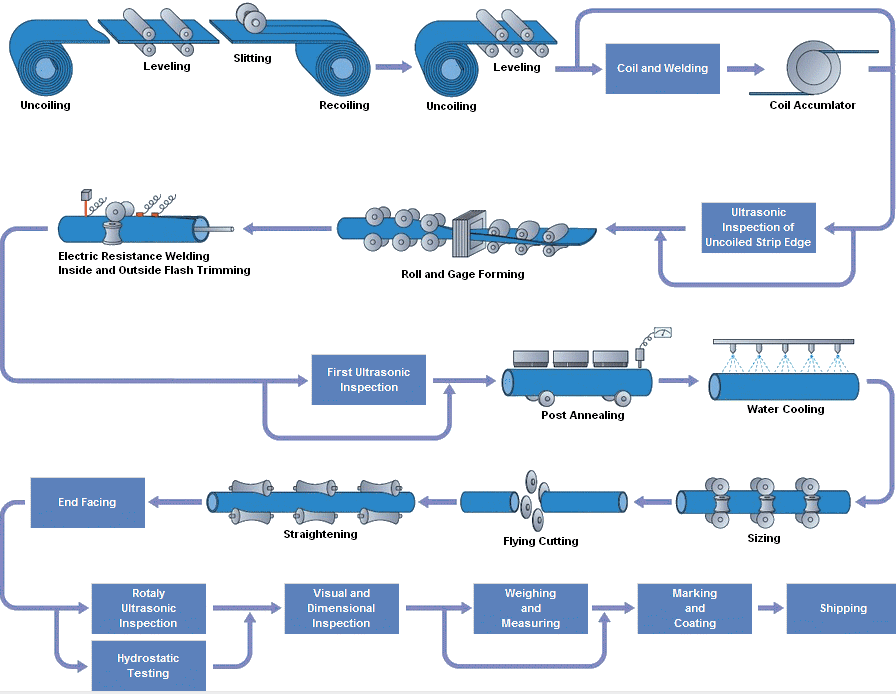
△ Unlike ordinary submerged arc welding, ERW is pressure welding, which does not add welding wire or flux; therefore, the chemical composition of the weld is the same as that of the base metal.
|
Parameters |
Typical Range |
Limiting Range (Custom Orders) |
|
Outer Diameter (OD) |
21.3 mm ~ 610 mm |
≤ 660 mm |
|
Wall Thickness (WT) |
1.0 mm ~ 16 mm |
≤ 20 mm |
|
Length |
6 m / 12 m / 18 m |
As per customer requirements |
|
Steel Grade (API 5L) |
Gr.B, X42, X52, X60, X65, X70 |
X80 (Less common) |
|
Shape |
Round, Square, Rectangular Tube |
Irregular Shape |
|
Standard Number |
Standard Name |
Applicable Scenarios |
|
API 5L PSL1/PSL2 |
Pipeline Steel Specification |
Oil and Gas Transportation (Medium and Low Pressure) |
|
ASTM A53 |
Seamless and Welded Steel Pipe |
Low Pressure Water, Gas, and Steam Piping |
|
ASTM A135 |
Resistance Welded Steel Pipe |
Water, Gas, and Air Transportation |
|
ASTM A500 |
Round/Square/Rectangular Cold-Formed Welded Structural Pipe |
Building and Mechanical Structures |
|
EN 10217 |
Welded Steel Pipe for Pressure Applications |
European Pressure Vessels and Piping |
|
GB/T 3091 |
Welded Steel Pipe for Low Pressure Fluid Transportation |
Water, Gas, Air, and Heating |
△ For the oil and gas industry, API 5L PSL2 + HFW + weld heat treatment is a hallmark of high-quality ERW pipe.
△ERW pipes are suitable for small to medium diameter, low to medium pressure, and cost-sensitive projects; unsuitable for large diameter, high pressure, and highly corrosive environments.
● Agriculture and Engineering: Sprinkler irrigation pipelines, water supply pipes, scaffolding
Q1: Are ERW and HFW the same thing?
A: Not entirely. HFW (High Frequency Welding) is a type of ERW, specifically referring to high-frequency resistance welding with a welding frequency ≥ 100 kHz. HFW welds have a smaller heat-affected zone and higher quality, and are often listed separately in the API 5L standard. All HFW belongs to ERW, but not all ERW is called HFW.Q2: Which is better, ERW pipe or seamless pipe?
A: It depends on the application:Q3: Will ERW welds crack?
A: Qualified ERW pipes (standardized + non-destructive testing + hydrostatic testing) will not crack under rated pressure. After heat treatment, the weld strength can actually reach 90-100% of the base material. Inferior ERW pipes do have a risk of weld cracking.Q4: How to judge the quality of ERW pipes?
A: Check the following four items:Q5: Why do "gray spots" appear on the welds of ERW pipes?
A: Gray spots are oxide inclusions in the center of the weld, caused by:
● Welding temperature being too high or too low
● Insufficient extrusion pressure
● Poor cleanliness of the steel strip edges
Gray spots significantly reduce weld toughness and must be detected and removed by UT (Ultimate Test) inspection.
ERW pipes are the most cost-effective small-diameter, medium- and low-pressure straight seam welded pipes, suitable for a wide range of applications including water, gas, structural, and mechanical applications; HFW is its high-frequency upgraded version, offering higher weld quality and suitable for oil and gas transportation.
For more details on the general manufacturing process and classifications of ERW tube, please refer to our guide:
● What is Electric Resistance Welded Tube?
● API 5L Specification (Official)
● ASTM A53 vs A106 vs API 5L – Comparison Guide
● ERW vs Seamless Pipe: Which One to Choose?
Related information
Copyright @2017 Hunan Standard Steel Co.,Ltd and Husteel Industry Group All Rights Reserved