sales@hu-steel.com
 English
 Español

A Material Test Certificate (MTC, also known as a Mill Test Report or MTR) is the most critical document in steel pipe procurement. It records the actual chemical and mechanical test results for the specific steel being delivered.
However, having an MTC on file isn't enough. Too often, buyers accept material only to discover later that the paperwork doesn't match the physical pipes, leading to failed inspections or rejected shipments.
A valid MTC must connect three things: the purchase order (PO), the specified standard, and the actual physical pipe in your warehouse.
This guide will show you exactly what to look for in a steel pipe MTC and how to cross-verify it field by field before you accept delivery.
Most steel pipe MTCs report a combination of the following fields. While the exact format varies by mill, a qualified certificate must include these core elements:
| MTC Information | What It Tells Buyers | Why It Matters |
|---|---|---|
| Material Grade & Standard | Which specification the material is reported against (e.g., API 5L, ASTM A106) | Confirms if it matches your PO. |
| Heat Number | Material traceability to the specific batch of steel | The most critical field for the "Three-Way Match" with pipe markings. |
| Chemical Composition | Reported chemical analysis (C, Mn, P, S, CE%, etc.) | Proves the steel's metallurgical integrity. |
| Mechanical Properties | Reported yield strength, tensile strength, and elongation | Proves the pipe can withstand the required pressure. |
| Product Size (OD, WT, Length) | Exact measurements and quantity/batch information | Ensures you got the dimensions you paid for. |
| Heat Treatment | Reported treatment condition (e.g., Hot Rolled, Normalized) | Affects the pipe's hardness and toughness. |
| Test Results (Hydro/NDT) | Records of hydrostatic, ultrasonic, or radiographic tests | Proves the pipe is leak-proof and defect-free. |
| Inspection/Approval | QC stamps, signatures, or Third-Party Inspection marks | Validates the document is legally binding (e.g., EN 10204 3.1). |
Here is how these fields look on a real MTC issued by HSCO:
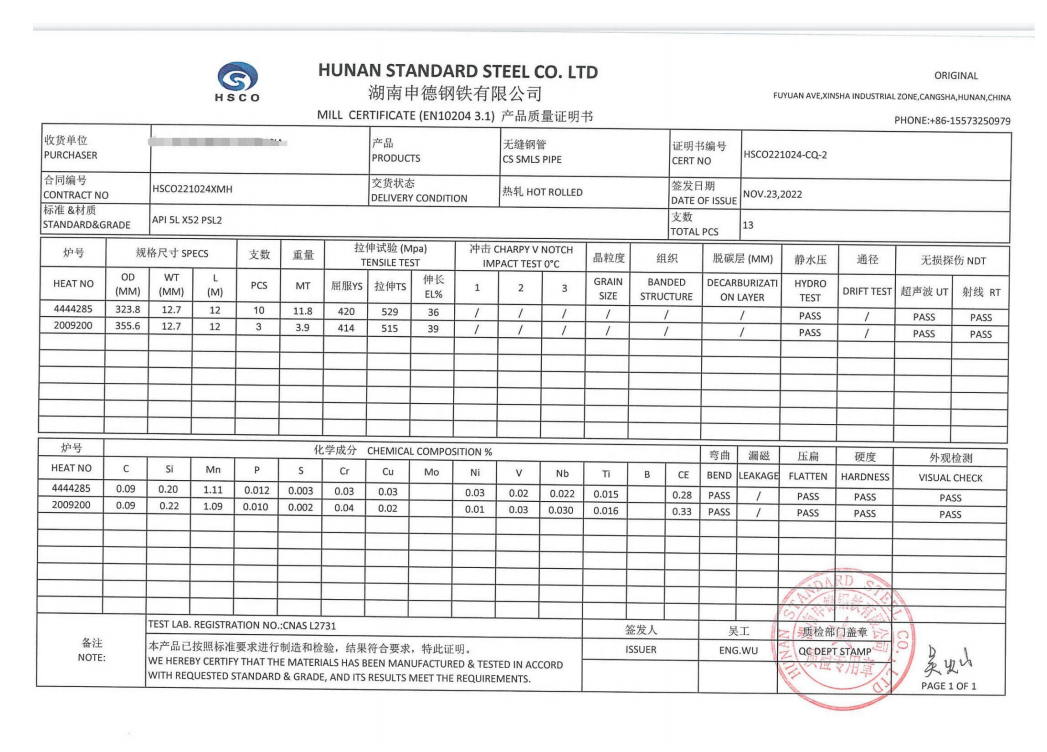
1. Top Header: Verify the Standard (API 5L X52 PSL2) and Delivery Condition (HOT ROLLED).
2. Dimensions & Data: Look at the first row for HEAT NO. 4444285. Check the OD (323.8), WT (12.7), and L (12m).
3. Mechanical Properties: Following the same row to the right, verify the Yield Strength (420 MPa) and Tensile Strength (529 MPa).
4. Chemistry: Look at the bottom section. For HEAT NO. 4444285, verify the Carbon (C: 0.09) and Manganese (Mn: 0.20).
5. Validation: Look at the bottom right corner to confirm the PASS stamps for NDT tests, along with the red QC DEPT STAMP and the Issuer's signature.
Having a document with these fields is step one. The real work is verifying the data. Use this checklist before accepting material:
| Check Item | What to Verify | Action |
|---|---|---|
| Material grade | Does the grade match the purchase order (PO)? | ☐ Pass ☐ Follow up |
| Standard | Does the stated standard and revision match the PO? | ☐ Pass ☐ Follow up |
| Heat number | Is a heat number provided and traceable to the pipe marking? | ☐ Pass ☐ Follow up |
| Chemical composition | Do reported values fall within the specified limits? | ☐ Pass ☐ Follow up |
| Mechanical properties | Are required values reported and consistent with the standard? | ☐ Pass ☐ Follow up |
| Dimensions | Do OD, wall thickness, and length match the order? | ☐ Pass ☐ Follow up |
| Testing | Are required hydrostatic/NDT tests documented and passed? | ☐ Pass ☐ Follow up |
| Certification | Is the document signed/stamped and attributable to the mill? | ☐ Pass ☐ Follow up |
| Standard | Grade | Carbon (max) | Manganese | Silicon (min) | Phosphorus (max) |
|---|---|---|---|---|---|
| ASTM A106 | Gr. B | ≤ 0.30% | 0.29–1.06% | ≥ 0.10% | ≤ 0.035% |
| ASTM A53 | Gr. B | ≤ 0.30% | ≤ 1.20% | No requirement | ≤ 0.05% |
| API 5L | X52 (PSL2) | ≤ 0.28% | ≤ 1.40% | No requirement | ≤ 0.030% |
Verify that the actual test results meet the minimums. For example, for API 5L X52, Yield Strength must be 359–499 MPa, and Tensile Strength must be 455–760 MPa. Do not mix expectations from different standards.
Confirm OD, wall thickness, and length against the order. Distinguish between Nominal Size (what was ordered) and Actual Measured Value (what the pipe is). Check the allowable deviation stated in the applicable standard.
If the order calls for Normalized or Quenched & Tempered, the MTC must state the exact condition. For testing, confirm whether a hydrostatic test was performed, or if it was omitted in favor of NDT.
Buyers often confuse these two documents. They serve different purposes:
| Feature | MTC (Mill Test Certificate) | CoC (Certificate of Conformance) |
|---|---|---|
| Main Purpose | Provides actual test data | Confirms product meets specifications |
| Data Provided | Reports specific chemical & mechanical results | May not provide detailed data |
| Traceability | Includes heat/batch numbers | Depends on the document |
At Hunan Standard Steel Co., Ltd (HSCO), we understand that a certificate is only as good as the mill behind it. We ensure:
1. 100% Traceability: Every pipe carries a heat number directly traceable to our mill records (as shown in Figure 1).
2. Original Documents: We provide digitally signed or original wet-stamped MTCs (EN 10204 3.1). Third-Party Inspection (3.2) can be coordinated upon request.
3. Pre-Shipment Verification: Send us your PO requirements. We cross-check the MTC, pipe markings, and physical dimensions before the material leaves our yard.
Have an MTC from another supplier that you need to verify? Send a redacted copy to our technical team. We offer a free document compliance check to help you avoid costly project rejections.
▶ Email: sales@hu-steel.com (Subject: MTC Verification Request)
Related information
Copyright @2017 Hunan Standard Steel Co.,Ltd and Husteel Industry Group All Rights Reserved