sales@hu-steel.com
 English
 Español

Unsure which API 5L ERW line pipe grade suits your project? The right API 5L ERW line pipe grade depends on four factors: design pressure, temperature, environment, and the media you're transporting.
The table below provides a quick reference:
| Steel Grade | Common Applications |
|---|---|
| X42 / X46 | Low-pressure urban gas and water supply networks, general structural applications |
| X52 | Medium-pressure oil and gas gathering and transmission pipelines, suitable for most conventional onshore pipelines |
| X60 / X65 | High-pressure long-distance transmission trunk lines, suitable for demanding onshore and offshore projects |
| X70 | High-pressure large-diameter trunk lines, commonly used in cold regions or high-specification projects |
Selection Principles: Higher steel grades (X52 → X70) offer greater strength, allowing for thinner wall thicknesses and lighter pipe weights under the same pressure. However, higher steel grades also place stricter requirements on welding processes and quality control.
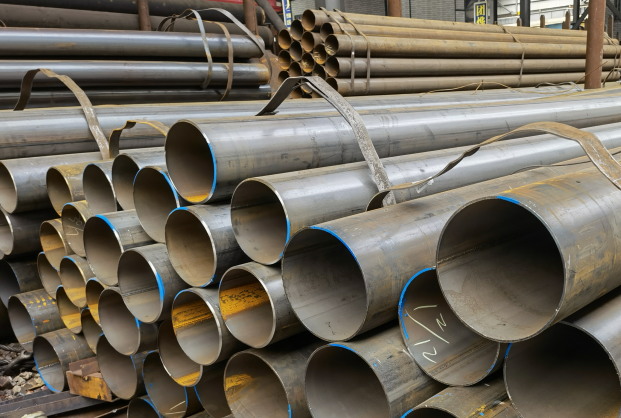
API 5L ERW pipe is manufactured to American Petroleum Institute specifications. These pipelines are used to transport petroleum products and other products along long pipelines. Therefore, pipes must be strong, corrosion-resistant, and wear-resistant.
ERW line pipes are continuously formed from hot-rolled steel strip and longitudinally welded using high-frequency resistance welding. Their chemical composition and mechanical properties meet API 5L and applicable ASTM standards. ERW line pipes are widely used in the oil and gas industry, as well as in pipe piles and cable conduit systems.
● PSL2: More stringent requirements. Includes higher fracture toughness, stricter chemical limits, and mandatory 100% non-destructive testing (NDT). Required for harsh conditions like acidic service (H₂S) and marine environments.
The table below shows the minimum mechanical requirements for common API 5L and ASTM ERW grades. Notice the difference between PSL1 and PSL2: PSL1 only sets a minimum yield and tensile limit, while PSL2 strictly caps both the minimum and maximum values to ensure better toughness and weldability.
| Grade / Standard | Product Level | Min. Yield Strength (psi) | Max. Yield Strength (psi) | Min. Tensile Strength (psi) | Max. Tensile Strength (psi) | Key Applications / Notes |
|---|---|---|---|---|---|---|
| Grade A (ASTM A53) | PSL1 | 30,000 | — | 48,000 | — | Standard / Line / Conduit |
| Grade B (ASTM A53) | PSL1 | 35,000 | — | 60,000 | — | Standard / Line / Conduit |
| Grade B (ASTM A53) | PSL2 | 35,000 | 65,000 | 60,000 | 110,000 | Pressure service |
| X42 | PSL1 | 42,000 | — | 60,000 | — | Low-pressure urban networks |
| X42 | PSL2 | 42,000 | 72,000 | 60,000 | 110,000 | Toughness-demanding applications |
| X52 | PSL1 | 52,000 | — | 66,000 | — | Medium-pressure gathering lines |
| X52 | PSL2 | 52,000 | 77,000 | 66,000 | 110,000 | High-demand transmission |
| X60 | PSL1 | 60,000 | — | 75,000 | — | High-pressure long-distance lines |
| X60 | PSL2 | 60,000 | 82,000 | 75,000 | 110,000 | Severe service conditions |
| X65 | PSL1 | 65,000 | — | 77,000 | — | High-pressure trunk lines |
| X65 | PSL2 | 65,000 | 87,000 | 77,000 | 110,000 | Arctic / offshore projects |
| X70 | PSL1 | 70,000 | — | 82,000 | — | High-pressure large diameter |
| X70 | PSL2 | 70,000 | 90,000 | 82,000 | 110,000 | Extreme environment projects |
| Grade 1 (ASTM A252) | — | 30,000 | — | 50,000 | — | Structural piling |
| Grade 2 (ASTM A252) | — | 35,000 | — | 60,000 | — | Structural piling |
| Grade 3 (ASTM A252) | — | 45,000 | — | 66,000 | — | High-capacity piling |
(Specific values should be verified by your pipeline designers)
● ≤ 4 MPa (City gas, water): X42 or X52 PSL1 is usually sufficient.
● 4 ~ 10 MPa (Medium-pressure gathering): X52 or X60 PSL2 is recommended.
● > 10 MPa (High-pressure trunk lines): X65 or X70 PSL2 is recommended. Here, low-temperature toughness and corrosive environments must be strictly evaluated.
Besides API 5L, ERW line pipes can also be manufactured according to the following standards:
● ASTM A252 (Grade 1/2/3): Specifically for pipe piles and load-bearing structural pile foundations.
● Seamless Pipe: Preferred for ultra-high pressure, small diameter, or ultra-thick walls. (For a detailed cost comparison, see [ERW vs. Seamless Pipe]).
HSCO steel manufactures high-frequency resistance welded (ERW) line pipes from hot-rolled steel strip. Our pipes meet strict API 5L and ASTM standards.
Why buyers choose our ERW line pipes:
● Uniform Dimensions: Continuous cold forming ensures smooth surfaces and uniform wall thickness, making coating and welding easier.
● 100% Testing: Every pipe undergoes online NDT (UT/ET) and hydrostatic testing to guarantee leak-tightness.
● Cost-Effective: High production efficiency for small-to-medium diameters.
(▶ Want to see how the pipes are made? see [ERW Steel Pipe Manufacturing Process].)
Q1: Is there a significant price difference between PSL1 and PSL2?
A: Yes. PSL2 is typically 10%~20% more expensive due to stricter chemical composition control, impact testing, and 100% NDT requirements. However, for high-pressure or sour service, PSL2 is non-negotiable for safety.
Q2: Can you provide third-party inspection?
A: Absolutely. We support SGS, BV, Intertek, and other third-party inspections. All pipes come with a Mill Test Certificate (MTC) and CE documentation (if required).
Q3: What is the difference between API 5L and ASTM A53?
A: ASTM A53 is a general standard for low-pressure fluid and structural pipes. API 5L is specifically for oil and gas pipelines with much stricter mechanical and NDT requirements. (See our [ASTM A53 vs. API 5L comparison]).
You might be interested in the following technical articles related to ERW pipes:
● API 5L PSL2 Pipeline Steel Pipe
Related information
Copyright @2017 Hunan Standard Steel Co.,Ltd and Husteel Industry Group All Rights Reserved