sales@hu-steel.com
 English
 Español
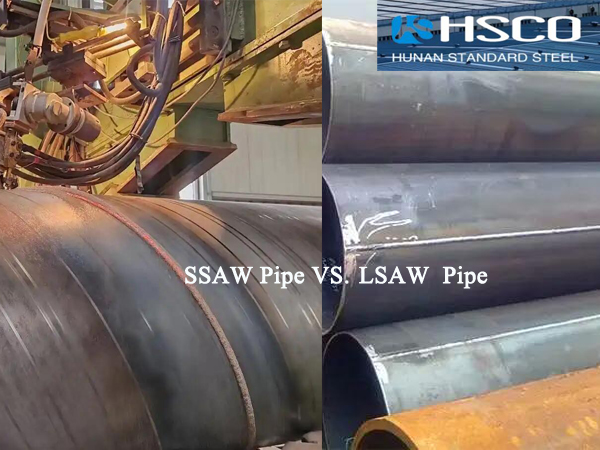
In oil, gas, water transmission, and structural engineering, the selection of large-diameter welded steel pipes is crucial. LSAW (Straight Seam Submerged Arc Welded) pipes and SSAW (Spiral Seam Submerged Arc Welded) pipes are two of the most common large-diameter submerged arc welded pipe products. Although they both use the same welding process, they differ significantly in manufacturing methods, mechanical properties, and application scenarios.
This article will provide an accurate and detailed comparison from a technical perspective, correcting common misconceptions and helping you make the right choice.
1. Manufacturing Process Differences: Straight Seam vs. Spiral Seam
LSAW Pipe: First, the steel plate undergoes edge treatment, then it is gradually pressed into an open cylindrical shape using JCOE or UOE forming processes. The weld seam is a straight line along the longitudinal axis of the pipe, formed by double-sided submerged arc welding.
SSAW Pipe: The steel coil is continuously uncoiled and fed into the forming machine at a certain spiral angle. The welding head forms a spiral weld seam along the length of the pipe. This process can produce very large diameter steel pipes from narrower steel strips.
A common misconception is that SSAW has a higher defect rate due to its longer weld length. For a given length of steel pipe, the weld length of SSAW is 2 to 5 times that of LSAW, statistically increasing the total number of potential defects. However, modern automated ultrasonic testing (AUT) and real-time weld monitoring make both pipe types highly reliable.
5. Size Range and Cost
SSAW pipe is more economical for large diameters, thin walls, and long lengths. LSAW pipe is suitable for thick-walled, high-pressure gas pipelines and acidic or polar service conditions where weld integrity is extremely important. Specific parameter comparisons are as follows:
|
Parameters |
LSAW Steel Pipe |
SSAW Steel Pipe |
|
Diameter Range |
Typically 16″~60″ (406mm~1524mm), maximum up to 72″ |
16″~120″ (406mm~3048mm) or even larger |
|
Wall Thickness |
Up to 2″ (50.8mm) or more |
Typically no more than 0.75″~1″ (19~25mm) |
|
Length |
Typically 40~60 feet (12~18 meters) |
Up to 100 feet (30 meters) or longer |
|
Cost |
Efficiency Higher cost per unit weight, suitable for thick walls |
Lower material cost, allowing for thinner wall thicknesses |
Common standards for LSAW and SSAW include:
ASTM A53 (low pressure), API 5L (high pressure), ASTM A252 (piling pipe), EN 10219 (structural tube).
6. Apllication Selection
Suitable Scenarios for LSAW Steel Pipes:
● High-pressure oil and gas long-distance pipelines (Class 600 and above)
● Acidic service environments (including H₂S)
● Deepwater risers and marine pipelines
● Thick wall requirements (>25mm)
● Scenarios where specifications explicitly require specific stress calculations for longitudinal welds
Suitable Scenarios for SSAW Steel Pipes:
● Water conveyance and irrigation projects
● Medium and low-pressure oil and gas gathering and transportation pipelines
● Structural piles (bridge piers, foundation piles)
● General fluid transportation where cost is the primary driver
● Projects requiring ultra-large diameters (>60″)
Conclusion:
Both LSAW and SSAW steel pipes are proven and reliable products when manufactured to API 5L or equivalent standards. LSAW steel pipes offer superior performance in high-pressure and thick-walled applications, while SSAW steel pipes provide cost-effectiveness and excellent ductility in large-diameter, thin-walled projects. The choice between LSAW and SSAW should be based on a comprehensive consideration of the required diameter, wall thickness, pressure rating, and budget. LSAW is typically specified for critical high-pressure gas pipelines; for water and structural applications, SSAW is often a more economical and technically sound choice.
Read more: Spiral Welded Pipe Material Selection or SSAW Steel Pipe Size Chart
Related information
Copyright @2017 Hunan Standard Steel Co.,Ltd and Husteel Industry Group All Rights Reserved