When choosing the right piping for your project, selecting between
Mild Steel Seamless Pipe and
Welded Pipe is crucial. While both have important applications in various industries such as construction, manufacturing, oil and gas, and automotive, their manufacturing processes, pressure requirements, efficiency, cost, and application scenarios differ significantly.
Choosing the solution best suited to your needs depends on understanding the fundamental differences between Mild Steel seamless pipe and Mild Steel welded pipe. Here are the differences:
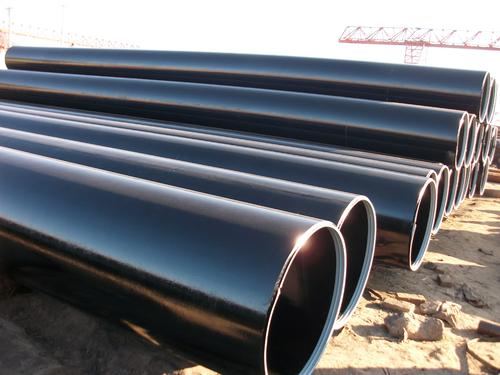
What is Mild Steel Seamless Pipe?
Mild steel (MS) seamless pipe refers to steel pipe made from
low-carbon steel (typically with a carbon content ≤ 0.25%) as raw material. It is manufactured through processes such as heating a solid steel billet, piercing it, and then hot rolling or cold drawing, resulting in a pipe body without any weld seams. It combines the material properties of "low-carbon steel" with the structural advantages of "
seamless pipe."
Features of Mild Steel Seamless Tubes:
1. High Pressure and High Temperature Resistance: With no weak weld seams, they are suitable for high-temperature and high-pressure conditions (e.g., ASTM A106 Gr.B can operate continuously at ≤425°C). Commonly used in boilers, steam pipelines, and petrochemical process pipelines.
2. Uniform Structure and Consistent Strength: The piercing and rolling process ensures a uniform and isotropic structure, eliminating performance abrupt changes caused by weld seams and resulting in extremely high reliability.
3. Smooth Inner Surface: After pickling or cold drawing, hot-rolled tubes have a clean, burr-free inner wall, facilitating fluid transport and reducing media residue. Cold-drawn seamless tubes can achieve a precision inner surface with Ra≤3.2μm.
4. Applicable to Various Applications: Widely used in critical pressure-bearing components, such as hydraulic cylinders, high-pressure oil pipes, power plant boilers, oil well casing (API 5CT), and non-nuclear grade pipelines in nuclear power plants.
5. Wide Size Range: Diameters range from precision cold-drawn tubes of Φ4mm to hot-rolled tubes of Φ660mm and above, with wall thicknesses up to 100mm and above.
6. Good Machining Performance: Can undergo secondary processing such as threading, flaring, bending, and welding to meet complex design requirements.
Typical Standards: ASTM A106, ASTM A53 Type S, API 5L, GB/T 8163, GB 9948
What is Mild Steel Welded Pipe?
Mild Steel (MS) welded pipe is also made from low-carbon steel, produced by rolling steel strips or plates into shape and then welding them together. Due to the good plasticity, toughness, and excellent weldability of low-carbon steel, it is very suitable as the base material for welded pipes.
Features of Mild Steel Welded Pipe:
1. Low price and easy availability: Continuous and efficient production, cost is 30-50% lower than seamless pipes, ample market supply, complete specifications, and short delivery cycle.
2. Suitable for medium and low pressure environments: Suitable for conventional working conditions with a working pressure ≤2.5MPa, such as municipal water networks, fire protection systems, low-pressure gas, and compressed air.
3. Simplified production process for larger diameter steel pipes: Large-diameter pipes (Φ219mm and above) can be produced using spiral submerged arc welding with narrow-width steel strips, resulting in lower equipment investment and higher flexibility.
4. Suitable for structural components and various applications: Widely used in building structures (scaffolding, railings, steel frame structures), mechanical parts (agricultural machinery frames, conveyor rollers), and municipal facilities (streetlight poles, traffic sign poles).
5. High dimensional accuracy: Cold bending and sizing processes result in small outer diameter tolerances and good straightness, facilitating on-site installation and connection.
6. Excellent surface quality: Smooth and flat inner and outer surfaces facilitate the application of anti-corrosion coatings (such as galvanizing, 3PE, epoxy coating).
7. Reliable weld quality: Modern high-frequency welding (ERW) technology ensures weld performance close to that of the base material, with quality guaranteed through online heat treatment and non-destructive testing.
Typical Standards:
ASTM A53 Type E, API 5L, EN 10219, GB/T 3091, GB/T 13793
Seamless Steel Pipe vs. Welded Steel Pipe: Key Differences
1. Strength and Pressure: Seamless steel pipes have higher strength and superior pressure and temperature resistance due to their seamless structure. Welded pipes have weak areas in the weld seam, resulting in lower strength, making them suitable for medium to low pressure applications.
2. Cost: Due to the complex manufacturing process and low yield, seamless pipes are typically 30%-50% more expensive than welded pipes, or even more. Welded pipes have a continuous and efficient manufacturing process with a high yield, making them a highly cost-effective choice.
3. Dimensional Accuracy and Surface Quality: Seamless pipes have rougher inner and outer surfaces and relatively lower precision, but cold-drawn seamless pipes can achieve higher precision. Welded pipes are formed by cold bending high-precision steel strips, resulting in a smooth surface and high dimensional accuracy.
Common Types and Processes:
MS Seamless Pipe Manufacturing Processes include:
● Hot-rolled seamless pipe: Steel billets are heated, pierced, rolled, and sizing. Suitable for medium to large diameters.
● Cold-drawn/cold-rolled seamless pipe: Cold-worked based on hot-rolled pipe, achieving higher dimensional accuracy and surface quality. Suitable for small diameters, thin walls, or high-precision requirements.
MS Welded Pipe Manufacturing Processes include:
●
ERW (High-frequency electric resistance welding): The most mainstream process, utilizing the skin effect and proximity effect of high-frequency current to rapidly heat the edges of the steel strip to a molten state, then pressing them together under the action of extrusion rollers to form a weld. Suitable for manufacturing small to medium diameter, thin-walled steel pipes, such as building scaffolding, furniture pipes, water pipes, fire-fighting pipes, and automotive drive shaft pipes.
● LSAW (Straight seam submerged arc welding): Using steel plates (not steel strips) formed by JCOE or UOE welding, suitable for Φ406-1626mm, with large wall thickness and high pressure resistance, used for high-voltage trunk lines.
●SAWH (Spiral Submerged Arc Welding): This method involves spirally coiling steel strips before welding. Suitable for diameters from Φ219-3000mm, it allows for the production of large-diameter pipes from narrow strips, offering high flexibility and low investment. It is used for medium- and low-pressure, large-diameter transportation.
●Furnace Welding/Continuous Furnace Welding: This is an outdated process, now rarely used. Small-diameter, thin-walled pipes have been completely replaced by high-frequency welded pipes (ERW).
Application:
Common Uses of Mild Steel Seamless Pipes:
High Temperature and High Pressure Conditions: Superheater tubes and steam pipelines in power plant boilers (commonly ASTM A106 standard), process pipelines in the petrochemical industry.
Pressure and Hydraulic Systems: Hydraulic cylinders, high-pressure oil pipes,
casing and tubing in natural gas wells (API 5CT standard).
Precision Mechanical Parts: Bearing sleeves, drive shafts, and other components with strict requirements for reliability and precision.
Common Uses of Mild Steel Seamless Pipes:
Fluid Transportation: Municipal water supply, low-pressure gas, fire sprinkler systems, HVAC systems.
Building Structures: Scaffolding, steel frame structures, guardrails, streetlights.
General Industry: Agricultural irrigation, temporary pipelines, protective covers and supports for machinery and equipment.
Mild Steel Seamless Pipe vs. Welded Pipe: How to Choose?
When the safety factor must be maximized (e.g., high temperature, high pressure, flammable and explosive media), seamless steel pipes are the only and necessary choice.
When the project budget is limited and the operating conditions are general scenarios with normal pressure and temperature, welded steel pipes are a smarter and more economical choice.
Read more: Schedule 80 Carbon Steel Pipe or SCH 40 Black Steel Pipe
 sales@hu-steel.com
 English
 Español