sales@hu-steel.com
 English
 Español
An incorrect choice directly impacts the system's flow distribution, pressure loss, stress distribution, and even the overall project cost. This article will clarify the differences between these two types of tees and how to select the right one, based on the ASME B16.9 standard.
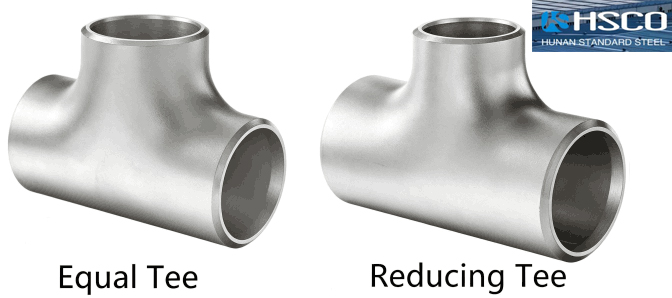
In ASME B16.9, the center distance dimensions C (along the main pipe direction) and M (along the branch pipe direction) of equal diameter tees are usually equal, resulting in symmetrical flow paths and relatively less fluid disturbance at the branch points.
A reducing tee has a branch pipe end size smaller than the main pipe. A common marking is main pipe size × main pipe size × branch pipe size, such as 6″ × 6″ × 4″, indicating a 6-inch main pipe and a 4-inch branch pipe.
Reducing tees are used to branch smaller diameter lines from a larger diameter main pipe. This is more common in industrial piping because most branch lines do not require the same flow capacity as the main pipe. Typical applications include:
● Drawing instrument lines from the main process pipe
● Reducing connections at pump inlets
● Transition connections between pipes of different sizes
The most direct criterion is whether the branch pipe size matches the main pipe size.
● Branch pipe smaller than main pipe → Choose reducing tee
However, key points that need to be considered in engineering selection:
The 90° branch structure of a tee inherently generates turbulence and pressure drop. If the transported medium is corrosive or contains solid particles, the risk of erosion at the branch connection increases significantly. Under the same conditions, the flow field of an equal-diameter tee is more symmetrical, and the risk of localized erosion is relatively lower; while the flow velocity change at the reduction point of a reducing tee is greater, resulting in a higher risk of erosion.
The table below summarizes the key differences between equal and reducing tees, providing a fast reference for selection.
| Feature | Equal Tee | Reducing Tee |
|---|---|---|
| Port Sizes | All three outlets same NPS | Branch outlet is smaller than the run pipe |
| Designation |
NPS × NPS × NPS (e.g., 6×6×6) |
Run × Run × Branch (e.g., 6×6×4) |
| Primary Use | Equal-flow branch connections | Reduced-flow branch connections |
| Flow Symmetry | High | Moderate / Lower |
| Stress Concentration | Lower | Higher (especially at branch junction) |
| Best Application | Headers, manifolds, fire loops | Process branches, pump suction, pipe size transitions |
5. Applicable Standard: Clearly indicate ASME B16.9
Q1: When should I use a reducing tee instead of an equal tee?
A: The choice depends on the branch pipe size. Use an equal tee when the branch pipe is the same size as the main run. Use a reducing tee when the branch pipe is smaller than the main run. A key rule: if the branch size is less than half the run size (e.g., 10″ × 10″ × 4″), consider a branch fitting (Weldolet) instead to reduce stress and cost.
Q2: What are the main differences between an equal tee and a reducing tee under ASME B16.9?
A: The primary differences lie in the center-to-end dimensions and flow characteristics. In an equal tee, the run (C) and branch (M) dimensions are typically the same; in a reducing tee, the branch dimension (M) is often smaller. Additionally, the pressure drop is generally higher in a reducing tee due to the abrupt change in flow area at the branch.
Q3: What is the branch-to-run ratio and why does it matter?
A: The branch-to-run ratio is the comparison between the branch pipe size and the main run (header) size. For a reducing tee, this ratio is always less than 1.0. A key rule is that when the branch size is less than half the run size (i.e., the ratio is below 0.5, e.g., 10″ × 10″ × 4″), a standard reducing tee may not be the best choice. In such cases, the high stress and flow turbulence may make alternatives like a weldolet more suitable. For most other ratios, a reducing tee is perfectly fine and the most cost-effective solution.
In most industrial piping projects, reducing tees are used far more frequently than equal-diameter tees because scenarios requiring full-flow branching are relatively limited. Correctly selecting the tee type not only meets process requirements but also effectively controls costs and ensures the long-term safety of the system.
Related Resources:
● [ASME B16.9 Tee Dimensions]
● [ASME B16.9 Elbow Dimensions]
● [ASME B16.9 Reducer Dimensions]
● [ASME B16.9 Pipe Fitting Standards Guide]
Related information
Copyright @2017 Hunan Standard Steel Co.,Ltd and Husteel Industry Group All Rights Reserved