sales@hu-steel.com
 English
 Español
MS Pipe is short for Mild Steel Pipe, which is a type of steel pipe made from low carbon steel with a carbon content of ≤0.25%. It is the most commonly used steel pipe in construction and general industry due to its excellent weldability, good formability, and low cost.
Key features at a glance:
Carbon content: ≤0.25%
Weldability: Excellent
Formability: Good for bending, stamping, and cold forming
Cost: Low compared to stainless and alloy steel
▶ Not sure what Mild Steel is? 【Learn about MS material properties】
In this guide, we'll cover the benefits, properties, types, specifications, grades, applications, and selection tips for Mild Steel Pipe to help you choose the right product for your project.
【Need a quick answer? Jump to MS Pipe Selection Suggestions】
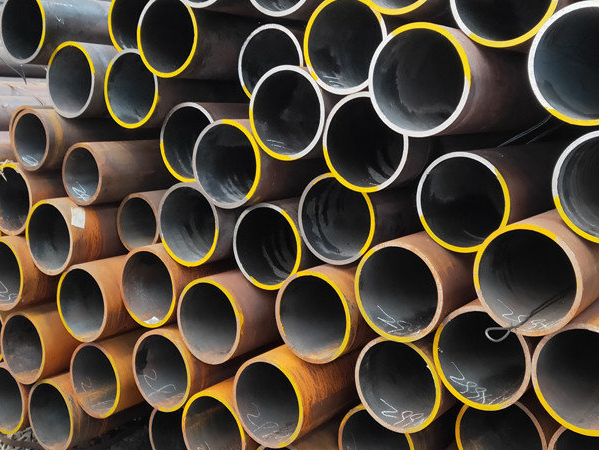
1. Affordability: Mild steel is one of the most cost-effective materials, with low cost stemming from abundant raw materials and efficient production processes.
2. Versatility and Ease of Fabrication: Mild steel can be easily cut, formed, welded, and machined, making it a favorite across industries from construction to household goods.
3. Recyclability: Mild steel is highly recyclable and can be melted down and reused without losing its properties, reducing environmental impact.
4. Strength and Durability: Despite its low carbon content, mild steel provides sufficient strength and durability for a wide range of structural and mechanical applications.
In summary, mild steel pipe is easy to process, weldable, and low cost, making it widely used in construction, machinery, pipelines, and other fields.
Cold Formability and Weldability:
Mild steel pipe annealing organization ferrite and pearlite is lower its strength and hardness, ductility and toughness. Therefore, the cold formability is good and can be crimping, bending, punching and other methods of cold forming. Like that mild steel pipe has good weldability. Carbon content from 0.10 to 0.30% of mild steel is easy to accept all kinds of processing such as forging, welding and cutting, commonly used in the manufacture of chains, rivets, bolts, shafts, etc.
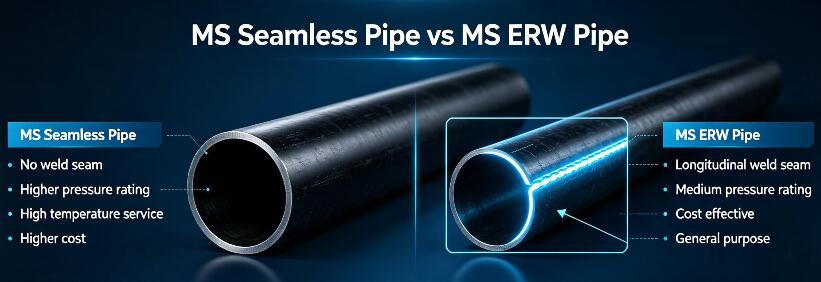
1. Classification by production process
● Mild Steel (MS) seamless pipe: Mild Steel Seamless Pipe is a weldless steel pipe made of low carbon steel ingot or solid pipe billet through perforation, hot rolling, cold rolling or cold drawing. Seamless carbon steel pipe has strong pressure bearing capacity and high price. It is mainly used in machinery, hydraulic, high pressure pipeline, petroleum and chemical fields.
● Mild Steel (MS) welded pipe: High frequency welding (ERW pipe) or submerged arc welding (SAW pipe), low cost. Mainly used for building structure pipes, water pipes, guardrails. 【View detailed MS ERW pipe guide →】
2. Classification by surface treatment
Black steel pipe: no coating, easy to rust, need to be coated with anti-rust paint.
Galvanized pipe (GI Pipe): hot dip galvanized surface, long anti-rust life.
Understanding the specifications and grades of MS pipes is essential for selecting the right product for your project.
| Parameter | Common Range |
|---|---|
| Outside Diameter (OD) | 1/8" – 48" (DN6 – DN1200) |
| Wall Thickness (WT) | 1.5mm – 40mm (SCH 10, SCH 40, SCH 80, etc.) |
| Length | 6m, 12m, or custom cut lengths |
Different standards and grades apply to MS pipes depending on the region and application:
| Standard | Grade | Yield Strength (MPa) | Tensile Strength (MPa) | Typical Application |
|---|---|---|---|---|
| ASTM A53 | Grade A | ≥205 | ≥330 | General piping, low pressure applications |
| ASTM A53 | Grade B | ≥240 | ≥415 | Medium pressure, structural applications |
| ASTM A106 | Grade B | ≥240 | ≥415 | High temperature service, seamless pipe |
| BS 1387 | Class B | — | ≥340 | General engineering, light construction |
| GB/T 3091 | Q195 / Q215 | ≥195 / ≥215 | 315-390 / 335-410 | Low pressure fluid transport, structural |
| Grade | Strength Level | Corrosion Resistance | Weldability | Common Use |
|---|---|---|---|---|
| Grade A | Lower | Similar | Excellent | Low-cost general construction |
| Grade B | Medium | Similar | Excellent | High-strength structural, piping |
| Grade C | Higher | Similar | Good | Heavy-duty structural applications |
| Feature | MS Seamless Pipe | MS ERW Pipe |
|---|---|---|
| Manufacturing | Perforated from solid billet, no weld seam | Formed from steel strips and welded longitudinally |
| Pressure Resistance | High – suitable for high-pressure applications | Lower – suitable for low/medium pressure |
| Size Range | Wider range available | Limited to small and medium diameters |
| Cost | Higher | Lower |
| Common Applications | High-pressure pipelines, hydraulic systems, petrochemical | Building structures, water pipes, general fabrication |
▶【View complete specifications and process guidelines for MS ERW welded pipes 】
The following sections focus on MS seamless pipe. For detailed information on MS welded (ERW) pipe, please refer to our dedicated guide.
1. Mild steel pipe with seamless is a carbon steel with a carbon content of less than 0.25%. It is also called mild steel because of its low strength, low hardness and softness.
2. The annealed structure of mild steel tubing with seamless is ferrite and a small amount of pearlite, which has low strength and hardness, and good plasticity and toughness.4. Mild steel pipe with seamless has good weldability. Easy to accept a variety of processing such as forging, welding and cutting.
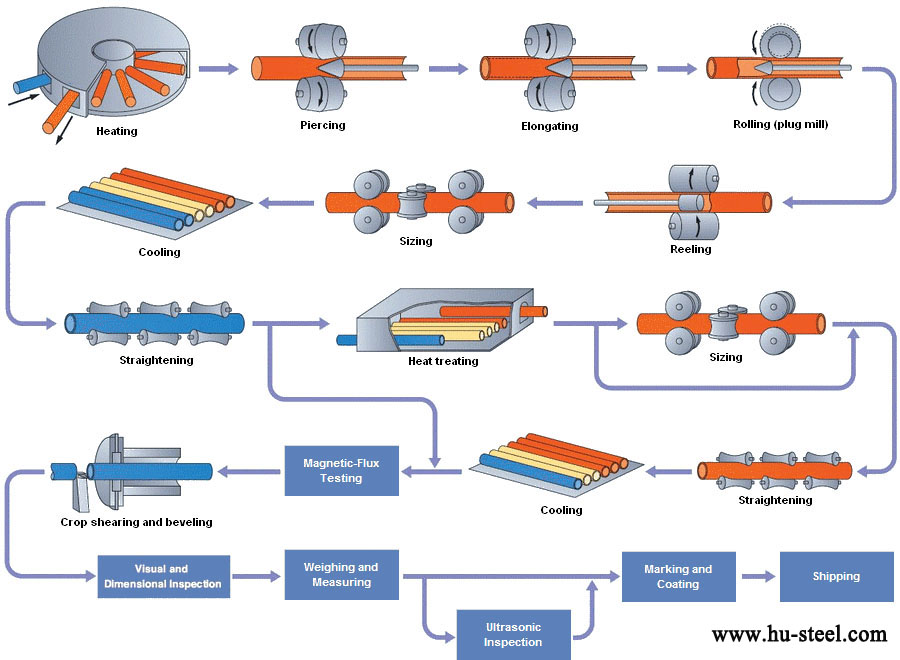
3. After piercing, the round tube billet is successively cross-rolled, continuous rolled or extruded by three rolls. After squeezing, take off the tube and calibrate. The sizing machine uses a tapered drill bit to rotate at a high speed into the steel blank to punch holes to form a steel pipe. The inner diameter of the steel pipe is determined by the length of the outer diameter of the drill bit of the sizing machine.
4. After the steel pipe is sized, it enters the cooling tower and is cooled by spraying water. After the steel pipe is cooled, it will be straightened. After straightening, the steel pipe is sent to the metal flaw detector (or hydraulic test) by the conveyor belt for internal flaw detection. If there are cracks, bubbles, etc. inside the steel pipe, it will be detected.
5. After the quality inspection of steel pipes, strict manual selection is required. After the quality inspection of the steel pipe, paint the serial number, specification, production batch number, etc. with paint. It is hoisted into the warehouse by a crane.
Ordinary mild steel pipe (MS seamless pipe) is for the production of building components, containers, tank, furnace and farm machinery. Quality mild steel pipe is for making car cab, hood and other deep-red products; also rolled into bars, strength requirements for the production of mechanical parts. Before using mild steel pipe is generally not by heat treatment, the carbon content of more than 0.15% by carburizing or cyanide treatment, used to require high surface temperature, wear good shafts, bushings, sprockets and other parts.
Due to the low strength of the low-carbon steel, use is restricted. Appropriate to increase the carbon content of manganese and add trace vanadium, titanium, niobium and other alloying elements, can greatly improve the strength of steel. If you reduce the carbon content of the steel and add a small amount of aluminum, and a small amount of boron carbide forming elements, you can get ULCB set high enough intensity, and maintain good ductility and toughness.
| Scenario | Recommended Option | Reason |
|---|---|---|
| General structure / low-pressure pipeline | Welded MS pipe (Grade A / Q195) | Low cost, adequate strength |
| Outdoor / humid corrosive environment | Galvanized MS pipe (GI Pipe) | Better rust resistance |
| High pressure / precision machinery | Seamless carbon steel pipe (Grade B / A106 Gr.B) | Higher pressure resistance |
| High temperature / high pressure scene | ASTM A106 Gr.B seamless pipe | Suitable for oil, steam pipelines |
| Cost-sensitive structural use | MS ERW Pipe (Grade A / Q215) | More economical |
▶ 【Need help selecting the right MS pipe for your project? Get expert advice and get a quote →】
Note: The following section covers technical details on heat treatment for advanced reference.
Low carbon content of mild steel pipe is very low hardness and poor machinability, normalizing process may improve machinability. Mild steel pipe tends to have a greater timeliness, both quench aging tendencies, as well as a tendency to strain aging.
Quench Aging:
When the rapid cooling from a high temperature steel, ferritic scraping carbon, nitrogen saturation, it can also slow the formation of iron carbonitride was at room temperature, and thus the strength and hardness of steel, the lower the ductility and toughness, a phenomenon called quench aging. Even without quenching and low carbon air cooling will produce aging.
Strain Aging:
Produce large amounts of low-carbon steel by deformation dislocations ferrite from carbon, nitrogen atom elastic dislocation interactions, carbon, nitrogen atom reign gathered around the wrong line. Such a combination of carbon and nitrogen atoms and the dislocation line is called the Coriolis-year-old air mass (Ke lop air mass). It will increase the strength and hardness of steel while reducing ductility and toughness, a phenomenon known as strain aging.
Low carbon steel pipes have greater plasticity and toughness risks than quenching aging deformation, and have obvious upper and lower yield points on the tensile curve. Since the yield on the yield point elongation occurs until the end, appear deformed due to uneven surface with folds formed on the surface of the sample, called Luders band. So many stampings are often scrapped. There are two methods of its prevention. A high pre-deformation method, the pre-deformed steel stamping place after a period of time will produce Luders band, so the pre-deformed steel stamping is placed before the time not too long. Another steel, aluminum or titanium is added to the formation of a stable compound with the nitrogen to prevent the formation of air masses caused by the Coriolis deformation of aging.
Mild Steel Pipe (MS Pipe) is the most commonly used steel pipe in construction and general industry due to its low price and easy processing, but it should be noted that it is easy to rust. In corrosive environment or high load scene, it is recommended to upgrade to galvanized pipe, stainless steel pipe or high-strength alloy steel pipe.
Q1: What is the difference between seamless and welded MS pipe?
A: Seamless pipe is made from solid billet, has no weld seam, and offers higher pressure resistance. Welded pipe is formed from steel strips and welded, with lower cost and suitable for general applications. → [【View full specifications and manufacturing guidelines for MS ERW welded pipes】
Q2: Is mild steel pipe rust proof?
A: No. MS pipe is prone to rusting in humid or corrosive environments. Surface treatment like galvanizing, painting, or oil coating is recommended for outdoor use.
Q3: What is the difference between MS and GI pipe?
A: MS (Mild Steel) pipe is uncoated and prone to rust. GI (Galvanized Iron) pipe is MS pipe coated with zinc, offering better corrosion resistance for outdoor and humid environments.
Q4: What is the carbon content of mild steel pipe?
Mild steel pipe has a carbon content of ≤0.25%, which gives it excellent weldability and formability but lower strength compared to medium or high carbon steels. → [Learn about MS material]
Q5: What sizes are available for MS pipe?
MS pipe is available in sizes from 1/8" to 48" (DN6 – DN1200), with wall thickness ranging from 1.5mm to 40mm (SCH 10, SCH 40, SCH 80, etc.), and lengths of 6m or 12m.
Related Resources:
● Schedule 40 Carbon Steel Pipe
● Seamless Steel Pipe Sizes and Weights
● ERW Pipe Thickness Chart & Sizing Guide
Related information
Copyright @2017 Hunan Standard Steel Co.,Ltd and Husteel Industry Group All Rights Reserved