sales@hu-steel.com
 English
 Español
ASME B16.9 is the industry standard for factory-made wrought butt-welding fittings, covering pipe tees and crosses in sizes from NPS 1/2″ to 48″. This guide provides complete dimensional data for equal tees and reducing tees, along with a brief overview of the straight cross (four-way fitting). It is intended as a quick reference for engineers, fabricators, and procurement specialists working with ASME B16.9 butt-weld tee and cross connections.
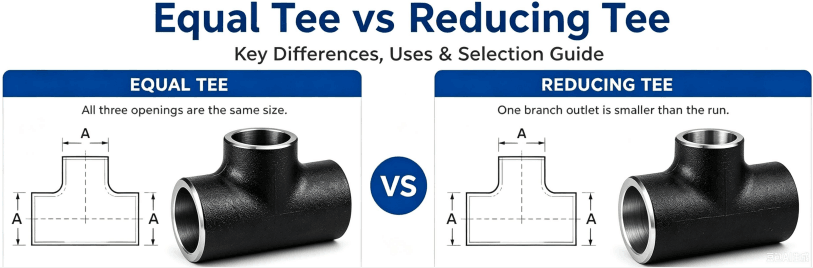
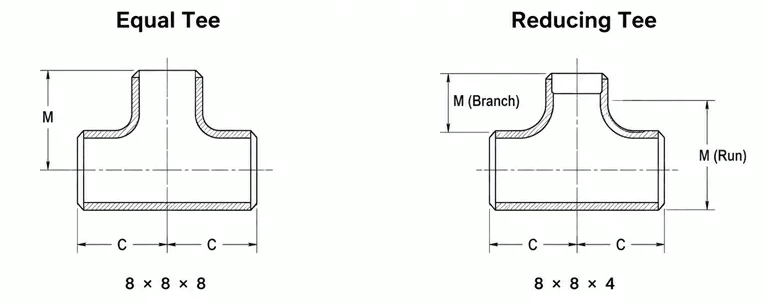
A pipe tee is a three-way fitting used to create branch connections in piping systems. It resembles the letter "T" – the main pipe run (header) passes through the fitting, while the branch outlet connects perpendicularly. ASME B16.9 covers two types:
● Equal Tee: All three outlets have the same nominal pipe size (NPS). Designated as NPS × NPS × NPS (e.g., 8″ × 8″ × 8″).
● Reducing Tee: The branch outlet is smaller than the run pipe. Designated as Run × Run × Branch (e.g., 8″ × 8″ × 4″)
Key dimensions defined by ASME B16.9:
| Dimension Symbol | Description |
|---|---|
| NPS | Nominal Pipe Size – designates the fitting size |
| OD (D) | Outside diameter of the run pipe |
| OD (P) | Outside diameter of the branch outlet (for reducing tees) |
| C | Center-to-end distance – measured from the fitting center to the run outlet weld face |
| M | Center-to-end distance – measured from the fitting center to the branch outlet weld face |
▶ Branch pipe and main pipe have the same diameter → Refer to the equal tee dimensions chart;
▶ Branch pipe is smaller than main pipe → Refer to the reducing tee dimensions chart.
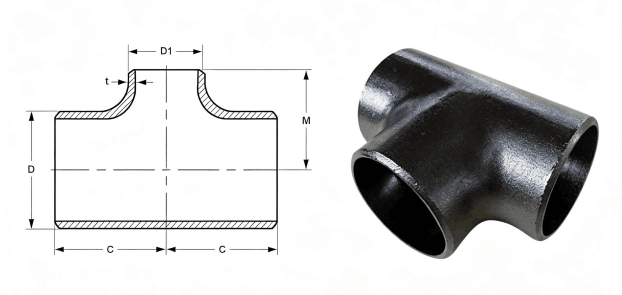
The following table lists the standard dimensions of equal tees manufactured according to ASME B16.9. It includes the nominal pipe size (NPS), outside diameter (OD), and center-to-end dimensions (C and M) for standard butt-welded equal tee fittings. All dimensions are in millimeters (mm).
Note: ASME B16.9 specifies fitting dimensions only. Wall thickness is determined by the applicable pipe schedule and is not included in this table.
| NPS (in.) | OD (mm) | C (mm) | M (mm) |
|---|---|---|---|
| 1/2 | 21.3 | 25 | 25 |
| 3/4 | 26.7 | 29 | 29 |
| 1 | 33.4 | 38 | 38 |
| 1 1/4 | 42.2 | 48 | 48 |
| 1 1/2 | 48.3 | 57 | 57 |
| 2 | 60.3 | 64 | 64 |
| 2 1/2 | 73.0 | 76 | 76 |
| 3 | 88.9 | 86 | 86 |
| 3 1/2 | 101.6 | 95 | 95 |
| 4 | 114.3 | 105 | 105 |
| 5 | 141.3 | 124 | 124 |
| 6 | 168.3 | 143 | 143 |
| 8 | 219.1 | 178 | 178 |
| 10 | 273.1 | 216 | 216 |
| 12 | 323.9 | 254 | 254 |
| 14 | 355.6 | 279 | 279 |
| 16 | 406.4 | 305 | 305 |
| 18 | 457.2 | 343 | 343 |
| 20 | 508.0 | 381 | 381 |
| 22 | 559.0 | 419 | 419 |
| 24 | 610.0 | 432 | 432 |
| 26 | 660.0 | 495 | 495 |
| 28 | 711.0 | 521 | 521 |
| 30 | 762.0 | 559 | 559 |
| 32 | 813.0 | 597 | 597 |
| 34 | 864.0 | 635 | 635 |
| 36 | 914.0 | 673 | 673 |
| 38 | 965.0 | 711 | 711 |
| 40 | 1016.0 | 749 | 749 |
| 42 | 1067.0 | 762 | 711 |
| 44 | 1118.0 | 813 | 762 |
| 46 | 1168.0 | 851 | 800 |
| 48 | 1219.0 | 889 | 838 |
Data source: ASME B16.9 standard for factory-made wrought butt-welding fittings.
For reducing tees, the branch outlet is smaller than the run pipe. Dimensions follow the same C and M measurements, with the branch OD (P) varying based on the specified branch size.
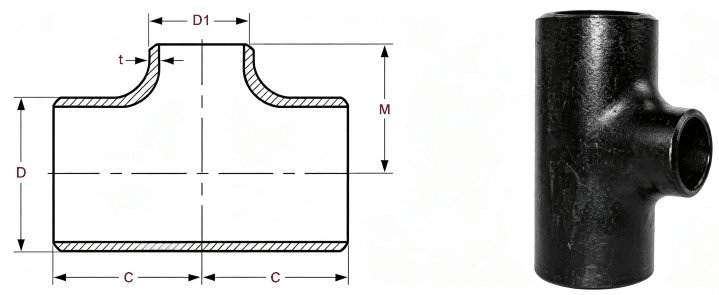
Key dimensions for reducing tees:
Each combination of Run NPS (nominal diameter of main pipe) and Branch NPS (nominal diameter of branch pipe) is listed separately for easy and quick searching.
| Run NPS | Branch NPS | Run OD (D, mm) | Branch OD (P, mm) | C (mm) | M (mm) |
|---|---|---|---|---|---|
| 1/2 | 3/8 | 21.3 | 17.1 | 25 | 25 |
| 1/2 | 1/4 | 21.3 | 13.7 | 25 | 25 |
| 3/4 | 1/2 | 26.7 | 21.3 | 29 | 29 |
| 3/4 | 3/8 | 26.7 | 17.1 | 29 | 29 |
| 1 | 3/4 | 33.4 | 26.7 | 38 | 38 |
| 1 | 1/2 | 33.4 | 21.3 | 38 | 38 |
| 1 1/4 | 1 | 42.2 | 33.4 | 48 | 48 |
| 1 1/4 | 3/4 | 42.2 | 26.7 | 48 | 48 |
| 1 1/4 | 1/2 | 42.2 | 21.3 | 48 | 48 |
| 1 1/2 | 1 1/4 | 48.3 | 42.2 | 57 | 57 |
| 1 1/2 | 1 | 48.3 | 33.4 | 57 | 57 |
| 1 1/2 | 3/4 | 48.3 | 26.7 | 57 | 57 |
| 1 1/2 | 1/2 | 48.3 | 21.3 | 57 | 57 |
| 2 | 1 1/2 | 60.3 | 48.3 | 64 | 60 |
| 2 | 1 1/4 | 60.3 | 42.2 | 64 | 57 |
| 2 | 1 | 60.3 | 33.4 | 64 | 51 |
| 2 | 3/4 | 60.3 | 26.7 | 64 | 44 |
| 2 1/2 | 2 | 73.0 | 60.3 | 76 | 70 |
| 2 1/2 | 1 1/2 | 73.0 | 48.3 | 76 | 67 |
| 2 1/2 | 1 1/4 | 73.0 | 42.2 | 76 | 64 |
| 2 1/2 | 1 | 73.0 | 33.4 | 76 | 57 |
| 3 | 2 1/2 | 88.9 | 73.0 | 86 | 83 |
| 3 | 2 | 88.9 | 60.3 | 86 | 76 |
| 3 | 1 1/2 | 88.9 | 48.3 | 86 | 73 |
| 3 | 1 1/4 | 88.9 | 42.2 | 86 | 70 |
| 3 1/2 | 3 | 101.6 | 88.9 | 95 | 92 |
| 3 1/2 | 2 1/2 | 101.6 | 73.0 | 95 | 89 |
| 3 1/2 | 2 | 101.6 | 60.3 | 95 | 83 |
| 3 1/2 | 1 1/2 | 101.6 | 48.3 | 95 | 79 |
| 4 | 3 1/2 | 114.3 | 101.6 | 105 | 102 |
| 4 | 3 | 114.3 | 88.9 | 105 | 98 |
| 4 | 2 1/2 | 114.3 | 73.0 | 105 | 95 |
| 4 | 2 | 114.3 | 60.3 | 105 | 89 |
| 4 | 1 1/2 | 114.3 | 48.3 | 105 | 86 |
| 5 | 4 | 141.3 | 114.3 | 124 | 117 |
| 5 | 3 1/2 | 141.3 | 101.6 | 124 | 114 |
| 5 | 3 | 141.3 | 88.9 | 124 | 111 |
| 5 | 2 1/2 | 141.3 | 73.0 | 124 | 108 |
| 5 | 2 | 141.3 | 60.3 | 124 | 105 |
| 6 | 5 | 168.3 | 141.3 | 143 | 137 |
| 6 | 4 | 168.3 | 114.3 | 143 | 130 |
| 6 | 3 1/2 | 168.3 | 101.6 | 143 | 127 |
| 6 | 3 | 168.3 | 88.9 | 143 | 124 |
| 6 | 2 1/2 | 168.3 | 73.0 | 143 | 121 |
| 8 | 6 | 219.1 | 168.3 | 178 | 168 |
| 8 | 5 | 219.1 | 141.3 | 178 | 162 |
| 8 | 4 | 219.1 | 114.3 | 178 | 156 |
| 8 | 3 1/2 | 219.1 | 101.6 | 178 | 152 |
| 10 | 8 | 273.1 | 219.1 | 216 | 203 |
| 10 | 6 | 273.1 | 168.3 | 216 | 194 |
| 10 | 5 | 273.1 | 141.3 | 216 | 191 |
| 10 | 4 | 273.1 | 114.3 | 216 | 184 |
| 12 | 10 | 323.9 | 273.1 | 254 | 241 |
| 12 | 8 | 323.9 | 219.1 | 254 | 229 |
| 12 | 6 | 323.9 | 168.3 | 254 | 219 |
| 12 | 5 | 323.9 | 141.3 | 254 | 216 |
| 14 | 12 | 355.6 | 323.9 | 279 | 270 |
| 14 | 10 | 355.6 | 273.1 | 279 | 257 |
| 14 | 8 | 355.6 | 219.1 | 279 | 248 |
| 14 | 6 | 355.6 | 168.3 | 279 | 238 |
| 16 | 14 | 406.4 | 355.6 | 305 | 305 |
| 16 | 12 | 406.4 | 323.9 | 305 | 295 |
| 16 | 10 | 406.4 | 273.1 | 305 | 283 |
| 16 | 8 | 406.4 | 219.1 | 305 | 273 |
| 16 | 6 | 406.4 | 168.3 | 305 | 264 |
| 18 | 16 | 457.2 | 406.4 | 343 | 330 |
| 18 | 14 | 457.2 | 355.6 | 343 | 330 |
| 18 | 12 | 457.2 | 323.9 | 343 | 321 |
| 18 | 10 | 457.2 | 273.1 | 343 | 308 |
| 18 | 8 | 457.2 | 219.1 | 343 | 298 |
| 20 | 18 | 508.0 | 457.2 | 381 | 368 |
| 20 | 16 | 508.0 | 406.4 | 381 | 356 |
| 20 | 14 | 508.0 | 355.6 | 381 | 356 |
| 20 | 12 | 508.0 | 323.9 | 381 | 346 |
| 20 | 10 | 508.0 | 273.1 | 381 | 333 |
| 20 | 8 | 508.0 | 219.1 | 381 | 324 |
| 22 | 20 | 559.0 | 508.0 | 419 | 406 |
| 22 | 18 | 559.0 | 457.2 | 419 | 394 |
| 22 | 16 | 559.0 | 406.4 | 419 | 381 |
| 22 | 14 | 559.0 | 355.6 | 419 | 381 |
| 22 | 12 | 559.0 | 323.9 | 419 | 371 |
| 24 | 22 | 610.0 | 559.0 | 432 | 432 |
| 24 | 20 | 610.0 | 508.0 | 432 | 432 |
| 24 | 18 | 610.0 | 457.2 | 432 | 419 |
| 24 | 16 | 610.0 | 406.4 | 432 | 406 |
| 24 | 14 | 610.0 | 355.6 | 432 | 406 |
| 24 | 12 | 610.0 | 323.9 | 432 | 397 |
| 24 | 10 | 610.0 | 273.1 | 432 | 384 |
| Feature | Equal Tee | Reducing Tee |
|---|---|---|
| Configuration | All three outlets same NPS | Branch smaller than run |
| Designation | NPS × NPS × NPS (e.g., 8×8×8) | Run × Run × Branch (e.g., 8×8×4) |
| Typical Use | Header branch of equal size | Takeoff to smaller pipe line |
| Branch/Run Ratio | 1.0 | 0.5 to < 1.0 |
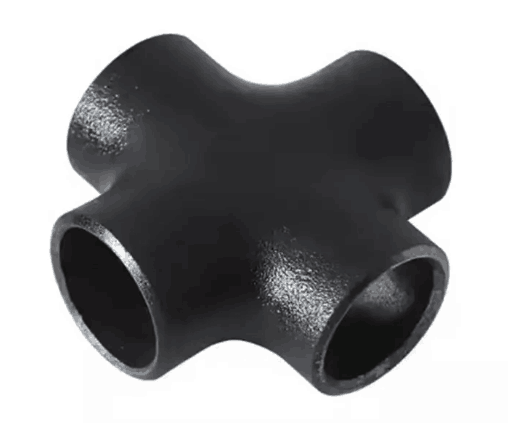
In addition to tees, the ASME B16.9 standard also covers straight crosses (also known as four-way fittings). A cross is similar to a tee but has four outlets arranged in a cross-shaped pattern – one inlet, one run outlet, and two branch outlets on opposite sides. It is used when a pipeline requires perpendicular connections on both sides of the header pipe, such as in manifold assemblies, fire protection loops, or distribution headers.
Dimension tables use standard symbols and terminology:
1. Identify the fitting type – Equal tee (single NPS) or reducing tee (Run × Branch).
2. Find the NPS – Locate the nominal pipe size in the first column.
3. Read OD values – Outside diameter of run (D) and branch (P) for reducing tees.
4. Check center-to-end dimensions – C (run outlet) and M (branch outlet) are critical for layout and welding fit-up.
Important: ASME B16.9 does not specify wall thickness. Wall thickness must match the connecting pipe schedule (e.g., Sch40, Sch80) and is governed by the applicable pipe specification. ▶ [View Pipe schedule thickness chart].
When specifying a pipe tee, confirm the following:
1. Tee Type – Equal or reducing? Based on branch connection requirements.
2. Nominal Size (NPS) – Run size and branch size according to piping layout.
3. Pipe Schedule – Select wall thickness matching the connected pipe.
4. Material Grade – Choose appropriate ASTM material specification:
● Carbon steel: ASTM A234 WPB, WPC
● Stainless steel: ASTM A403 WP304/316
● Alloy steel: ASTM A234 WP11/WP22
● Low-temperature: ASTM A420 WPL6
5. Applicable Standards – Verify compliance with ASME B16.9 and any additional project or material standards.
▶ For more details on pipe fitting material selection, please refer to [Pipe Fitting Materials – Carbon Steel vs Stainless Steel vs Alloy Steel].
Q1: What is the difference between an equal tee and a reducing tee?
A: An equal tee has three outlets of the same nominal pipe size, while a reducing tee has a smaller branch outlet than the run pipe. Equal tees are used for same-size branch connections; reducing tees are used when the branch line has a smaller diameter.
Q2: How do I choose between an equal tee and a reducing tee?
A: The choice is based on your branch connection requirements. Use an equal tee when the branch pipe is the same size as the main run (header). Use a reducing tee when you need a smaller branch connection. Consider the branch-to-run ratio; if it’s below 0.5, alternative fittings like weldolet may be more suitable.
Q3: Does ASME B16.9 specify wall thickness?
A: No. ASME B16.9 specifies dimensional standards for butt-weld fittings. Wall thickness is determined by the connecting pipe schedule (e.g., SCH 40, SCH 80) and material specification.
Q4: How do I read a reducing tee designation (e.g., NPS 8 × 8 × 4)?
A: The first two numbers indicate the run pipe size, and the third number is the branch outlet size. In 8 × 8 × 4, the run is NPS 8″ and the branch is NPS 4″.
Q5: What does "wrought" mean in ASME B16.9?
A: "Wrought" means the fitting is formed by hot or cold working processes (such as pushing, pressing, or forging), as opposed to casting. ASME B16.9 specifically covers wrought steel fittings and excludes cast fittings.
Q6. What is the difference between ASME B16.9 and MSS SP-75?
A: ASME B16.9 specifies the dimensions of factory-made wrought buttwelding fittings, while MSS SP-75 covers high-strength wrought buttwelding fittings primarily used in pipeline applications.
This guide provides key data for equal and reducing tees. For full dimensional charts covering all fitting types (elbows, reducers, caps, crosses) and schedules, please refer to the related materials below for detailed technical size tables for other fitting products.
Related Resources:
● [ASME B16.9 Elbow Dimensions]
● [ASME B16.9 Reducer Dimensions]
● [ASME B16.9 Pipe Fitting Standards Guide]
Related information
Copyright @2017 Hunan Standard Steel Co.,Ltd and Husteel Industry Group All Rights Reserved