sales@hu-steel.com
 English
 Español
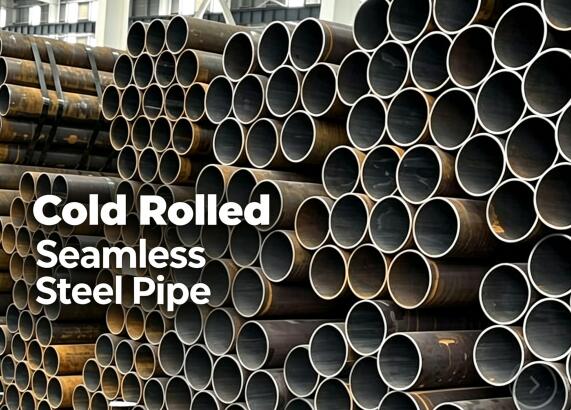
The cold rolling process is distinct from cold drawing—while cold drawing relies on tensile pulling through a die, cold rolling uses compressive rolling forces. This fundamental difference gives cold rolled pipes unique advantages in production efficiency and product quality, making them the preferred choice for precision engineering applications such as hydraulic cylinders, automotive steering systems, and aerospace components.
The main process sequence is:
▶ Hot Rolled Pipe → Annealing → Pickling → Phosphorizing → Saponifying → Cold Rolling (Pilger mill, multi-pass) → Degreasing → Heat Treatment → Straightening → Cutting → Inspection (NDT + dimensional) → Marking → Storage
The production of cold rolled seamless steel pipe follows a systematic process that transforms hot rolled pipe blanks into precision-engineered tubing:
1. Blank Preparation – Hot rolled seamless steel pipe serves as the starting material. The blanks are inspected and cut to appropriate lengths for cold rolling.
2. Annealing – The pipe blanks are heat-treated to soften the material, relieve residual stresses, and prepare the microstructure for cold deformation.
3. Pickling and Lubrication – The annealed pipes are immersed in acid solution to remove surface scale and oxides, followed by phosphating and saponification treatment to create a lubricating layer that reduces friction during rolling.
4. Cold Rolling (Pilger Rolling) – The prepared pipe is rolled through a cold Pilger mill, which uses compressive rolling forces to progressively reduce the outer diameter and wall thickness. This step achieves high dimensional precision and improves the material’s mechanical properties through work hardening.
5. Heat Treatment – After cold rolling, the pipe undergoes final heat treatment to eliminate residual stresses and achieve the desired mechanical properties.
6. Straightening – The pipe is straightened to meet dimensional and straightness standards.
7. Finishing and Inspection – The finished pipes undergo dimensional inspection, surface quality checks, and non-destructive testing (NDT) to verify quality.
8. Marking and Packaging – Approved pipes are marked with specifications and packaged for shipment.
The table below summarizes the main differences between cold-rolled seamless steel pipes and hot-rolled seamless steel pipes.
| Factor | Cold Rolled Seamless Pipe | Hot Rolled Seamless Pipe |
|---|---|---|
| Diameter Range | Small diameters (as small as 5–6mm) | Large diameters (typically > 32mm) |
| Wall Thickness | Thin walls (as thin as 0.25mm) | Thicker walls (2.5–75mm) |
| Dimensional Tolerance | High precision (±0.01mm) | Looser tolerances (about 0.5mm variation) |
| Surface Finish | Smooth, bright surface | Rougher surface with mill scale or red rust |
| Production Temperature | Room temperature (cold working) | Above recrystallization temperature (~1,200°C) |
| Cost | Higher cost | More cost-effective |
| Best Applications | Precision machinery, hydraulic systems, automotive, aerospace | Oil/gas pipelines, general industrial, structural |
Key point: Cold rolled seamless steel pipes offer superior precision and surface quality at a higher cost, while hot rolled pipes provide larger sizes and better cost-effectiveness for general applications.
Cold rolling produces pipes with exceptionally tight tolerances, typically within ±0.01mm. This precision is essential for applications requiring exact fit and consistent performance.
2. Superior Surface Finish
The cold rolling process yields a bright, smooth surface free from mill scale, reducing friction in hydraulic and pneumatic systems and improving corrosion resistance.
3. Enhanced Mechanical Properties
Cold rolling increases yield strength and tensile strength through work hardening. Some cold rolled seamless pipes achieve yield strength exceeding 800MPa.
4. High Production Efficiency
Cold rolling achieves production speeds of 20–50 meters per minute, making it more suitable for mass production compared to cold drawing (3–10 meters/minute).
5. Excellent Thin-Wall Capability
Cold rolling can produce pipes with wall thicknesses as thin as 0.25mm and outer diameters as small as 5mm, enabling lightweight designs in precision applications.
6. Wide Application Range
Cold rolled seamless pipes are used in mechanical manufacturing, automotive steering systems, hydraulic cylinders, rebar couplers, nuclear power equipment, and aerospace.
Cold rolled seamless steel pipes are essential in industries demanding high precision and reliability:
● Hydraulic Systems: Hydraulic cylinders, hydraulic tubing, and fluid power systems requiring tight tolerances and smooth internal surfaces.
● Automotive Industry: Steering systems, fuel injection components, and transmission parts.
● Precision Machinery: Shafts, rollers, and structural components in machine tools and industrial equipment.
● Aerospace: Small-diameter precision components for hydraulic and fuel systems.
● Nuclear Power: High-strength, high-precision tubing for nuclear equipment.
● Mechanical Structures: High-precision mechanical structures and hydraulic equipment.
Since cold rolling and cold drawing are both cold working processes, it’s important to understand their differences.
| Factor | Cold Rolled | Cold Drawn |
|---|---|---|
| Deformation Method | Compressive rolling forces | Tensile pulling through a die |
| Production Speed | 20–50 m/min (high efficiency) | 3–10 m/min (slower) |
| Dimensional Accuracy | H9–H10 level | Up to H8 level (higher precision) |
| Surface Hardness | Moderate work hardening | Higher work hardening |
| Production Flexibility | Better for mass production, thin-wall | Better for small batches, flexible |
| Equipment Cost | Higher equipment cost | Simpler equipment, lower tooling cost |
Key point: Cold rolling offers higher production efficiency and is better suited for mass production and thin-wall applications, while cold drawing provides higher dimensional accuracy (up to H8 level) and greater production flexibility for small batches.
Hunan Standard Steel supplies high-quality cold rolled seamless steel pipes manufactured to ASTM, API, and other international standards. Our cold rolled pipes are available in a wide range of sizes and materials to meet your project requirements, from hydraulic systems to precision machinery and aerospace components. Contact our team for technical support and a competitive quote.
Read more:
● Seamless Steel Pipe Manufacturing Process – Hot Rolled & Cold Drawn
● Seamless Steel Pipe Sizes and Weights
● Hot Rolled Seamless Steel Tube – Advantages, Disadvantages & Selection Guide
● Cold Drawn Seamless Steel Pipe Manufacturing Process – Features, Applications & Selection Guide
Related information
Copyright @2017 Hunan Standard Steel Co.,Ltd and Husteel Industry Group All Rights Reserved