sales@hu-steel.com
 English
 Español
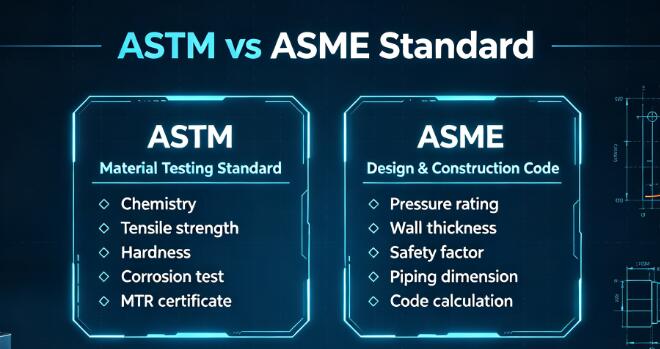
ASTM (American Society for Testing and Materials) and ASME (American Society of Mechanical Engineers) are two of the most influential standards organizations in the engineering and manufacturing industries. The key difference is that ASTM focuses on material standards (chemical composition, mechanical properties, testing methods), while ASME focuses on design, fabrication, and inspection standards for pressure-containing components like boilers and piping systems. This guide explains their differences, how they relate, and when to apply each standard in your projects.
| Aspect | ASTM (American Society for Testing and Materials) | ASME (American Society of Mechanical Engineers) |
|---|---|---|
| Primary Focus | Material standards (properties, testing, composition) | Design, fabrication, and inspection standards for pressure systems |
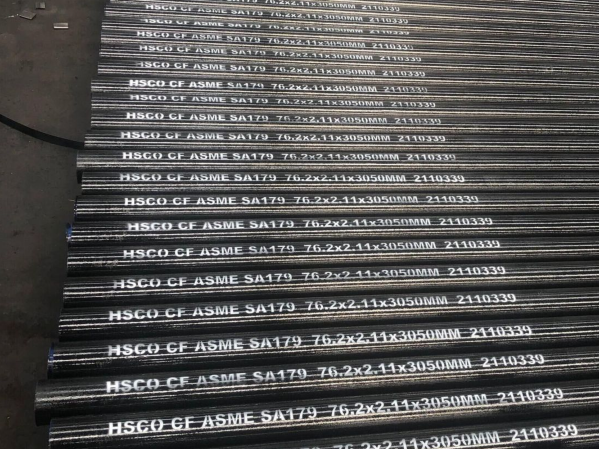
| Typical Standard Numbers | A53, A106, A312 (e.g., ASTM A106) | SA106, SA312, B16.5 (e.g., ASME SA106) |
| Typical Applications | Material selection, quality control, material verification | Boiler, pressure vessel, piping system design and construction |
| Legal Status | Generally voluntary unless referenced by code or contract | Often legally required (e.g., ASME Boiler & Pressure Vessel Code) |
| Relationship | ASME adopts and adapts ASTM material standards for pressure applications | ASME incorporates ASTM standards into its own code system |
ASTM material standards are developed by the American Society for Testing and Materials. They can include the chemical, mechanical, physical, and electrical properties of materials, as well as test methods and required shapes and sizes. Building materials like concrete can be required to meet ASTM standards before being used in construction. Among the most widely used ASTM standards are ASTM A53 and ASTM A106 for seamless steel pipe.
ASME is the standard of the American Society of Mechanical Engineers. ASME material specifications are based on those published by ASTM, AWS, and other recognized national and international standards. ASME standards are legally required when building infrastructure like bridges, power plant piping, and boilers. Among the most widely used ASME standards is ASME B16.5 for pipe flanges.
ANSI (American National Standards Institute) is another important organization in the U.S. standards system. The three organizations work together, but with distinct roles:
● ASTM develops material standards.
● ASME develops design, fabrication, and inspection standards for mechanical systems.
● ANSI coordinates and approves national standards, including many flange and fitting standards.
For pipes and pipe accessories, these three are basically unified and are commonly known as American standard pipes, pipe fittings, and pipe accessories (flanges, gaskets, etc.). Learn more about [ASME B16.5 and B16.47 Steel Flange Dimensions Chart].
Note: As a very simplified reference for Chinese readers:
ASTM develops material standards (similar in role to GB material standards like GB/T 8163 or GB713, though the systems differ significantly).
ANSI coordinates U.S. national standards, including the widely used flange standards (comparable in application to China's HG/T 20592/20615 flange standards).
ASME is a comprehensive design and construction code system for mechanical engineering (like China's GB/T 150 or JB 4732 for pressure vessels, but as a larger, integrated system).
Use ASTM standards when you are specifying or verifying the material properties of a product (e.g., chemical composition, tensile strength). This is common in material procurement and quality control. For example, you would specify "ASTM A106 Grade B" for a seamless carbon steel pipe.
Use ASME standards when you are designing, fabricating, or inspecting pressure vessels, boilers, or piping systems that require compliance with a legal code (e.g., ASME Boiler and Pressure Vessel Code). For example, you would specify "ASME SA106" for a seamless carbon steel boiler tube.
Important Note: ASME often adopts ASTM material standards but may add additional requirements or modifications for specific pressure-related applications. For example, ASME SA106 is based on ASTM A106, but includes additional requirements for elevated-temperature service.
Q1: Is ASME stricter than ASTM?
A: Not necessarily stricter, but more application-specific. ASME standards often incorporate ASTM material standards but add additional requirements (e.g., impact testing, thickness tolerances) that are critical for pressure-retaining components.
Q2: Why does ASME use "SA" instead of "A" for some materials?
A: The "SA" prefix indicates that the material is part of the ASME Boiler and Pressure Vessel Code (Section II). For example, ASME SA106 is the pressure-vessel version of ASTM A106, often with added requirements for elevated-temperature service.
Q3: Can I use ASTM standards instead of ASME for pressure piping?
A: Generally, no. Pressure piping and boiler applications are typically governed by the ASME code, which legally requires the use of ASME-approved materials and design rules. ASTM standards alone are not sufficient for code compliance.
Q4: What is the relationship between ASTM, ASME, and ANSI?
A: ASTM creates material standards, ASME creates mechanical design standards (often adopting ASTM materials), and ANSI coordinates and approves national standards. For pipes and fittings, these are often collectively referred to as "American Standard."
Read more:
● ASME B36.10/B36.19 Steel Pipe Dimensions & Sizes Chart
● Out Diameter(OD) VS Nominal Diameter(NB)
Related information
Copyright @2017 Hunan Standard Steel Co.,Ltd and Husteel Industry Group All Rights Reserved