This page provides a complete steel flange dimensions chart based on ASME B16.5 and B16.47 standards. Find flange sizes, thickness, bolt hole patterns, and weight for Classes 150, 300, 600, and 900, covering NPS 1/2" to 60". Use the charts below to quickly find the exact specifications for your project.
What is a steel flange?
A steel flange is a steel annular disc-shaped component used to connect pipes, valves, and equipment. It is bolted and sealed to achieve a detachable connection of the pipeline system. It is a key component in industrial pipeline systems and is widely used in petroleum, chemical, electric power, shipbuilding and other fields.
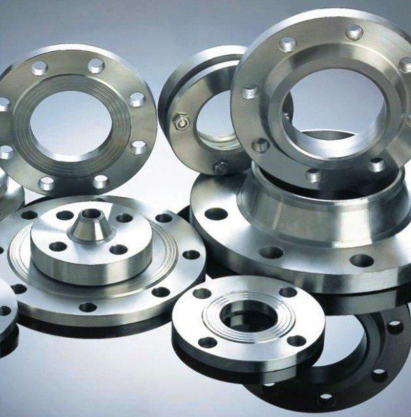
Quick Reference for Common Flange Sizes (ASME B16.5 Class 150)
● DN50 (2") Flange Thickness (Min.) : 19.0 mm
● DN80 (3") Flange Thickness (Min.): 23.8 mm
● DN100 (4") Flange Thickness (Min.): 23.8 mm
● DN150 (6") Flange Thickness (Min.): 25.4 mm
● DN200 (8") Flange Thickness (Min.): 28.6 mm
For detailed data on all sizes and pressure classes, refer to the complete charts below.
Steel Flange Dimensions & Sizes Chart:
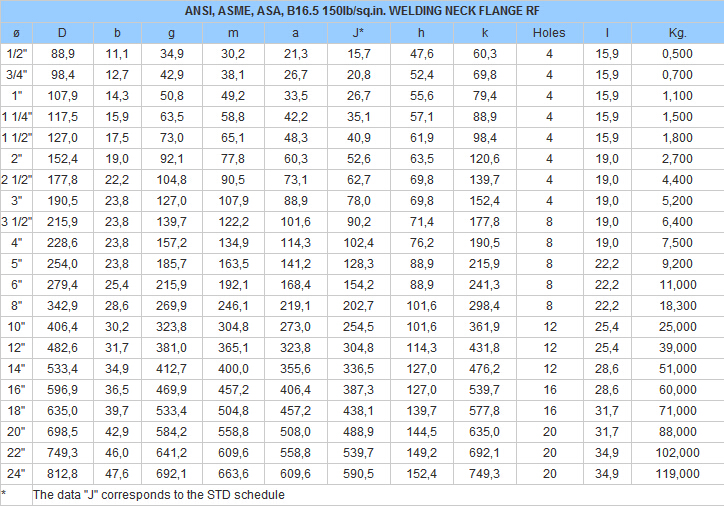
ASME B16.5 Class 150 Weld Neck Flange Dimensions (RF)
This chart provides complete dimensions for Class 150 weld neck flanges. All measurements are in millimeters (mm) unless noted. Use this table to find critical data including flange thickness (b), bolt circle diameter (k), number of bolt holes, and weight.
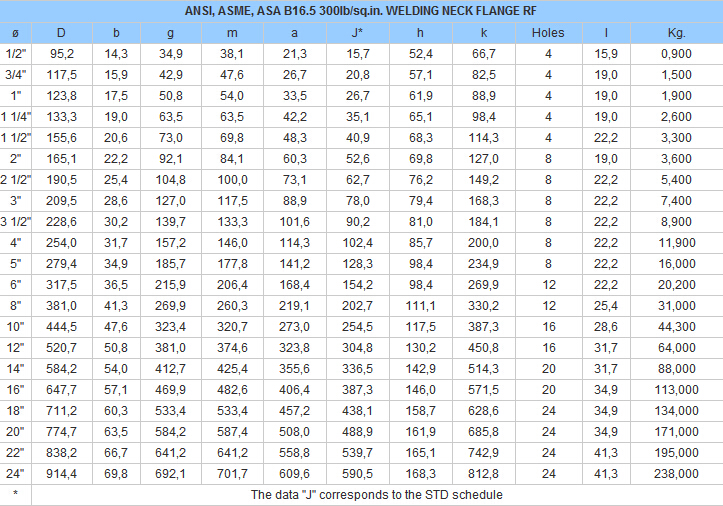
ASME B16.5 Class 300 Weld Neck Flange Dimensions (RF)
Dimensions for Class 300 weld neck flanges. Compared to Class 150, these flanges have increased thickness (b) and bolt hole sizes to accommodate higher pressure ratings.
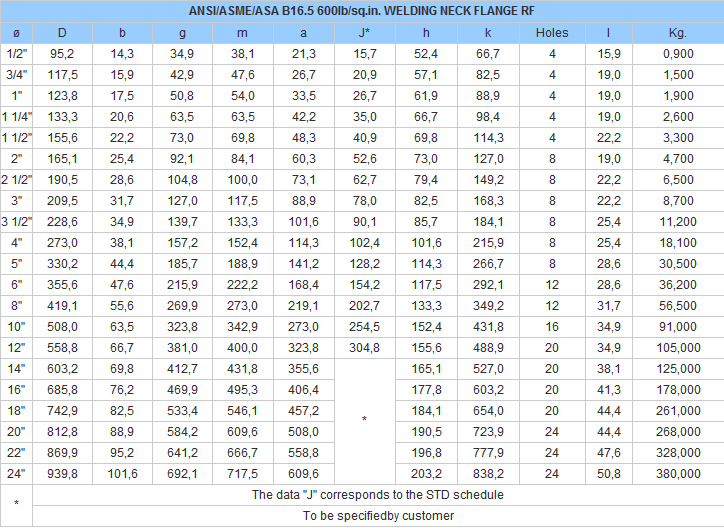
ASME B16.5 Class 600 Weld Neck Flange Dimensions (RF)
High-pressure Class 600 weld neck flange dimensions. Note the significant increases in flange thickness (b) and overall diameter (D) compared to lower classes.
△ Download Complete Flange Dimension Chart (PDF)
Get a complete reference for ASME B16.5 Class 150, 300, and 600 weld neck flanges. Includes all dimensions from 1/2" to 24" in mm.
▶ [Download ASME B16.5 Flange Dimensions PDF Now]
ASME B16.47 Series A (MSS SP-44) Large Diameter Flange Dimensions (Class 400) Chart:
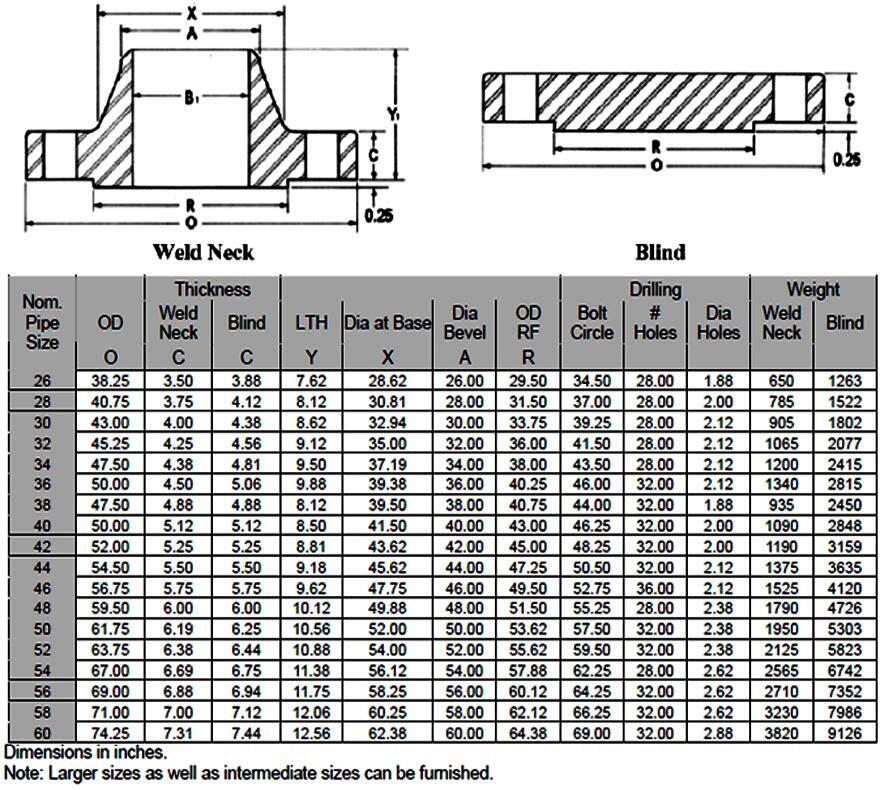
Dimensions for Series A large diameter flanges from NPS 26" to 60", covering Class 400. This chart includes data for both Weld Neck and Blind flanges. Series A flanges conform to MSS SP-44 and are known for their robust construction. All measurements are in inches.
ASME B16.47 Series B (API 605) Large Diameter Weld Neck Flange Dimensions (Class 300) Chart:
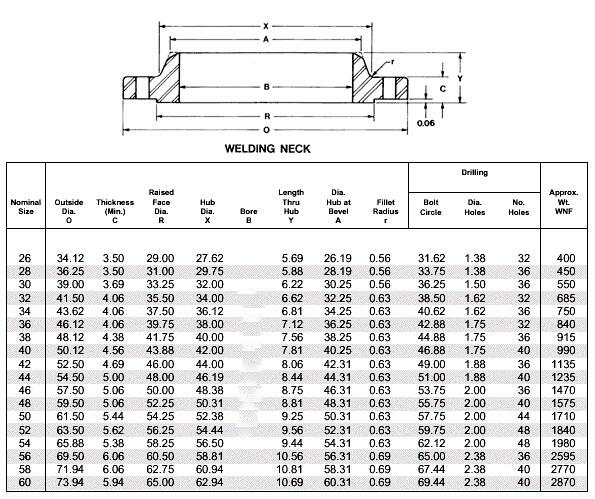
This chart provides dimensions for Series B large diameter weld neck flanges from NPS 26" to 60", covering Class 300. Series B flanges are based on the former API 605 standard (now part of ASME B16.47) and are more compact and lighter than Series A. All measurements are in inches.
ASME B16.47 Series B (API 605) Weld Neck Flange Dimensions (Classes 400, 600 & 900) Chart:
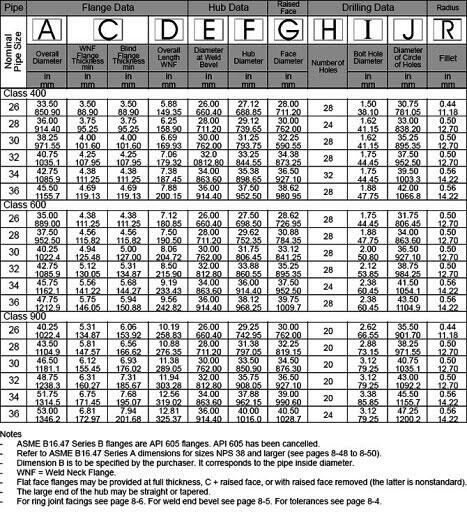
Dimensions for Series B large diameter weld neck flanges from NPS 26" to 36", covering Classes 400, 600, and 900. All measurements are in mm unless noted.
△ Download the Complete ASME B16.47 Series A & B Flange Dimensions PDF
Get a single reference file covering both Series A (MSS SP-44) and Series B (API 605) large-diameter flanges. This PDF includes Classes 75 to 900, NPS 26" to 60", with complete dimensions for Weld Neck and Blind flanges. All data is provided in both inches and millimeters for easy cross-reference.
▶ [Download ASME B16.47 Series A & B Flange Dimensions PDF Now]
Steel Flange Dimensions & Sizes:
The dimension & size of a steel flange depends on its flange type, pressure rating and applicable standards. The following are the typical size ranges of steel flanges under international general standards (ASME, EN, GB, etc.):
1. American Standard Flange (ASME B16.5 & B16.47)
Flange Type
|
Size Range (NPS)
|
Pressure Rating (Class)
|
Applicable Standards
|
Welding Flange (WN)
|
1/2" ~ 24"
|
150 ~ 2500
|
ASME B16.5
|
Socket Weld (SW)
|
1/2" ~ 4"
|
300 ~ 6000
|
ASME B16.5
|
Threaded Flange (THD)
|
1/2" ~ 12"
|
150 ~ 2500
|
ASME B16.5
|
Blind Flange (BL)
|
1/2" ~ 60"
|
150 ~ 2500
|
ASME B16.5/ASME B16.47
|
Large Diameter Flange
|
26" ~ 60"
|
75 ~ 900
|
ASME B16.47
|
Note:
NPS (Nominal Pipe Size): Nominal diameter expressed in inches (e.g. NPS 2" ≈ DN50).
Class: American standard pressure class (Class 150 ≈ PN20, Class 300 ≈ PN50).
2. European standard flange (EN 1092-1)
Flange type
|
Size range (DN)
|
Pressure class (PN)
|
Applicable standard
|
PL (slip-on flange)
|
DN10 ~ DN4000
|
PN6 ~ PN100
|
EN 1092-1
|
WN (butt-weld flange)
|
DN10 ~ DN2000
|
PN10 ~ PN400
|
EN 1092-1
|
SO (loose flange)
|
DN15 ~ DN600
|
PN6 ~ PN40
|
EN 1092-1
|
BL (blind flange)
|
DN15 ~ DN3000
|
PN6 ~ PN400
|
EN 1092-1
|
Note:
DN (nominal diameter): expressed in millimeters (e.g. DN100 ≈ NPS 4").
PN (nominal pressure): European standard pressure level (PN16 ≈ 16 bar).
3. Chinese standard flange (GB/T 9119 & HG/T 20592)
Flange type
|
Size range (DN)
|
Pressure level (PN)
|
Applicable standards
|
Slip-on flange (PL)
|
DN10 ~ DN2000
|
PN0.25 ~ PN10
|
GB/T 9119
|
Butt welding flange (WN)
|
DN10 ~ DN2000
|
PN10 ~ PN160
|
GB/T 9115
|
Socket welding (SW)
|
DN10 ~ DN80
|
PN10 ~ PN160
|
HG/T 20592
|
Threaded flange (TH)
|
DN8 ~ DN150
|
PN10 ~ PN63
|
GB/T 9114
|
Note:
Chinese standard flange is compatible with both American standard (Class) and European standard (PN) systems, for example, HG/T 20592 includes Class 150 ~ 2500 flanges.
4. Special flange size range
API 6A flange
Size range: 2-1/16" ~ 21-1/4"
Applicable standard: API 6A (wellhead equipment)
JIS flange
Size range: DN10 ~ DN1000
Applicable standard: JIS B2220
DIN flange
Size range: DN10 ~ DN4000
Applicable standard: DIN 2576/2633
American standard flanges (ASME B16.5 & B16.47):
The following mainly introduces the size specification table of American standard flanges (ASME B16.5 & B16.47), covering common flange types, pressure levels and key size parameters.
American standard flange standard classification:
ASME B16.5: pipe flanges and flange fittings
Pressure level (Class): 150, 300, 600, 900, 1500, 2500
Size range (NPS): ½" ~ 24"
ASME B16.47: large diameter flange (Series A/B)
Pressure level (Class): 75, 150, 300, 400, 600, 900
Size range (NPS): 26" ~ 60"
API 6A: high pressure flange for wellhead equipment
Pressure level (Class): 2000, 3000, 5000, 10000 psi
Size range (NPS): 2-1/16" ~ 21-1/4"
How to Choose Flange Size?
Material matching:
ASTM A105 (carbon steel) is suitable for conventional working conditions.
ASTM A182 F304/F316 (stainless steel) for corrosive media.
Matching pipe size: The DN/NPS of the flange must be consistent with the pipe.
Pressure level: Select PN/Class according to the system working pressure (e.g. PN16 ≈ Class 150).
Bolt specification: Class 300 flanges require ASTM A193 B7 bolts (high-strength alloy steel).
High temperature/high pressure correction: Class 150 flanges need to be derated above 200°C.
Flange type:
High pressure/high temperature → Butt welding flange (WN)
Low pressure/small diameter → Flat welding flange (PL)
Frequent disassembly → Loose flange (SO)
Frequently Asked Questions (FAQ):
Q: What do "DN" and "PN" or "Class" on a flange represent?
A:
1. DN: Represents the nominal size. DN is not the actual measured size but a "nominal size" used for identification. Flanges of different standards may have slightly different actual inner or outer diameters, but as long as the DN is the same, they can be matched. The PN series is commonly found in European standards (DIN) and Chinese standards (GB). For example, PN10, PN16, PN25, PN40. The number represents the maximum working pressure in "bar" (at 20°C).
2. PN / Class: Pressure rating, representing the maximum permissible working pressure that the flange can withstand at a certain temperature. The Class series is commonly found in American standards (ASME). For example, Class150, Class300, Class600. This number is a dimensionless rating and does not directly equal the pressure value. The higher the Class number, the stronger the pressure resistance, and the larger the flange size and thickness.
Note: PN and Class do not have a direct mathematical conversion relationship! They belong to different standard systems. When selecting flanges, the system specified in the design documents must be followed; mixing different types is not allowed.
Q: How to ensure two flanges can be installed together?
A: Flange mating requires meeting three matching principles:
1. Size Matching: The nominal sizes must be the same: one DN150 flange must be connected to another DN150 flange.
Pressure Rating Matching: one PN16 flange must be connected to another PN16 flange. Flanges with different pressure ratings may have different bolt hole sizes, center distances, and flange thicknesses, making forced mating impossible.
2. Standard Matching: It is best to follow the same standard system. For example, one ASME B16.5 Class 150 flange should be mated with another ASME B16.5 Class 150 flange. Although different standards (such as GB and DIN) may be compatible in some specifications, there is a risk, and mixing them is not recommended.
3. Sealing Face Type Matching: The sealing face types of the flanges must be compatible.
Matching principle: RF to RF, FF to FF, RTJ to RTJ, T to G.
Q: How to choose the flange sealing face type (RF, FF, RTJ, etc.)?
A: Simple selection principle:
General operating conditions: Choose RF.
Low-pressure, cast iron equipment: FF may be used.
High-pressure oil and gas, chemical: Choose RTJ.
Q: Are American standard (Class) and European standard (PN) flanges interchangeable?
A: In principle, they are not directly interchangeable.
Size differences: Even if the DN and theoretical pressure are similar (e.g., DN100 PN40 and DN100 Class300), their key dimensions such as bolt hole center distance, bolt hole diameter, and flange thickness may differ, making alignment impossible.
Pressure-temperature rating differences: The two systems define different maximum allowable working pressures for the same material at different temperatures.
Exception: There is a type of "transition flange" on the market, with one end being PN series and the other end being Class series, specifically designed to connect systems of different standards. It is used in projects with both American standard equipment and European standard piping.
Q: When selecting a flange, besides DN and PN, what other parameters should be considered?
A: Flange type: WN/SO/BL, etc.
Material: ASTM A105/ASTM A182
Bolt holes: The number, diameter, and center circle diameter must be exactly the same as the mating flange.
Gaskets and bolts: Select the correct gasket (e.g., non-metallic gasket, spiral wound gasket, metal ring gasket) based on the flange's sealing surface type, pressure rating, and media.
The bolt material and length must meet pressure and temperature requirements.
Q: What does the flange's pressure-temperature rating mean?
A: The flange's permissible working pressure is not a fixed value but varies with temperature.
For example, a PN16 flange can withstand 16 bar of pressure at 20°C. However, when the temperature rises to 200°C, the material's strength decreases, and its maximum permissible working pressure may drop to 12 bar.
Conclusion:
Steel flanges have a wide range of sizes, from DN10 (NPS 1/8") to DN4000 (NPS 160"), covering almost all industrial pipeline needs. When selecting, factors such as standards, pressure, temperature, and media should be considered.
Need custom flanges or non-standard sizes?
Contact HSCO Steel today. Our engineering team can provide technical support and competitive quotes for your specific project requirements.
▶ sales@hu-steel.com
Related topics you might be interested in:
● Pipe Flange Size Guide: Types, Classification & Selection
● How are Pipe Flanges Manufactured?
● Pipe Flange Gasket Types: Selection Guide & Material Comparison
 sales@hu-steel.com
 English
 Español