sales@hu-steel.com
 English
 Español
American Standard (NPS, inches): 1/2", 3/4", 1", 1.5", 2", 3", 4", 6", 8", 10", 12", etc.
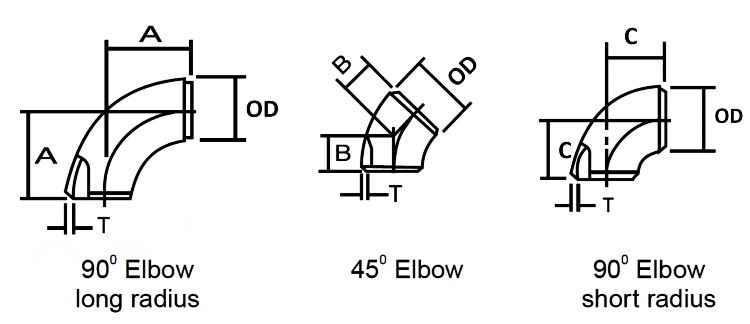
- LR: R = 1.5 × DN (such as DN100 elbow R = 150mm) Application: space-constrained installation scenarios (such as equipment interface, compact pipeline).

For example, PN10, PN16. These grades determine the dimensions and pressure-temperature ratings of flange connections. For weld neck fittings such as elbows, the PN grade guides wall thickness design, and pressure requirements are ultimately met by selecting the Sch wall thickness class or directly specifying the wall thickness value.
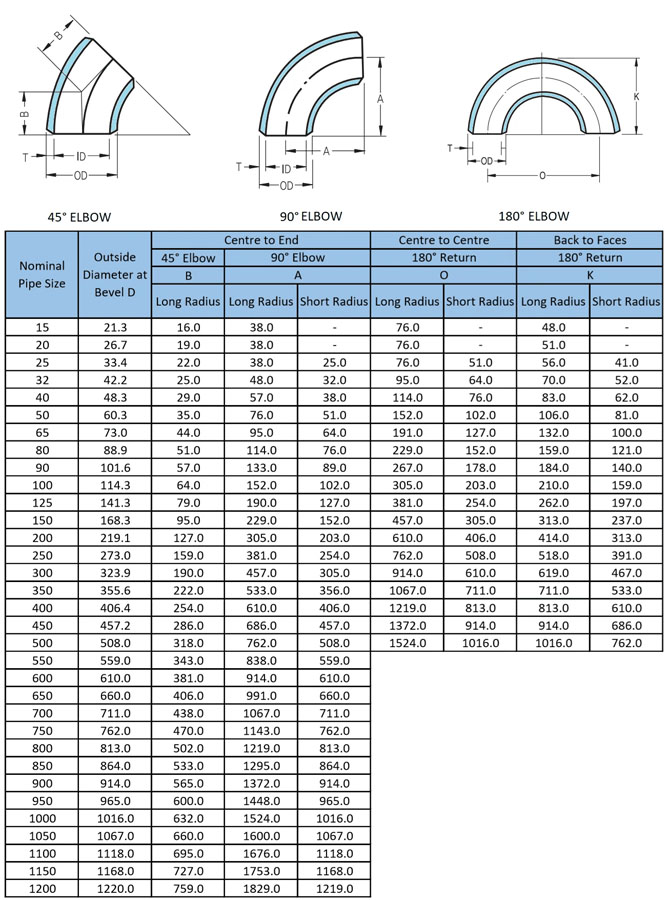
Pipe Elbow dimensions are covered in ASME B16.9. Refer to the table given below for the dimension of the elbow size 1/2″(21.3mm) to 48″(1220mm).
Stamped elbows: Commonly used for small diameters (DN15-DN50), the dimensions may be slightly smaller than welded elbows.
|
Comparison Dimensions |
Long Radius Elbow (LR) |
Short Radius Elbow (SR) |
|
Radius of Curvature |
1.5D (Centerline Radius = 1.5 × Nominal Diameter) |
1.0D (Centerline Radius = 1.0 × Nominal Diameter) |
|
Turn Sharpness |
Smooth turn, smoother fluid path |
Sharp turn, abrupt change in fluid direction |
|
Fluid Resistance |
Lower pressure drop, lower pressure loss |
Higher pressure drop |
|
Erosion and Wear |
Less severe, with minimal impact on the pipe wall. |
More severe, with the back of the elbow susceptible to erosion. |
|
Pipeline Cleaning Capability |
Can be cleaned; pipeline cleaning equipment can pass through. |
Cannot be cleaned; pipeline cleaning equipment cannot pass through. |
|
Applicable Pressure |
Applicable to high, medium, and low pressure |
Only applicable to low pressure and low flow rate conditions |
|
Applicable Flow Rate |
Applicable to high, medium, and low pressure |
Only applicable to low pressure and low flow rate conditions |
|
Installation Space |
Requires more space, large turning radius |
Space-saving, small turning radius |
|
Cost |
Slightly higher price for the same specifications (more material usage) |
Slightly lower price for the same specifications (less material usage) |
|
Standard Basis |
Preferred elbows in standards such as ASME B16.9 and GB/T 12459. |
Allowed use as specified in the standards. |
|
Application Frequency |
Most commonly used, accounting for over 90% of elbow usage. |
Less used, only when space is limited. |
|
Use Cases / Customer Needs |
Recommended |
Reasons |
|
Conventional Pipeline Design (No Special Space Restrictions) |
Long Elbow (LR) |
Low fluid resistance, low pressure drop, high safety; the industry default standard. |
|
High-Pressure Pipeline Systems (≥4.0MPa) |
Long Elbow (LR) |
Short elbows with sharp turns are prone to localized high pressure and erosion, posing safety hazards. |
|
High-Speed Fluid Pipelines (Gas, Steam, etc.) |
Long Elbow (LR) |
Effectively reduces erosion and wear, extending elbow lifespan. |
|
Pipelines Requiring Pigging (Long-Distance Oil and Gas Pipelines) |
Long Elbow (LR) |
Short elbows cannot pass through pigging equipment; long elbows are necessary. |
|
Pulsating Flow or Vibrating Pipelines |
Long Elbow (LR) |
Smooth turns reduce fluid impact and pipeline vibration. |
|
Extremely Limited Installation Space (e.g., densely populated equipment areas) |
Short Elbow (SR) |
Only used as an alternative when long elbows cannot be installed. |
|
Temporary Pipelines or Low-Pressure Drainage Pipelines |
Short Elbow (SR) |
Low pressure, slow flow rate, controllable risk, saves space. |
|
Customers Extremely Cost-Sensitive and Operating Conditions Allow |
Short Elbow (SR) |
Less material is used, resulting in slightly lower cost, but safety risks need to be assessed. |
Online tools: Use pipe size calculator (e.g. PVC elbows and metal elbows have different sizes).
Pressure ratings: Sch5s, Sch10s, Sch20, Sch40, STD, Sch80, XS, Sch160, XXS, etc., among which STD and XS are the most commonly used.
Example of standard ordering representation:
LR STD 90° 8" = Long radius, pressure rating STD, 90°, 8-inch elbow
SR XS 45° 4" = Short radius, pressure rating XS, 45°, 4-inch elbow
Q2: What are the requirements for elbow dimensional tolerances in ASME B16.9 standard?
A: ASME B16.9 is the core dimensional standard for welded pipe fittings, clearly defining the dimensional tolerances for elbows. Generally, the larger the size (±3.2~±4.8), the wider the allowable tolerance range; the smaller the size, the stricter the tolerance requirements (±0.8~±1.6). During acceptance, special attention should be paid to the wall thickness, using an ultrasonic thickness gauge to check the back arc of the elbow to ensure that the thinning does not exceed 12.5%.
Q3: How is the pressure rating of the elbow indicated? How to match it with the pipeline?
The pressure rating of an elbow is indicated by its wall thickness series number (Schedule No.), which must match the wall thickness of the connected pipe.
Common wall thickness series:
STD: Standard – Most commonly used, suitable for normal pressures
XS: Extra Strong – Most commonly used, suitable for higher pressures
XXS: Double Extra Strong – For high-pressure applications
Selection Notes:
a. The pressure rating (wall thickness) of the elbow must not be lower than the wall thickness of the connected pipe;
b. Common combinations: STD wall thickness elbows with STD pipes, XS wall thickness elbows with XS pipes;
c. The wall thickness series should be clearly specified when purchasing, such as 90° LR Sch40. 6"
Q4: How to measure and accept the key dimensions of elbows?
A: When accepting elbows, customers are advised to focus on the following dimensional items:
Outer/Inner Diameter: The port is the key inspection area.
Wall Thickness: Focus on the back arc (outer arc), where it is the thinnest – ultrasonic thickness gauge
Bending Angle: Deviation ≤ ±1° – angle gauge, template
Radius of Curvature: 1.5D or 1.0D, tolerance ±2mm (NPS≤24) – template, coordinate measuring machine
Ellipticity: Ensure matching with the pipe – calipers to measure the maximum/minimum outer diameter
End Face Perpendicularity: Affects the quality of weld joints – right-angle ruler
Practical Experience:
Assemble four 90° elbows into a circle to quickly check angle accuracy;
Wall thickness must be measured at multiple points along the back arc, as measuring the port with calipers alone cannot detect thinning issues.
Q5: What are the dimensions of a DN40 elbow?
A: A DN40 elbow refers to a small-diameter pipe elbow with a nominal diameter (DN) of 40 mm. DN is an internationally recognized pipe size designation system; DN40 is approximately equal to 1.5 inches of pipe. The outer diameter of a DN40 elbow ranges from approximately 40.0 to 48.3 mm, with a center length of approximately 45-85 mm and a bending radius (typically 1.5D). Its main applications cover multiple industries including industrial manufacturing, food and pharmaceuticals, and construction and municipal engineering, and it is a key component in piping systems for changing the direction of connections.
Note: In actual engineering, when we say "DN40 elbow," if it is manufactured according to American Standard (ASME) or Chinese Standard (GB) for butt-welded pipe fittings, its interface outer diameter (OD) is always 48.3 mm, not 40 mm.
The dimensions of DN40 elbows also vary depending on the material and connection method. For example:
● Sanitary welded elbow: outer diameter approximately 40mm, center length approximately 60mm;
● Grooved ductile iron elbow: outer diameter 48.3mm, center length 45mm, bending radius 50mm;
● Aluminum elbow for compressed air: outer diameter 40.1mm, inner diameter 36.5mm.
Q6: What are the dimensions of 4-inch and 6-inch long radius elbows?
A:
● 4-inch long radius elbow dimensions (DN100): Outer diameter 114.3mm, 90° center distance 152mm, 45° center distance 64mm
● 6-inch long radius elbow dimensions (DN150): Outer diameter 168.3mm, 90° center distance 229mm, 45° center distance 95mm
● 8-inch long radius elbow dimensions (DN200): Outer diameter 219.1mm, 90° center distance 305mm, 45° center distance 127mm
Note: Engineers prioritize long-radius elbows (R=1.5D) whenever space permits, accounting for over 90% of applications. The reasons are as follows:
a. Lower flow resistance → Lower energy consumption
b. Less wear → Longer pipe life
c. Less stress → Safer system
Short-radius elbows are only considered when the equipment layout is extremely compact and long-radius elbows cannot be installed. This is why long-radius elbows dominate most elbow inventories and product catalogs.
The actual selection of pipe elbows needs to be determined in combination with the pipe material (carbon steel, stainless steel, PVC, etc.), medium pressure/temperature and installation space!
Related Resources:
● Material Selection and Application of Pipe Elbows
● ASTM A403 WP316 Stainless Steel Butt-weld Elbow
Related information
Copyright @2017 Hunan Standard Steel Co.,Ltd and Husteel Industry Group All Rights Reserved