sales@hu-steel.com
 English
 Español
ASTM A234 is the standard specification for wrought carbon and alloy steel pipe fittings used in moderate and high-temperature services. This guide covers the scope, material grades, referenced standards, and application considerations for ASTM A234 fittings across various industrial piping systems.
▶ Looking for specific fitting dimensions? → [View ASME B16.9 Pipe Elbow Dimensions]
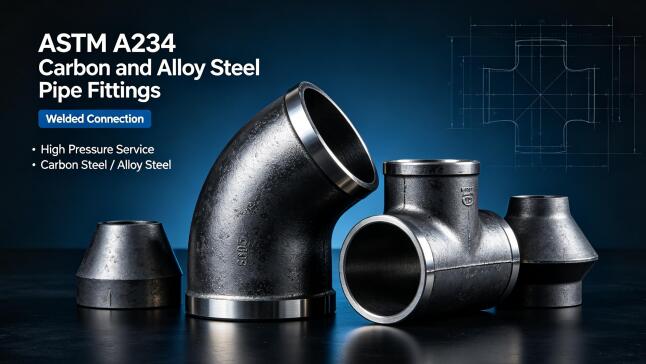
ASTM A234 covers seamless and welded wrought steel fittings made from killed steel, forgings, bars, plates, or tubular products. It applies to butt-welding fittings such as elbows, tees, reducers, and caps used in pressure piping and vessel fabrication.
Key points:
● This standard is for wrought products only – it does not cover cast fittings or fittings machined from castings.
● Fittings are intended for service at moderate and elevated temperatures.
● The standard ensures consistent mechanical properties and chemical composition across different manufacturers.
ASTM A234 is widely referenced in industries including petrochemical, power generation, oil and gas, and general industrial piping.
ASTM A234 includes multiple material grades to suit different service conditions. The following table summarizes the primary grades and their general characteristics:
| Grade | Material Type | Temperature Range | Characteristics & Applications |
|---|---|---|---|
| WPB | Carbon Steel | -29°C to 425°C | Most common grade. Excellent weldability, good strength. Used for general oil, gas, water, and steam services. |
| WPC | Carbon Steel (High Strength) | -29°C to 425°C | Higher strength than WPB. Used for high-pressure services requiring a stronger carbon steel fitting. |
| WP5 | Alloy Steel (5Cr-0.5Mo) | -29°C to 650°C | Good oxidation and corrosion resistance. Used in high-temperature and corrosive environments. |
| WP9 | Alloy Steel (9Cr-1Mo) | -29°C to 650°C | Superior high-temperature strength. Used in refinery and power plant applications. |
| WP11 | Alloy Steel (1.25Cr-0.5Mo) | -29°C to 565°C | Standard alloy steel for high-temperature creep service, e.g., steam piping in power plants. |
| WP12 | Alloy Steel (1Cr-0.5Mo) | -29°C to 540°C | Similar to WP11. Used for moderate high-temperature services. |
| WP22 | Alloy Steel (2.25Cr-1Mo) | -29°C to 565°C | Enhanced creep resistance. Widely used in high-temperature steam and hydrogen service. |
| WP91 | Alloy Steel (9Cr-1Mo-V) | -29°C to 650°C | High-strength, creep-resistant alloy. Used in ultra-supercritical power plants and advanced high-temperature systems. |
Selection Tips: For most general water, oil, and gas applications, WPB is the standard and most cost-effective choice. For temperatures above 425°C, switch to WP11 or WP22. For temperatures above 565°C, consider WP5, WP9, or WP91.
The raw material used affects the fitting's final properties but must always meet the chemical and mechanical requirements of the ASTM A234 grade.
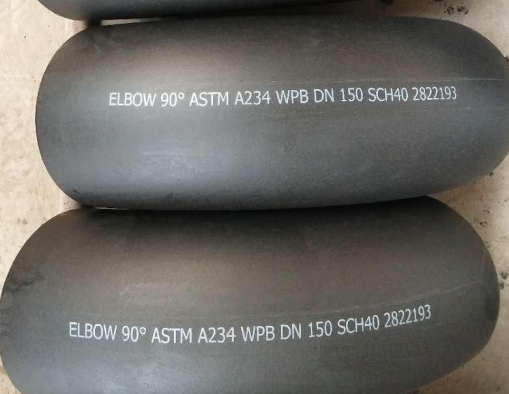
● Seamless fittings: Made from seamless pipe/tube. No longitudinal weld seam. Preferred for high-pressure, toxic fluids, and critical safety applications.
Size range: Up to approx. DN600 (24") typically.
● Welded fittings: Made from welded pipe or plate. Suitable for general water, oil, gas, and low-to-medium pressure services. Wall thickness is typically more uniform than seamless fittings.
Size range: Available in all sizes, including very large diameters.
▶ For more detailed guidance, see our [Seamless vs. Welded Pipe Fittings Selection Guide].
| Standard | Title / Scope | Relevance to ASTM A234 Fittings |
|---|---|---|
| ASME B16.9 | Factory-Made Wrought Butt-Welding Fittings | Defines dimensions, tolerances, and marking for elbows, tees, reducers, and caps. Most commonly referenced standard. |
| ASME B16.28 | Wrought Steel Butt-Welding Short Radius Elbows and Returns | Specific to short-radius elbows and return bends. |
| ASME B16.11 | Forged Fittings, Socket-Welding and Threaded | Applies to smaller, socket-weld, or threaded fittings covered under the broader ASTM A234 material specification. |
| MSS SP-79 | Socket Welding Reducer Inserts | Specialized insert fittings. |
| MSS SP-83 | Socket Welding and Threaded Unions | Union fittings. |
| MSS SP-95 | Swage(d) Nipples and Bull Plugs | Pipeline accessories. |
| MSS SP-97 | Integrally Reinforced Branch Outlet Fittings | For branch connections. |
| Product Type | Primary Function |
|---|---|
| Elbows | Change pipeline direction (45°, 90°, 180°). |
| Tees | Create branch connections (straight or reducing). |
| Reducers | Connect pipes of different diameters (concentric or eccentric). |
| Caps | Seal the end of a pipe. |
| Crosses | Connect four pipe sections in a cross pattern. |
Follow this general workflow to specify the correct fitting for your system:
1. Determine the service temperature and pressure – This is the primary driver for material grade selection.
2. Identify the fluid corrosivity – For corrosive services, consider alloy grades or protective coatings.
3. Select the material grade – Use carbon steel (WPB/WPC) for general, non-corrosive services up to 425°C. Choose alloy steel (WP11/WP22 or higher) for elevated temperatures or corrosive environments.
4. Choose the product type and dimensions – Select the required fitting shape (elbow, tee, etc.) and size (NPS or DN) using the referenced ASME B16.9 tables.
5. Specify the wall thickness (Schedule) – Determine the required Schedule (e.g., Sch40, Sch80, XS) based on the system design pressure and the selected material's derating at the operating temperature.
▶ For project-specific support, our engineering team can assist with material selection and dimension verification. [Contact us for technical support].
Q1: What is the difference between ASTM A234 and ASTM A105?
A: ASTM A234 is the standard specification for wrought fittings (elbows, tees, reducers, caps) used in pressure piping. ASTM A105 is the standard for forged carbon steel components, primarily flanges and other forged pipe fittings. Both are common, but A234 is for butt-weld fittings, while A105 is typically for flanges.
Q2: Can ASTM A234 fittings be used for low-temperature services?
A: The standard carbon steel grades (WPB, WPC) are generally suitable down to -29°C. For services below -29°C, the ASTM A420 standard (low-temperature carbon steel fittings) should be used instead of A234.
Q3: What is the difference between ASTM A234 and ASTM A403?
A: ASTM A234 covers carbon and alloy steel fittings. ASTM A403 covers stainless steel fittings. The choice depends on the fluid corrosivity and temperature requirements.
Q4: Why is heat treatment important for ASTM A234 fittings?
A: Heat treatment (such as normalizing or annealing) is essential to relieve internal stresses from forming and to achieve the required mechanical properties and grain structure. It ensures the fitting can withstand service conditions without premature failure. Always verify that the fittings have undergone the required final heat treatment.
Q5: How do I verify the quality of ASTM A234 fittings upon delivery?
A: Key steps include:
● Reviewing the Material Test Report (MTR) for chemical composition and mechanical properties.
● Verifying the heat treatment status.
● Conducting dimensional inspections to ensure compliance with the referenced standard (e.g., ASME B16.9).
● Performing non-destructive testing (NDT) if required by project specifications, such as ultrasonic or magnetic particle inspection.
ASTM A234 is the essential standard for carbon and alloy steel butt-welding fittings in moderate and high-temperature piping systems. This guide provides an overview of its scope, material grades, and selection considerations. For detailed dimensional data, always refer to the referenced ASME B16.9 tables.
Related Resources:
● Carbon Steel Pipe Temperature Range
● ASME B16.9 Butt-Welding Fittings Dimensions
● Pipe Fitting Materials – Carbon Steel vs Stainless Steel vs Alloy Steel
Related information
Copyright @2017 Hunan Standard Steel Co.,Ltd and Husteel Industry Group All Rights Reserved