sales@hu-steel.com
 English
 Español
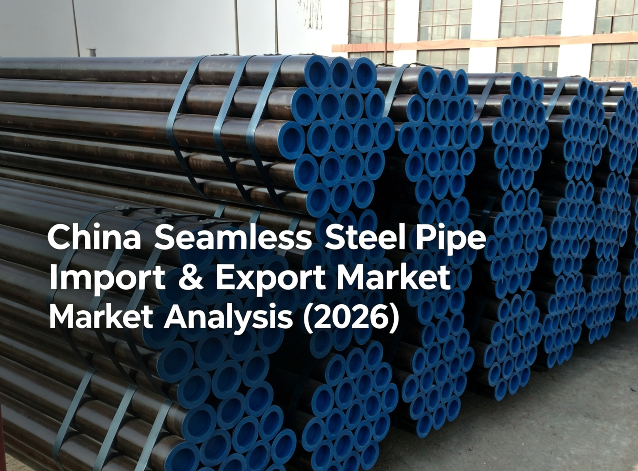
China's seamless steel pipe industry maintained its position as the world's largest producer and exporter in 2026, accounting for over 50% of global production. The market experienced significant structural shifts during the year, driven by geopolitical factors, changing demand patterns, and ongoing capacity expansion.
In the first seven months of 2026, China exported 342.93 million tons of seamless steel pipes, representing a 1.02% year-on-year increase. Monthly export data shows the following trends:
● January-February: 99.34 million tons exported, up 14.71% year-on-year, driven by pre-carbon tariff front-loading● The export market demonstrated strong resilience, recovering from a mid-year slowdown to return to year-on-year growth by July.
After reaching a record high of approximately 6.28 million tons in 2025, the industry is expected to see exports gradually decline in 2026 to around 5.6–5.8 million tons. This still represents historically high export volumes, even if the five-year growth streak ends.
● Average export price stabilized at approximately $1,150–1,200/ton
● Price decline narrowed to 1.8% year-on-year, compared to 6.03% in 2025
In 2026, severe turmoil in the Middle East led to a sharp decline in exports to the region. This forced a rapid structural shift in export destinations, with Southeast Asia, North Africa, and Middle Eastern countries outside the Persian Gulf emerging as key growth markets.
This rebalancing reflects China's structural advantage in the global seamless steel pipe market—the ability to redirect exports to alternative emerging markets when traditional routes are disrupted.
High-value energy pipes have become the primary driver of export growth in 2026:
● Oil and gas drill pipes, casing pipes and tubing accounted for 48.83% of total June exports
● Three categories of energy pipes (high-strength casing, low-strength casing, and medium-diameter transmission pipes) represented the top three export products
● Energy pipes overtook general structural pipes as the dominant export category
General structural pipes continue to serve as the export "baseline," supported by infrastructure and construction demand in Africa and Southeast Asia.
2. Inventory consumption of existing imported materials has kept overseas procurement subdued
1. Significant price advantage: Chinese seamless pipes offer competitive pricing in global markets, creating a "falling price, rising volume" dynamic
2. Strong overseas demand: Infrastructure and energy projects, particularly in the Middle East and Southeast Asia, provide stable export markets
1. Overcapacity: 2026 is expected to add 2.05 million tons of new production capacity, raising total capacity to approximately 44.41 million tons
2. Intense competition: Capacity utilization remains at 65–70%, indicating significant structural surplus
3. Profit pressures: Industry profits remain thin, with blast furnace enterprises averaging only RMB 88/ton in 2025
4. Geopolitical uncertainty: Trade protectionism and regional conflicts continue to impact export stability
The "Fifteenth Five-Year Plan" period (2026–2030) will see the seamless steel pipe industry transition from "quantity growth" to "value growth," with high-end transformation, intelligent upgrading, green development, and internationalization as strategic directions.
Read more:
● Seamless Steel Pipe Price Per Ton (2026)
● Top 8 Seamless Pipe Manufacturers and Suppliers in China
● Complete Directory of Seamless Pipe Manufacturers & Suppliers in China
Related information
Copyright @2017 Hunan Standard Steel Co.,Ltd and Husteel Industry Group All Rights Reserved