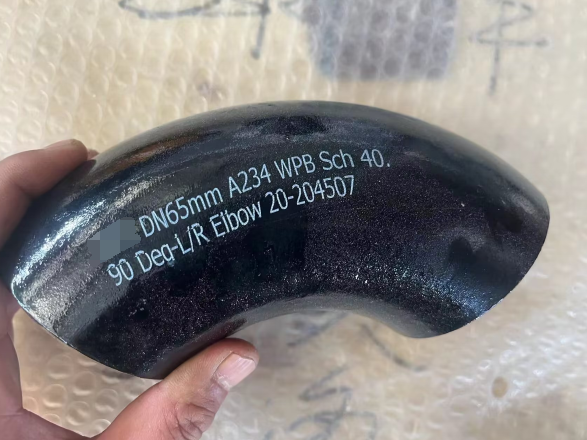
ASTM A234 is a standard developed by the American Society for Testing and Materials (ASTM), which is specifically used for forged carbon steel and alloy steel butt-welding pipe fittings for medium and high temperatures, covering pipe elbows, tees, reducers, etc. Among them, carbon steel elbows are the most commonly used type.
Features of ASTM A234 elbows:
Typical materials: WPB (carbon steel), WP11/WP22 (alloy steel)
Applicable process: Butt welding connection (Butt Welding), in accordance with ASME B16.9 size specifications.
Applicable temperature: -29°C ~ 425°C (WPB)
Pressure level: ASME B16.9 Class 3000~9000
Manufacturing process: Forging/hot push forming + machining
Surface treatment: sandblasting/galvanizing/epoxy coating
Size range:
Nominal diameter (NPS): 1/2"~48"
Wall thickness grade: Sch 40, Sch 80, XXS, etc.
Angle type:
90° elbow (LR long radius, SR short radius), 45° elbow, 180° elbow.
Material properties of ASTM A234 pipe elbow:
Chemical composition (WPB): C≤0.3%; Mn≤1.2%; P≤0.05%; S≤0.058%.
Mechanical properties (WPB):
Tensile strength: ≥415 MPa;
Yield strength: ≥240 MPa;
Elongation: ≥22%.
Process performance:
Weldability: Good (need to preheat 150-200°C to prevent cracking)
Formability: Can be hot-pushed/forged into 90°, 45°, 180° pipe elbows
Related standards:
ASME B16.9: Pipe fittings dimensional tolerances
ASME B16.25: Butt weld end groove requirements
ASME B31.3: Process piping installation specifications
Advantages and disadvantages of ASTM A234 pipe elbows:
Advantages:
1. High cost performance: The cost of carbon steel materials is lower than that of stainless steel, suitable for large-scale procurement.
2. Strong pressure resistance:
Sch 80 pipe elbows can withstand pressures above 600 psi.
3. Mature process: easy to weld and forge, and perfect supply chain.
Disadvantages:
1. Poor corrosion resistance
Carbon steel is easy to rust, and galvanizing or epoxy coating is required in humid environments.
Stainless steel (such as ASTM A403 316) should be used in acidic media.
2. High temperature limitations: WPB long-term use temperature ≤425°C, higher temperature requires alloy steel (such as WP11).
3. Heavy weight: Compared with stainless steel of the same specification, carbon steel elbows are 20%-30% heavier.
Frequently Asked Questions:
Q1: Can WPB elbows be used in low temperature (-50°C) environments?
A1: No! ASTM A420 WPL6 (low temperature carbon steel) should be used instead.
Q2: How to distinguish forged and cast elbows?
A2: Forged: The surface is smooth and has no pores, and is marked with the word "Forged".
Casting: MT (magnetic particle testing) is required to check for defects.
Q3: Can Sch 40 elbows be welded with Sch 80 pipes?
A3: Prohibited! Mismatched wall thickness can lead to stress concentration.
Conclusion:
ASTM A234 carbon steel elbows (especially WPB) are core components of industrial pipelines. Their advantages are low cost, good pressure resistance, and easy processing, but attention should be paid to corrosion protection and temperature limits. For harsh environments (high temperature/corrosion), it is recommended to upgrade to WP11 alloy steel or stainless steel elbows.
Read more: Pipe Elbow Dimensions & Sizes– Long & Short Radius Elbow
 sales@hu-steel.com
 English
 Español