sales@hu-steel.com
 English
 Español
ASTM A105/A105M is a forged carbon steel material standard developed by the American Society for Testing and Materials (ASTM), specifically for the manufacture of pipe flanges, valves, fittings and other high-pressure components for pressure systems at ambient and higher-temperature service.
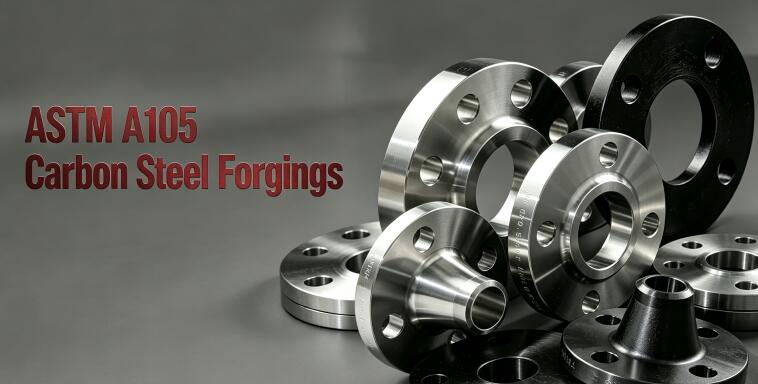
This standard specification is mainly applicable to various pipe fittings in pipeline systems, such as pipe flanges, elbows, tees, reducers, valves and other parts. It is widely used in pipeline connections and transportation systems in industries such as petroleum, chemical, power, and construction.
Common product forms include:
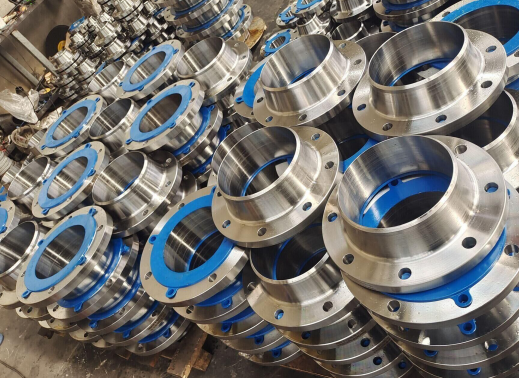
● A105 Flanges: Weld neck (WN), socket weld (SW), blind (BL), and others (conforming to ASME B16.5).
● Fittings: Elbows, tees, and reducers (conforming to ASME B16.9/B16.11).
● Valve Components: Valve bodies, bonnets, and other pressure-containing parts.
These products can be manufactured to customer-specific dimensions or in accordance with industry standards such as MSS, ASME, and API specifications.
● Conventional range: -29°C ~ 425°C
● Low temperature limit: impact test is required below -29°C (such as A350 LF2 is more applicable). For design temperatures below -29°C, ASTM A350 LF2 (suitable down to -46°C) should be selected.● High temperature risk: graphitization may occur at >425°C, and it is recommended to use chromium-molybdenum steel (such as A182 F11) instead.
1. Oil and gas: pipeline flanges, valve housings (Class 150~2500).
2. Power industry: medium and low pressure steam systems (≤425°C).
3. Chemical equipment: pipe fittings for non-corrosive media (such as water, oil, and air).
4. General industry: pump and compressor inlet and outlet connectors.
| Element | Composition (%) |
|---|---|
| Carbon (C) | ≤ 0.35 |
| Silicon (Si) | 0.10 – 0.35 |
| Manganese (Mn) | 0.60 – 1.05 |
| Phosphorus (P) | ≤ 0.035 |
| Sulfur (S) | ≤ 0.040 |
In addition. It may also contain a certain amount of copper, nickel, molybdenum, vanadium, chromium and other elements as needed.
Below are the key mechanical properties required by the ASTM A105 standard, including strength, ductility, and hardness.
| Property | Value |
|---|---|
| Tensile Strength | ≥ 485 MPa |
| Yield Strength | ≥ 250 MPa |
| Elongation (50mm) | ≥ 22% |
| Reduction of Area | ≥ 30% |
| Hardness (HB) | ≤ 187 (Brinell) |
- Heat treatment: Generally, the heat treatment process of normalizing and tempering is adopted to eliminate forging stress, improve the organizational structure of the material, improve its comprehensive performance, and provide a good organizational state for subsequent processing and use.
Except for flanges above 300 pounds, special design flanges with unknown design pressure or design temperature, and parts above 4 inches NPS and above 300 pounds, heat treatment is not a mandatory requirement. If heat treatment is required, annealing, normalizing, normalizing and tempering, normalizing quenching and tempering, etc. should be used.
Manufacturing Standards:
● ASME B16.5 (flanges)
● ASME B16.11 (socket welding fittings)
● MSS SP-44 / API 6A (for special applications)
Inspection and Test Requirements:
Appearance inspection: The surface should be smooth, without cracks, folds, scars, or burrs.
Dimensions and tolerances: Must meet the tolerance range specified in the standard to ensure interchangeability and sealing.
Physical and chemical performance tests: Including tensile, impact, and hardness tests to verify material properties.
Non-destructive testing: Ultrasonic, magnetic particle, or penetration testing to detect internal and surface defects.
Special Certification:
NACE MR0175: For resistance to hydrogen sulfide corrosion in sour service, sulfur/phosphorus content must be strictly controlled.
| Material | Standard | Key Feature | Typical Application |
|---|---|---|---|
| A105 | ASTM A105 | General purpose carbon steel, cost-effective, used in medium and low pressure, non-corrosive media environments. | Medium and low pressure, non-corrosive media environments. |
| A182 F304 | ASTM A182 | Stainless steel, corrosion-resistant, | Chemical, food industry |
| A350 LF2 | ASTM A350 | Excellent low-temperature toughness (-46°C) | LNG, cryogenic pipelines |
| A694 F60 | ASTM A694 | High strength (yield ≥ 415 MPa) | High-pressure oil/gas pipelines |
NACE MR0175 is not met: high sulfur environment (acidic oil and gas) requires strict sulfur control (S≤0.02%), and ordinary A105 may not meet the standard.
1. What is the difference between ASTM A105 and A105N?
A105N refers to A105 material that has been normalized. Standard A105 (forged state) does not require forced heat treatment, while A105N refines the grains through normalizing treatment, improves the toughness and impact performance of the material in low temperature environments, and is more suitable for working conditions with higher safety and stability requirements. If the project requires NACE MR0175 or low temperature shock testing, A105N will usually be specified.
2. Which one should I choose between ASTM A105 and A350 LF2?
Mainly depends on the use temperature. A105 is suitable for -29°C ~ 425°C, has low cost and is the first choice for general working conditions. A350 LF2 is designed for low temperature environments (as low as -46°C) and has excellent low temperature impact toughness. If the operating temperature is lower than -29°C, A350 LF2 must be selected, otherwise A105 will face the risk of fracture due to increased brittleness.
3. What is the maximum pressure that the A105 flange can withstand?
The pressure rating of the A105 flange depends on size, temperature and design standards. In the ASME B16.5 standard, the Class grades of A105 flange (150, 300, 600, 900, 1500, 2500) correspond to different maximum working pressures. For example, Class 150 flange can withstand approximately 2.0MPa at normal temperature, while Class 2500 can withstand approximately 40MPa. High temperatures will significantly reduce its pressure-bearing capacity. Please refer to the pressure-temperature rating table of ASME B16.5 for details.
4. What is the difference between ASTM A105 and A182 F304 stainless steel?
The core differences are corrosion resistance and cost. A105 is carbon steel, which is economical and high-strength, but easy to rust. It is suitable for non-corrosive media (such as air, water vapor). A182 F304 is an austenitic stainless steel with excellent corrosion resistance, but the cost is 3-5 times that of A105. It is suitable for corrosive environments such as chemical industry and food. If the medium does not contain acids, salts or moisture, A105 is the cost-effective choice; otherwise 304 stainless steel should be chosen.
ASTM A105 is the "Gold Standard" for carbon steel flanges and pipe fittings. With good mechanical properties and cost advantages, it has become the preferred material for industries such as oil and power.
However, materials must be selected carefully in high temperature (>425°C), low temperature (<-29°C) or corrosive environments – in these cases, consider upgrading to alloy steel, low-temperature steel, or stainless steel respectively. Always verify material suitability against your specific project requirements and standards.
▶ [Contact our team for a quote or technical support].
Related Resources:
● ASME B16.5 & B16.47 Steel Flange Dimensions
● Types and Specifications of Forged Flanges
● Pipe Fitting Materials – Carbon Steel vs Stainless Steel vs Alloy Steel
Related information
Copyright @2017 Hunan Standard Steel Co.,Ltd and Husteel Industry Group All Rights Reserved