sales@hu-steel.com
 English
 Español
This article focuses specifically on ASTM A105 flanges – their types, pressure classes, and selection criteria for piping systems. For detailed material properties and chemical composition of A105, please refer to our companion guide: ▶ [ASTM A105 Carbon Steel – Complete Material Guide].
A pipe flange is a vital component in the pipeline system, used to connect pipes and maintain their sealing. The material of the pipe flange directly determines its performance and service life. Among the many flange materials, ASTM A105 is one of the most widely used forged carbon steel flanges in industrial pipeline systems.
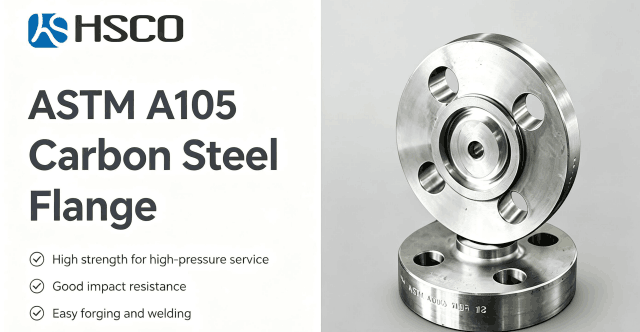
An A105 flange is a pipe connector made from ASTM A105 forged carbon steel, manufactured in accordance with ASME B16.5 (for sizes up to NPS 24) or ASME B16.47 (for large diameters NPS 26-60). It is designed for moderate and high-temperature pressure systems and is the most commonly used carbon steel flange material in oil, gas, petrochemical, and power industries.
Pressure Rating: Covers Class 150 to Class 2500 (ASME B16.5/B16.47).
3. Good machinability: A105 carbon steel is easy to forge, cut, weld and other processing operations, and is convenient for making flanges of various specifications and shapes.
4. Strong versatility: widely used in non-corrosive media systems such as oil, natural gas, electricity, and water supply.
3. Low hardness: Not suitable for high wear conditions (such as sandy media).
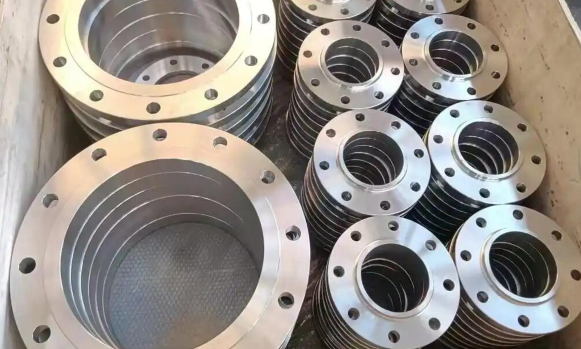
The table below summarizes the most common A105 flange types, their key features, and where they are used.
| Flange Type | Key Feature | Typical Application |
|---|---|---|
| Weld Neck Flange (WN) | Butt-welded, high integrity, reinforced hub | High-pressure, high-temperature, critical services (Class 300-2500) |
| Slip-On Flange (SO) | Slips over pipe, fillet welded | Low-pressure, non-critical systems (Class 150-300) |
| Blind Flange (BL) | Solid plate, no bore | Pipe closure, system isolation, pressure testing |
| Threaded Flange (THD) | Screwed connection, no welding | Low-pressure, non-vibration, small-diameter systems (e.g., fire protection) |
| Socket Weld Flange (SW) | Pipe inserted and fillet welded | Small-diameter, high-pressure systems (NPS ≤ 4") |
| Parameter | Limit | Notes |
|---|---|---|
| Standard Temperature Range | -29°C to 425°C | Normal service range for A105. |
| Above 425°C | Graphitization risk | Use A182 F11/F22 (chrome-moly) instead. |
| Below -29°C | Impact test required | Use A350 LF2 for design temperatures below -46°C. |
The base A105 material is typically supplied in the as-forged condition. When normalized, it is designated as A105N – the normalizing heat treatment refines the grain structure, improving toughness and impact resistance, especially at low temperatures. For critical low-temperature or high-pressure services, many specifications require A105N over standard A105
Non-critical, non-welded connections → Threaded (THD).
Although A105 flanges have many advantages, the following matters should also be noted during use:
1. Inspection before installation: Check flange faces for scratches, cracks, or unevenness that could affect sealing.
2. Welding precautions: For weld neck flanges, control welding temperature and interpass temperature to avoid distortion or cracking.4. Regular inspection: Periodically check bolting torque and flange face condition, especially in high-temperature or vibrating services.
Q1: When should I use a blind flange (BL) instead of other flange types?
A: A blind flange is used primarily to close off the end of a piping system, isolate a section for maintenance, or provide access for pressure testing. Unlike weld neck or slip-on flanges, it has no bore and is a solid plate. It is ideal for temporary or permanent pipe closures and is commonly used in high-pressure systems where a secure seal is required.
Q2: What is the difference between raised face (RF) and ring-type joint (RTJ) flange sealing faces?
A: The raised face (RF) flange has a small raised area around the bore that compresses a gasket to create a seal. It is the most common facing for general service. The ring-type joint (RTJ) flange uses a metal ring gasket that seats into a machined groove, creating a metal-to-metal seal. RTJ flanges are used in high-pressure and high-temperature services where a more robust, leak-proof seal is required, such as in oil and gas applications.
Q3: Can ASTM A105 flanges be welded directly to stainless steel pipes?
A: While technically possible, it is not recommended for corrosive services. Direct welding of carbon steel (A105) to stainless steel can create a galvanic corrosion risk in the presence of an electrolyte. Additionally, the weld area may become susceptible to cracking due to differences in thermal expansion and material properties. For such connections, it is best to use a transition joint or a flange adapter, or to match the flange material to the pipe material (i.e., use a stainless steel flange with a stainless steel pipe).
ASTM A105 pipe flange is an economical and practical choice for industrial pipelines. It offers reliable mechanical properties and good machinability, especially suitable for normal-temperature, non-corrosive, medium to high-pressure conditions. However, it must be used with caution in extreme temperature or corrosive environments – consider upgrading to alloy steel (A182 F11), low-temperature steel (A350 LF2), or stainless steel (A182 F316) as needed. Always consult the ASME B16.5 standard and project specifications for final selection.
Related Resources:
● ASME B16.5 Flange Dimensions – Complete size reference for Class 150-2500 flanges.
● ASTM A105 Carbon Steel Forgings Specification –Detailed material properties and chemical composition.
Related information
Copyright @2017 Hunan Standard Steel Co.,Ltd and Husteel Industry Group All Rights Reserved