sales@hu-steel.com
 English
 Español

Although both hydraulic tubes and mechanical tubes are industrial steel tubes, they have different focuses in industrial applications due to different application scenarios and performance requirements. They have significant differences in materials, size range, manufacturing processes, performance, standards, etc., but they may be cross-used in some scenarios. The following is a detailed comparison:
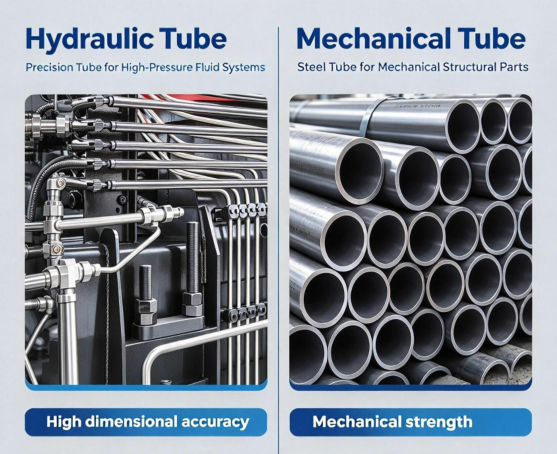 Hydraulic Tube:
● Core requirements: High pressure resistance, fatigue resistance, and sealing.
The table below summarizes the core technical differences at a glance. For a detailed engineering explanation, please refer to the sections below.
| Feature | Hydraulic Tube | Mechanical Tube |
|---|---|---|
| Typical Materials | High-strength carbon steel (E355 / ST52, ASTM A106), 304/316 SS |
Standard carbon steel (ASTM A519 1020, EN 10297 E235) |
| Common Size Range |
OD: 6 mm – 50.8 mm; WT: 0.71 mm – 6.0 mm (Cold drawn) |
OD: Up to 660 mm (per EN 10297) / 325 mm (per ASTM A519); WT: Typically 2 mm – 100 mm (Custom heavy-wall available). |
| Manufacturing | Cold-drawn or precision-rolled seamless pipe | Seamless or welded (depending on application) |
| Inner Wall Treatment | Honed or polished (reduces fluid resistance) | No special treatment (unless rust prevention is required) |
| Surface Treatment | Galvanizing, chrome plating, phosphating | Painting, blackening, galvanizing |
| Delivery Condition | NBK (+N) for bendability, BK (+C) for high strength | As-rolled, normalized, or annealed |
| Defect Tolerance | Zero tolerance: Micro-cracks and pores are strictly prohibited | Minor defects acceptable: Non-pressure bearing |
| Main Standards | EN 10305-4, DIN 2391, ISO 3304 | ASTM A519, EN 10297, JIS G3445 |
*Note: The size ranges above are general references. For detailed OD and WT combinations, please view our full [Cold Drawn Seamless Tube Size Chart].
This is where most buyers make costly mistakes.
Hydraulic systems run hot and under extreme pressure spikes. If the inside of the tube isn't smooth enough, it will chew up the O-rings, and you'll get leaks. That's why real hydraulic tubing has to be cold-drawn to an ID tolerance of ±0.05 mm and a wall thickness of ±5%. It also has to be honed to a mirror finish (Ra ≤ 0.8 μm) to keep the seals intact and survive pressure cycles without corroding.
Mechanical tubes don't have this problem. They just sit there and hold things up (like machine frames or steel rollers). For mechanical tubes, physical strength and straightness are what matter. The inside can be left rough. Their tolerances are standard mill grades (often ±10%), and they don't go through any extra honing steps.

Short answer: One-way interchangeability, but with strict safety limits.
1. Can Hydraulic Tubes Replace Mechanical Tubes?
Yes. Because of their high precision and strength, hydraulic tubes can be used for high-load mechanical structures (like precision guide rails). The only downside is the high cost—you pay for pressure testing you might not actually need.
2. Can Mechanical Tubes Replace Hydraulic Tubes?
Absolutely NOT for high-pressure systems. High-pressure systems strictly require certified tubes (like EN 10305-4) to ensure safety. Ordinary mechanical pipes lack pressure testing and inner wall treatment. Putting one in a high-pressure line is asking for trouble:
1) Leakage: Rough inner walls destroy seals.
2) Bursting: Insufficient pressure bearing capacity is a severe safety hazard.
3) Short Lifespan: It doesn't have the fatigue resistance to survive pressure spikes.
Exception: Very low-pressure return lines (like agricultural equipment) might use thick-walled welded mechanical pipes, but strict hydrostatic testing is mandatory.
Buyers often get confused by related terms. Here is the breakdown:
● Hydraulic Hose vs. Tube: A hose is flexible (rubber/PTFE) and absorbs vibration, ideal for moving parts. A tube is rigid steel, used for high-pressure main lines where absolute stability is needed.
● Hydraulic and Instrumentation Tube: Instrumentation tubes are the "clean room" version of hydraulic tubes. They feature ultra-tight tolerances and ultra-clean inner surfaces for measurement and control systems.
● Mechanical Tubing vs. Structural Tubing: Mechanical tubing is usually cold-drawn to be machined into precision parts (like bearing sleeves). Structural tubing (like GB/T 8162) is for heavy frames where dimensional accuracy is less critical. ▶ Read our full comparison: [Mechanical Tubing vs. Structural Tubing: How to Choose the Right One]
Engineers: If it moves fluid and the pressure is 10 MPa or higher, stick to hydraulic tubes. For pure structural support, use mechanical tubes to save money.
Procurement/QA: Always ask for the hydrostatic test report (ISO 10763) for hydraulic tubes and check the inner wall finish. For mechanical tubes, focus on straightness and pick the right anti-rust coating (galvanized or painted) for your environment.
A hydraulic tube is basically a precision-engineered mechanical tube. Both might use similar steel chemistry, but the hydraulic version goes through much stricter drawing, honing, and testing.
Never try to save a few bucks by putting a mechanical tube into a high-pressure hydraulic system. The cost of a blown seal or a burst line is way higher than the price difference.
Email: sales@hu-steel.com
Read more:
● Precision Hydraulic Seamless Tube
● EN 10305 Cold Drawn Precision Steel Tubes
● Cold Drawn Seamless Tube Size Chart: Mechanical & Hydraulic
Related information
Copyright @2017 Hunan Standard Steel Co.,Ltd and Husteel Industry Group All Rights Reserved