sales@hu-steel.com
 English
 Español
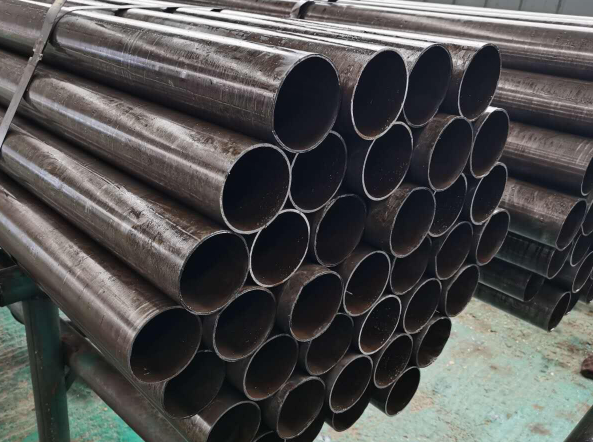
Cold rolled seamless tube is a precision-engineered tubing product manufactured through cold working at room temperature. Unlike hot rolled seamless tubes, which are processed above the recrystallization temperature (approximately 1,200°C), cold rolled tubes are formed through compressive rolling forces at ambient temperature, resulting in higher dimensional accuracy, smoother surface finish, and enhanced mechanical properties.
Compared with welded steel pipes, cold rolled seamless tubes offer superior strength and reliability due to the absence of a weld seam.
While the terms "pipe" and "tube" are often used interchangeably in everyday language, they are manufactured to different standards in the industry. Pipe is typically specified by nominal pipe size (NPS) and schedule (wall thickness), whereas tube is specified by exact outside diameter and wall thickness. Cold rolled seamless tubes are held to tighter dimensional tolerances than pipes, making them the preferred choice for precision engineering applications.
Unlike cold drawing, which pulls pipe through a die using tensile forces, cold rolling uses compressive rolling forces. This allows higher production efficiency (20–50 m/min vs. 3–10 m/min for cold drawing) and better capability for producing thin-wall tubes.
Common standards for cold rolled seamless tubes include ASTM A519 for mechanical tubing and ASTM A513 for cold-formed seamless tubes.
| Parameter | Typical Tolerance Range |
|---|---|
| Outside Diameter | ±0.05mm to ±0.10mm |
| Wall Thickness | ±5% to ±10% of nominal wall |
| Straightness | ≤ 1.0mm per meter |
| Surface Roughness (Ra) | ≤ 0.4μm (hydraulic applications) |
5. Aerospace and Nuclear Power – Small-diameter precision components for hydraulic and fuel systems in aircraft, as well as high-strength tubes for nuclear power equipment, require the exceptional quality and reliability that cold rolled seamless tubes provide.
Compared to hot rolled pipes, which are commonly used in oil/gas pipelines and general structural applications, cold rolled seamless tubes are specifically selected for applications where precision, surface quality, and dimensional stability are critical.
Raw material selection:
Raw material selection is a critical first step in the manufacturing process. Under normal circumstances, the raw materials selected should be high-quality carbon structural steel or alloy structural steel. The quality of raw materials directly affects the quality and performance of the finished pipes, so the material selection needs to be very careful.
The main process sequence for cold rolled seamless tube production is:
△ Hot Rolled Pipe → Annealing → Pickling → Phosphorizing → Saponifying → Cold Rolling (multi-pass) → Degreasing → Heat Treatment → Straightening → Inspection → Marking → Storage
The key steps are as follows:
1. Annealing – Softens the material and prepares the microstructure for cold deformation.
2. Pickling – Removes surface oxide scale and impurities.
3. Phosphorizing & Saponifying – Forms a lubricating layer to reduce friction during rolling.
4. Cold Rolling – Progressively reduces OD and wall thickness; single-pass reduction typically does not exceed 50%.
5. Degreasing – Removes residual rolling lubricants.
6. Heat Treatment – Eliminates stresses and achieves final mechanical properties.
7. Straightening & Inspection – Meets dimensional standards and verifies quality.
1. Dimensional Inspection – Outside diameter, wall thickness, roundness, and straightness are measured with high-precision instruments to ensure compliance with ASTM A519 tolerances and customer specifications.
2. Surface Quality – Both outer and inner surfaces are inspected for defects such as cracks, scratches, pitting, and inclusions. For hydraulic applications, inner surface roughness (Ra) is measured to ensure it meets the required standard (typically ≤ 0.4μm).
3. Mechanical Property Testing – Tensile strength, yield strength, hardness, and elongation are tested to verify that the tube meets the required mechanical performance standards.
4. Non-Destructive Testing (NDT) – Ultrasonic testing (UT) and eddy current testing (ET) are applied to detect internal and surface defects without damaging the tube. Hydrostatic testing is also performed to verify pressure integrity.
5. Wall Thickness Uniformity – Ensuring consistent wall thickness across the entire tube length and circumference is critical for applications such as hydraulic cylinders and drive shafts, where uneven wall thickness can lead to premature failure.
| Selection Factor | Consideration |
|---|---|
| Material Grade | Choose carbon steel (e.g., ASTM A519 1020/1045) or alloy steel based on strength and wear resistance requirements. |
| Dimensional Tolerances | Specify required OD, wall thickness, and straightness tolerances. H8/H9 grades are common for hydraulic applications. |
| Surface Finish | For sealing or fluid applications, specify surface roughness (Ra) requirements. |
| Mechanical Properties | Define tensile strength, yield strength, and hardness requirements based on application loads. |
| End Use | Consider whether the tube will be used as-manufactured or require additional processing (honing, machining, coating). |
▶ For a complete understanding of the cold rolling process, including detailed step-by-step descriptions and comparisons with hot rolled and cold drawn seamless pipes, refer to our comprehensive guide: [Cold Rolled Seamless Steel Pipe – Manufacturing Process, Advantages & Selection Guide].
Read more:
● Seamless Steel Pipe Sizes and Weights
● What is Seamless Mechanical Tubing?
● Hot Rolled Seamless Steel Tube
● Cold Drawn Seamless Tube Manufacturing ProcessRelated information
Copyright @2017 Hunan Standard Steel Co.,Ltd and Husteel Industry Group All Rights Reserved