sales@hu-steel.com
 English
 Español
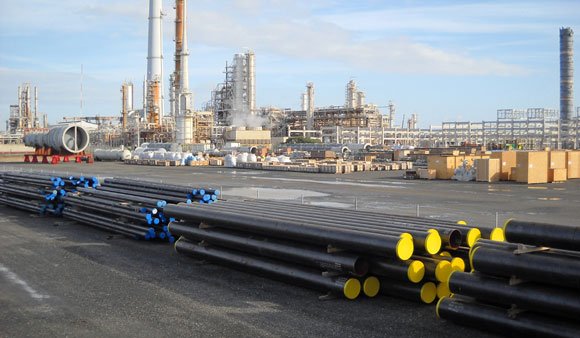
ASTM A513 ERW carbon steel pipe covers round, square, rectangular, and special shape tubing.
Standard Definition:
Suitable for carbon steel and alloy steel mechanical tubing produced by the electric resistance welding (ERW) process, including round, square, and rectangular tubing made from hot-rolled or cold-rolled steel.
Manufacturing Process:
The core process is electric-resistance welding. After cold-rolling the steel strip, an electric current is passed through the tube blank to heat the edges until they are molten, and then the tubes are welded together under pressure. Filler metal is typically not added to the weld.
Applications:
Mechanical and structural applications. This means these pipes are primarily used to carry loads, serve as moving parts, or form product frames, rather than to transport fluids. Examples include automotive chassis components, bicycle frames, shopping carts, furniture, office equipment, agricultural machinery components, and sports equipment.
Technical Parameters:
Covers pipe wall thickness tolerances (such as strict tolerances for unspecified thicknesses), outer diameter range (9.5-380mm), and length (3-12 meters).
Materials:
Covers carbon steel and alloy steel. Common steel grades include:
1010, 1015, 1020, 1026 (ordinary carbon steel)
4130, 4140, 8620 (alloy steel, offering higher strength)
Applications: Automotive manufacturing, construction machinery, precision instruments, and other fields requiring high-strength welded pipes.
An analysis of each heat of steel shall be made by the steel manufacturer to determine the percentages of the elements specified. The chemical composition for common grades is shown below:
| Grade | C (%) | Mn (%) | P (≤%) | S (≤%) | Notes |
|---|---|---|---|---|---|
| 1010 | 0.08-0.13 | 0.30-0.60 | 0.035 | 0.035 | General purpose, good formability |
| 1020 | 0.17-0.23 | 0.30-0.60 | 0.035 | 0.035 | Higher strength than 1010 |
| 1026 | 0.22-0.28 | 0.60-0.90 | 0.035 | 0.035 | Higher carbon for increased strength |
| 4130 | 0.28-0.33 | 0.40-0.60 | 0.035 | 0.040 | Chromium-molybdenum alloy steel |
| 4140 | 0.38-0.43 | 0.75-1.00 | 0.035 | 0.040 | Higher strength alloy steel |
| 8620 | 0.18-0.23 | 0.70-0.90 | 0.035 | 0.040 | Nickel-chromium-molybdenum alloy |
Note – Chinese Grade Equivalents:
ASTM 4140 alloy steel corresponds to Chinese grade 42CrMo. Carbon steels such as 1015 and 1026 correspond to 20Cr and 20# steel, respectively.
Minimum mechanical properties for common ASTM A513 grades:
| Grade | Tensile Strength (MPa) | Yield Strength (MPa) | Elongation (%) | Hardness (HRB) |
|---|---|---|---|---|
| 1010 | 379 | 310 | 12 | ~60 |
| 1020 | 448 | 379 | 10 | ~70 |
| 1026 | 517 | 448 | 10 | ~75 |
| 4130 | 621 | 552 | 10 | ~85 |
| 4140 | 655 | 586 | 8 | ~90 |
| 8620 | 586 | 448 | 10 | ~80 |
Testing Requirements: When requested on the purchase order, a product analysis shall be made by the supplier. If the original test for product analysis fails, retests of two additional lengths shall be made. Both retests for the elements in question shall meet the requirements of the specification; otherwise, all remaining material in the lot shall be rejected.
ASTM A513 covers three primary types of ERW mechanical tubing, each distinguished by its manufacturing process and resulting properties. Use this table to understand the differences in size range, surface finish, and typical applications—from general structural use (Type 1) to high-precision components (Type 5 DOM).
| Type | Manufacturing Process | Outside Diameter & Wall Thickness | Key Characteristics | Typical Applications |
|---|---|---|---|---|
| Type 1 | ERW from Hot-Rolled Steel |
OD: 1/2" to 15" (19.0 to 381.0 mm) WT: 0.065" to 0.650" (1.65 to 16.50 mm) |
Lower cost, as-rolled surface | Furniture, racks, general structures |
| Type 2 | ERW from Cold-Rolled Steel |
OD: 3/8" to 12" (9.92 to 304.8 mm) WT: 0.022" to 0.134" (0.71 to 3.40 mm) |
Smooth surface, tight tolerances | Bicycle frames, office furniture, exercise equipment |
| Type 5 (DOM) | Drawn Over Mandrel (DOM tubing) | Varies (precision sizes) | Superior finish, extremely tight tolerances, uniform wall | Hydraulic cylinders, shock absorbers, precision shafts |
▶ For more details on seamless mechanical steel tubing specifications, please refer to: [Mechanical Tube Size Chart].
While both are ERW carbon steel tubes, they serve different purposes:
| Aspect | ASTM A513 (Mechanical Tubing) | ASTM A500 (Structural Tubing) |
|---|---|---|
| Primary Purpose | Mechanical and machined parts | Structural load-bearing members |
| Key Properties | Dimensional accuracy, machinability | Strength, load-carrying capacity |
| Typical Shapes | Round, square, rectangular, special | Square, rectangular, round |
| Common Grades | 1010, 1020, 1026, 4130, 4140, 8620 | Grade A, B, C, D |
| Applications | Hydraulic cylinders, driveshafts, furniture | Building columns, bridges, frames |
▶ For more detailed comparisons of mechanical and structural tubing, please refer to:[Mechanical Tubing vs. Structural Tubing].
Due to its high dimensional accuracy and excellent machinability, ASTM A513 mechanical tubing is widely used in:
1. Automotive Manufacturing: Chassis components, drive shafts, steering columns, axle housings
2. Construction Machinery: Hydraulic cylinder bodies, agricultural implement frames
3. Precision Instruments: Bearing retainers, sensor housings, medical equipment frames
4. Consumer Products: Bicycle frames, exercise equipment, shopping carts, furniture, office chairs
5. General Industry: Conveyor rollers, display racks, scaffolding components
Q1: Can ASTM A513 tubing be used for pressure applications?
→ No. ASTM A513 is a mechanical standard, not a pressure-containing standard. It is not intended for transporting fluids under pressure. For pressure applications, use ASTM A53 or API 5L.Q2: What is the difference between Type 2 and Type 5 (DOM)?
→ Type 2 is standard ERW from cold-rolled steel with a smooth surface. Type 5 (DOM) is drawn over a mandrel after welding, which further improves dimensional accuracy, surface finish, and concentricity, making it suitable for precision applications like hydraulic cylinders.
Related Resources:
● Carbon Steel ERW Pipe Specification
● SAW vs ERW and EFW Welded Steel Pipe
Related information
Copyright @2017 Hunan Standard Steel Co.,Ltd and Husteel Industry Group All Rights Reserved