In piping systems, pipe reducers are essential fittings when connecting pipe sections of different diameters. They are mainly divided into two types: Concentric Reducers and Eccentric Reducers. Although their function is the same—to change the diameter of pipes—they differ fundamentally in structure, applicable scenarios, and installation requirements. Choosing the wrong type or installing them in the wrong direction can seriously affect system operation, such as causing pump cavitation or liquid accumulation in the pipes.
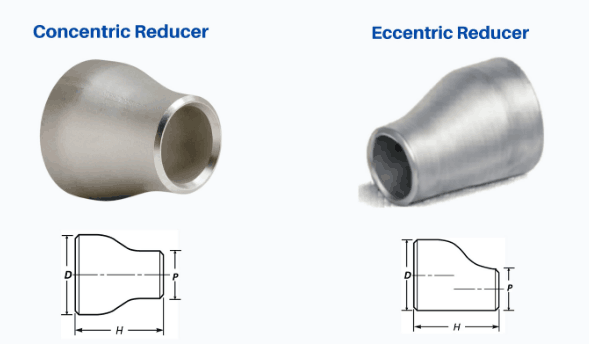
Core Difference: Structure and Centerline
The most fundamental difference between the two lies in whether the centerlines of the two pipe ends are on the same axis.
|
Feature
|
Concentric Reducer
|
Eccentric Reducer
|
|
Centerline
|
Centerlines of both ends are aligned on the same axis.
|
Centerlines are offset; not on the same axis.
|
|
Cross-section shape
|
Symmetric conical transition.
|
One side is straight, the other is inclined, exhibiting an asymmetrical transition.
|
|
Projection relationship
|
Small circle is concentric with the large circle.
|
Small circle is tangent to (and inscribed within) the large circle.
|
This structural difference determines their distinct roles under different operating conditions
.
Concentric Reducers: When to Use?
The structure of concentric reducers ensures symmetrical and gradual flow path changes, minimizing interference with the flow regime. Its core applications are as follows:
1. Vertical Piping Systems: This is the most typical and preferred application scenario for concentric reducers. When changing diameter on a vertical riser, there is no need to consider liquid accumulation at the bottom of the pipe or gas separation at the top. The concentric structure maintains flow path symmetry, reducing resistance. Commonly used in building water supply risers, chemical tower connection pipes, etc.
2. Horizontal Gas Pipelines: For horizontal pipelines transporting gas or steam, concentric reducers can avoid localized liquid accumulation or additional pressure drops that may be caused by eccentric structures.
3. Pump Outlet Pipelines: Concentric reducers are typically chosen on the outlet side of centrifugal pumps. This is because the primary consideration here is the efficient conversion of the pumped medium's kinetic energy into static pressure energy, and the concentric structure provides a more uniform flow field.
4. Equipment Interfaces Sensitive to Fluid Disturbances: For upstream and downstream of flow meters and control valves, a smooth fluid transition is required to ensure measurement and control accuracy, making concentric reducers a preferred choice in these cases.
Eccentric Reducers: Why are they the first choice for pump inlets and horizontal pipes?
The value of eccentric reducers lies in the fact that one side is flat (i.e., there is a horizontal straight edge). This design provides a key means of solving the "venting" and "draining" problems in piping systems.
1. Pump Inlet Pipelines (Core Application, Preventing Cavitation)
This is the most important application of eccentric reducers. To prevent pump cavitation, an eccentric reducer must be used on the pump's inlet horizontal line, and it must be installed
"Flat on Top" (FOT).
Principle: When liquid flows from a large-diameter pipe to a small-diameter pump inlet, if a concentric reducer is used, an "air pocket" or "cavitation" will form at the top of the pipe. This accumulated gas enters the pump body with the liquid, causing severe cavitation and damaging the impeller. With a "Flat on Top" eccentric reducer, the top is flat, preventing gas accumulation; the gas is flushed away by the liquid flow, thus protecting the pump.
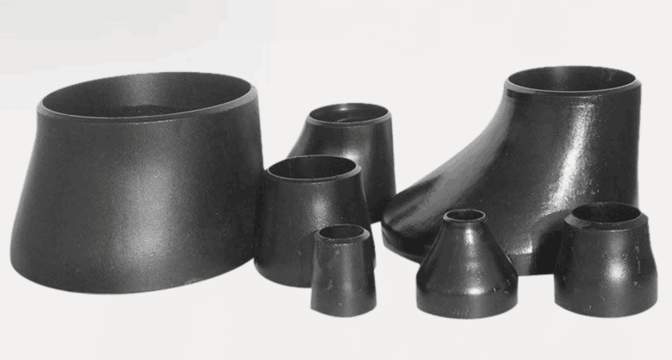
2. Horizontal Piping Systems
● Liquid Piping (Drainage Requirements): Horizontal liquid piping should be installed
"Flat on Bottom" (FOB). This ensures the bottom of the pipe remains at the same level, facilitating complete drainage of liquid and preventing impurities or solid particles from accumulating and clogging the diameter change.
● Gas/Steam Piping (Drainage Requirements): In horizontal piping handling gas or steam, condensate will form as the temperature decreases. At this point, a top-flat installation should be used to prevent condensate from accumulating at the bottom of the pipe, avoiding water hammer or accelerated corrosion.
3. Pipe Gallery Support Design
When laying pipes in a pipe gallery, if concentric reducers are installed in horizontal pipe sections, the change in pipe diameter will alter the bottom elevation of the pipe, making it impossible to place the pipe stably on supports at the same elevation. Using bottom-flat eccentric reducers maintains a constant bottom elevation (BOP) of the pipe, greatly simplifying support design and installation.
Quick Reference Table for Pipe Reducer Selection
To help you make a quick decision, the following table summarizes the main selection scenarios for concentric and eccentric reducers:
|
Application Scenario
|
Recommended Type
|
Installation Requirement
|
Core Purpose
|
|
Vertical pipelines
|
Concentric reducer
|
No specific orientation
|
Symmetric flow, reduced resistance
|
|
Horizontal gas pipelines
|
Concentric reducer
|
No specific orientation
|
Avoid liquid accumulation, stable flow
|
|
Pump discharge (outlet)
|
Concentric reducer
|
No specific orientation
|
Efficient conversion of kinetic to pressure energy
|
|
Pump suction (inlet) - horizontal
|
Eccentric reducer
|
Must be flat side up (FOT)
|
Prevent cavitation, protect pump
|
|
Horizontal liquid lines (drainage)
|
Eccentric reducer
|
Must be flat side down (FOB)
|
Complete drainage, prevent sediment buildup
|
|
Horizontal gas lines (condensate)
|
Eccentric reducer
|
Must be flat side up (FOT)
|
Prevent condensate pooling, reduce water hammer & corrosion
|
|
Pipe rack / horizontal support
|
Eccentric reducer
|
Must be flat side down (FOB)
|
Maintain constant Bottom of Pipe (BOP) elevation for easy support
|
Ready to Order?
Tell us your:
● Upstream and downstream pipe sizes (e.g., 8" x 6")
● Required wall thickness (
Sch 40, Sch 80, etc.)
● Material grade (WPB, WP304, etc.)
We will reply with a confirmed specification and lead time within 24 hours.
▶
[Get Your Quote Now]
FAQ:
Q1: How should an eccentric reducer be oriented during installation?
A: Horizontal liquid pipes should have a flat top (to prevent cavitation), and horizontal gas pipes should have a flat bottom (to prevent liquid accumulation). This is the most critical practical issue when selecting an eccentric reducer.
Q2: When should I use a concentric reducer vs. an eccentric reducer?
A: Use concentric reducers for vertical pipes and eccentric reducers for horizontal liquid/pump inlets. This helps users quickly decide between the two types.
Q3: How do I read the size marking on a reducer (e.g., 6" x 4")?
A: The marking order is usually: large end × small end, to avoid problems caused by incorrect order during procurement and installation.
Q4: What is the difference between ANSI B16.9 and MSS SP-75 reducers?
A:
ANSI B16.9 is a general standard, while MSS SP-75 is suitable for larger diameter pipelines requiring higher strength.
Q5: Can I use a reducer with a different wall thickness than my pipe?
A: It must be matched; otherwise, it will cause stress concentration during welding, posing a safety hazard. This is a critical detail for engineering safety.
Read more:
● Types of Pipe Reducers
● Pipe Reducer Size Selection
● Seamless vs. Welded Pipe Fittings: A Procurement Guide for Industrial Buyers
● ASTM A403 WP316/316L Stainless Steel Butt-weld Pipe Fittings
 sales@hu-steel.com
 English
 Español