sales@hu-steel.com
 English
 Español
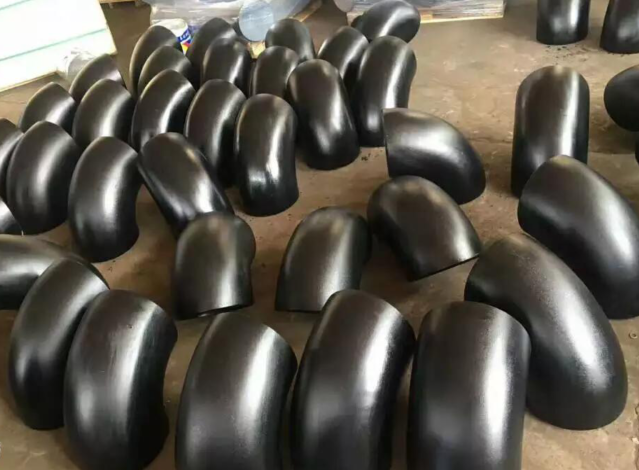
Seamless steel pipe fittings and welded steel pipe fittings are the two most widely used types of pipe fittings in industrial piping systems.
Simply put, seamless steel pipe fittings are made from seamless steel pipes through processes such as pressing, pushing, and forging. Their main characteristic is that the entire fitting has no weld seams; it is a complete metal unit. Welded pipe fittings, on the other hand, are made by rolling steel plates (strips) into shape and then welding them together, resulting in a single weld seam on the surface.
|
Comparison Dimensions |
Seamless Steel Pipe Fittings |
Welded Steel Pipe Fittings |
|
Features |
Seamless, integrally formed, structurally complete; |
Has one longitudinal or spiral weld seam. |
|
Production Process |
Heated round steel billet, pierced, rolled, and drawn; |
Steel plate (strip) rolled and welded. |
|
Pressure/Temperature |
High pressure resistance, excellent high-temperature resistance; |
Relatively lower pressure rating, suitable for medium and low pressure environments. |
|
Dimensional Accuracy |
Larger wall thickness tolerance, may result in uneven wall thickness; |
Uniform wall thickness, high dimensional accuracy, smooth inner and outer surfaces. |
|
Cost and Price |
Complex process, expensive; |
High production efficiency, cheaper, more than 25% lower than seamless pipes. |
|
Diameter Range |
Limited by the process, mainly small to medium diameters; |
Can produce large diameter pipe fittings, no equipment limitations. |
b. Mechanical Strength: Under harsh conditions of high pressure, high temperature, or complex stress, seamless steel pipes remain the preferred choice due to their structural advantage of having no weld seams, resulting in superior overall strength and reliability.
|
Application Scenarios |
Recommended Choice |
Reasons |
|
High pressure and high temperature environments (e.g., boilers, petrochemical reactors, main steam pipelines) |
Seamless steel pipe fittings |
No weld seams, providing the highest safety margin and reliability. |
|
Highly corrosive media (e.g., chemical fluids, submarine pipelines) |
Depends on the situation |
Seamless pipes or high-quality welded pipes that have passed rigorous corrosion tests are preferred. Focus on weld quality and heat treatment processes. |
|
General low- and medium-pressure fluids (such as water, gas, and air conditioning water) |
Welded steel pipe fittings |
High cost-effectiveness, fully meet requirements, and effectively control costs. |
|
Large-diameter pipelines (such as long-distance oil and gas pipelines and circulating water mains) |
Welded steel pipe fittings (especially spiral welded pipes) |
Seamless processes are difficult to produce ultra-large diameter fittings. |
|
High-precision requirements (such as heat exchanger tubes and instrument tubes) |
Welded steel pipe fittings |
Welded steel pipe fittings offer superior wall thickness tolerances and concentricity, ensuring uniform heat exchange. |
Experience Summary: If the project budget is sufficient and the operating conditions are extreme (high temperature, high pressure, high corrosion, high risk), seamless pipes should be prioritized. For most other conventional operating conditions, high-quality welded pipes are a more economical choice, and their performance is sufficient.
Current technological breakthroughs, through post-weld cold rolling thinning (overall or only the weld seam) and solution heat treatment, can significantly refine the weld grains and eliminate residual welding stress, enabling high-quality welded pipe fittings to achieve or even surpass the corrosion resistance of seamless pipes of the same material.
Read more: Pipe Elbow Dimensions & Sizes– Long & Short Radius Elbow Dimensions in mm
Related information
Copyright @2017 Hunan Standard Steel Co.,Ltd and Husteel Industry Group All Rights Reserved