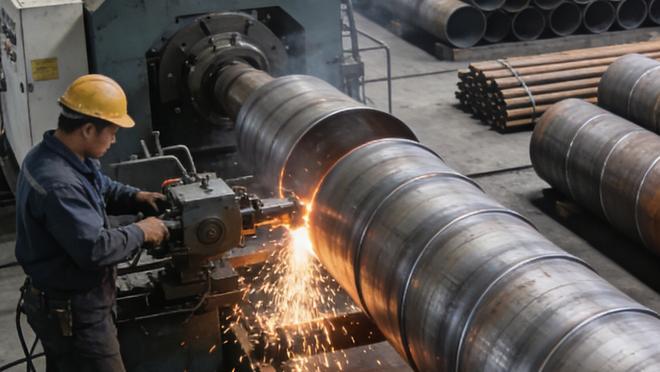
SSAW steel pipe, short for Spiral Submerged Arc Welded Pipe, is a large-diameter
welded steel pipe manufactured by spiral forming of hot-rolled steel strip or coil and then double-sided submerged arc welding. Due to its high production efficiency, relatively low cost, and ability to produce large-diameter pipes, SSAW steel pipe is widely used in oil, natural gas, water transportation, building structures, and pile foundation engineering.
Among numerous technical standard systems, American standards (API, ASTM, etc.) are among the most frequently referenced specifications in SSAW steel pipe manufacturing and procurement due to their comprehensive system and high international engineering recognition. This article will mainly introduce the American standard material classification and selection guidelines for SSAW steel pipe.
1) API 5L Standard Pipeline Steel – The Core Material for Oil and Gas Transportation
The
API 5L standard, developed by the American Petroleum Institute (API), is one of the most widely used and stringent general standards for pipeline steel pipes in the global oil and gas industry. Under this standard, SSAW steel pipes are classified into two performance levels: PSL1 and PSL2. PSL2 has stricter requirements in terms of chemical composition, mechanical properties, toughness, and non-destructive testing, making it suitable for harsh conditions such as high pressure, low temperature, or acidic media.
Common steel grades include:
●
GR.A and B grades: As basic steel grades, GR.B is the most versatile and cost-effective choice, suitable for transportation environments with general pressure and low corrosiveness.
●
X42-X80 series: This is the high-strength pipeline steel series in the API 5L standard. The numbers represent the minimum yield strength (in ksi, thousand pounds per square inch). For example, X42 has a yield strength of 42 ksi (approximately 289 MPa), while X80 has a yield strength as high as 80 ksi (approximately 552 MPa). In long-distance high-pressure oil and gas pipelines, steel grades such as X52, X60, X65, and X70 are widely used due to their good strength-toughness balance.
2) ASTM A53 Standard – General and Low-Pressure Piping Materials
The
ASTM A53 standard covers
seamless and welded black steel pipes and
hot-dip galvanized steel pipes, suitable for mechanical and pressure applications, and commonly used for the transport of steam, water, air, and natural gas.
The main steel grades under this standard are GR.A and GR.B, with GR.B offering higher strength and being the most commonly used choice. Unlike API 5L, which is strictly targeted at the oil and gas industry, ASTM A53 has a broader range of applications, covering various scenarios from fire-fighting piping in civil buildings to general industrial fluid transport.
3) ASTM A252 Standard – Pile Foundation and Structural Specific Materials
ASTM A252 is a standard specifically for welded and seamless steel pipes used in pile foundations. SSAW steel pipes are often used as helical pile pipes in the foundation treatment of bridges, docks, and high-rise buildings.
This standard classifies steel into three grades: Grade 1, Grade 2, and Grade 3, based on the mechanical properties and wall thickness requirements. Grade 3 steel has the highest strength and is suitable for deep foundation projects requiring significant axial loads. These steel pipes have specific requirements for roundness, straightness, and crush resistance to meet the harsh conditions of piling.
4) ASTM A671 Standard – Medium and Low Temperature Pressure Vessels and Piping
The
ASTM A671 standard primarily targets electrofusion welded steel pipes, suitable for high-pressure piping systems in medium and low temperature environments (-29℃ to +343℃). The CB70 grade is a typical carbon-manganese steel material with a minimum yield strength requirement of 70 ksi (approximately 483 MPa).
Materials under this standard have strict control over the carbon, sulfur, and phosphorus content in their chemical composition and possess good low-temperature impact toughness. They are commonly used in chemical plants, nuclear power auxiliary systems, and industrial pipelines with special welding quality requirements.
Other related ASTM standards:
In addition to the above mainstream standards, the production of SSAW steel pipes may also involve standards such as ASTM A1005 (double-sided submerged arc welded black steel pipe for mains lines). Furthermore, in some structural applications, standards such as ASTM A572 (High Strength Low Alloy Niobium Vanadium Structural Steel) may be referenced to procure specific steel grades of raw materials.
Conclusion:
SSAW steel pipes under the American standard system offer a wide variety of materials, and the selection criteria primarily depend on the specific application conditions:
If you are responsible for long-distance oil and gas pipeline projects, the X42 to X80 series pipeline steels under the API 5L standard are the professional choice;
If you need general fluid transportation or mechanical structural pipes,
ASTM A53 GR.B standard offers excellent cost-effectiveness;
If you are involved in foundation engineering, you should strictly adhere to ASTM A252 standard Grade 1-3 for material selection;
If facing medium-low temperature, high pressure, and special safety regulatory requirements, ASTM A671 CB70 can meet more stringent performance specifications.
Read more: SSAW Steel Pipe Sizes Chart
 sales@hu-steel.com
 English
 Español