How to Distinguish Between ERW and LSAW Pipes?
ERW (Electric Resistance Welded Pipe) and LSAW (Longitudinal Submerged Arc Welded Pipe) are two mainstream types of straight seam welded pipes. Their core differences lie in raw materials, manufacturing processes, and applicable scenarios: ERW pipe uses hot-rolled coils for high-speed continuous production of small- and medium-diameter pipes, offering high cost-effectiveness; LSAW pipe uses medium- and heavy plates for single-sheet forming to produce large-diameter, thick-walled pipes, providing stronger pressure resistance and reliability.
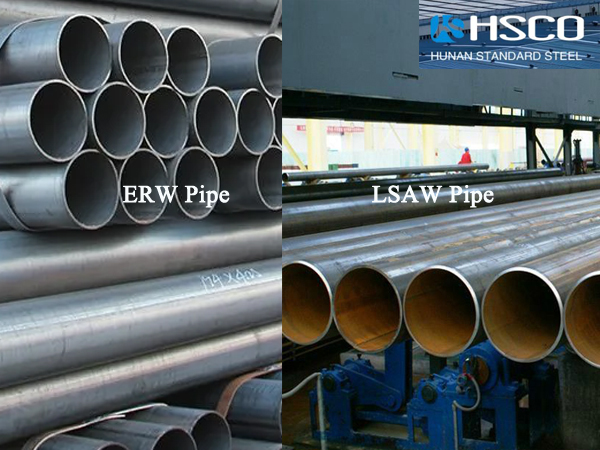
ERW vs LSAW Pipe: Key Differences Comparison Table
The following is a detailed parameter comparison between ERW and LSAW pipes:
Comparison Dimensions
|
ERW (Electric Resistance Welded Pipe)
|
LSAW (Longitudinal Submerged Arc Welded Pipe)
|
Raw Materials
|
Hot-rolled steel coils
|
Single-sheet medium-thick steel plates
|
Forming Process
|
Continuous roll forming
|
Single-sheet pressing (UOE/JCOE, etc.)
|
Welding Method
|
High-frequency resistance welding (no welding wire, weld composition close to the base material)
|
Submerged arc welding (with welding wire and flux, double-sided welding)
|
Outer Diameter Range:
|
10mm - 610 mm (Advantageous range ≤ 24 inches)
|
406mm - 1422 mm (Advantageous range ≥ 16 inches)
|
Wall Thickness Range
|
≤ 20 mm (Limited thick-wall production capacity)
|
≤ 40 mm (Some can reach over 50 mm)
|
Weld Coefficient
|
0.85 - 1.00 (Relies on strict non-destructive testing)
|
1.00 (Double-sided welding + full weld flaw detection, high reliability)
|
Dimensional Accuracy
|
High (tight OD and WT tolerances))
|
Good (improved roundness after expanding)
|
Cost
|
Low (high production efficiency, high material utilization)
|
Medium/High (complex process, large investment)
|
Core Advantages
|
Low cost, high precision, high production efficiency
|
Large diameter, large wall thickness, high pressure resistance, low temperature/corrosion resistance
|
Selection Guide: 3 Steps to Determine Which Pipe You Need
The choice between ERW and LSAW welded pipes mainly depends on the project's pipe diameter, pressure level, operating conditions, and budget. ERW pipes are suitable for most conventional, low-to-medium pressure conveying tasks; while LSAW welded pipes are specifically designed for critical projects requiring high pressure, large diameter, and high reliability.
1. By Pipe Diameter: When to Choose ERW or LSAW
For pipe diameters of DN600 (24 inches) and below: ERW welded pipes are usually the first choice. Within this size range, ERW offers the highest production efficiency, lowest cost, and best dimensional accuracy, providing an overwhelming economic advantage.
For pipe diameters of DN400 (16 inches) and above: LSAW welded pipes gain an advantage. When the pipe diameter exceeds the economic production limit of ERW (approximately 24 inches), LSAW is the only feasible straight seam welded pipe process. Especially for diameters above DN1000 (40 inches), LSAW is almost the only option.
2. By Pressure and Service Conditions: Performance Matters
Low and Medium Pressure, Conventional Environments: For urban water supply, gas transmission and distribution, fire-fighting pipelines, low-pressure steam, and building structural support, ERW welded pipes fully meet pressure and safety requirements and offer the highest cost-effectiveness.
High Pressure, High-Risk, or Extreme Environments: For long-distance high-pressure oil and gas pipelines (e.g., above 10MPa), crossing rivers or earthquake zones, submarine pipelines, and projects transporting highly toxic or flammable and explosive media, the double-sided submerged arc welding process of LSAW welded pipes provides higher weld strength and reliability. Its weld coefficient can reach 1.0 (equal strength to the base material), and it undergoes 100% non-destructive testing, resulting in greater safety redundancy. In these fields, regulations often mandate the use of LSAW.
3. By Wall Thickness and Special Needs: Reliability Matters
Thick Wall Requirements: When the wall thickness exceeds 20mm, the welding process and quality control of ERW (Electrical Wire Welded) become drastically more difficult. LSAW (Laminated Steel Wire Welded) can easily weld steel plates 40mm or thicker, making it suitable for deep-sea subsea pipelines or high-pressure vessels.
High Steel Grade: Both can produce high-steel grade (e.g.,
X70, X80) line pipes. However, LSAW performs better in terms of extreme low-temperature toughness and fracture toughness, better meeting the stringent standards of Arctic or deep-sea projects.
ERW vs LSAW Pipe Applications: Where to Use Each
1) Applications of ERW welded pipes
● Urban Lifelines: Urban water supply and low-to-medium pressure gas (≤4MPa) transmission networks.
● Building and Structures: Fire risers, sprinkler systems, scaffolding, and steel structure support columns in high-rise buildings.
● Industrial Sector: Compressed air, steam, and general industrial circulating water pipelines in factories.
● Machinery Manufacturing: Automobile drive shafts, agricultural machinery frames, furniture tubing, etc.
2) Applications of LSAW welded pipes
● National energy arteries: High-pressure, long-distance oil and gas transmission trunk lines spanning provinces and countries.
● Marine engineering: Jacket structures for offshore oil and gas fields, subsea oil/gas pipelines, and pile foundations and structural pipes for offshore platforms.
● Urban high-pressure pipeline networks: High-pressure (4-10MPa) gas pipelines connecting gate stations to urban ring networks.
● Major infrastructure: Water diversion pressure steel pipes for large-scale water conservancy projects, steel pipe piles for cross-sea bridges, and the main cylinder of wind turbine towers.
Frequently Asked Questions about ERW and LSAW Pipe Selection:
Q1. How to choose between ERW and LSAW pipes in the oil and gas industry?
A: The oil and gas industry selects pipes based on pressure level and region:
Gas production pipelines (high pressure): Seamless steel pipes are preferred;
Gas gathering branch lines transporting moist gas: LSAW pipe is recommended;
Long-distance trunk lines: When passing through high-altitude cold regions, seabeds, densely populated urban areas, etc., the API standard exclusively specifies LSAW; In ordinary areas (Class III and IV),
spiral submerged arc welded pipes (SSAW) can be used;
In urban gas low- and medium-pressure pipelines: ERW is an economical and efficient choice.
Q2. Which is cheaper, ERW or LSAW pipes?
A: Under the same specifications, ERW is cheaper:
ERW: Continuous production using hot-rolled coils, high material utilization, high production efficiency, and lowest cost;
LSAW: Single-sheet pressing of medium-thick plates, complex process, long welding time, and moderate cost.
Economical selection advice: Under the same wall thickness and steel grade, ERW should be chosen whenever possible. Large diameter pipes (>24 inches) can only be LSAW, where cost differences are meaningless.
Q3: Can welding defects be repaired on-site?
Minor leaks or small defects: can be repaired by grinding and then locally welding. After repair, appropriate non-destructive testing (UT/MT) and pressure testing must be performed to verify integrity. Serious defects: the damaged section should be removed, replaced with a new section, and a hydrostatic test should be performed according to standards.
Q4: With the same wall thickness and steel grade, which can withstand higher pressure, ERW or LSAW?
A: LSAW. This is because its weld coefficient is 1.0 (equal strength to the base material), while ERW weld coefficients are typically designed to be 0.85~1.0. Under the same design conditions, LSAW pipes have a larger design stress margin and are more suitable for high-pressure, high-risk operating conditions.
Q5: What international standards do ERW and LSAW steel pipes comply with?
A: Both comply with the API 5L pipeline steel standard, but with different focuses:
● ERW pipes: Common standards also include
ASTM A53 (low-pressure applications) and
EN 10219 (European standard structural pipe).
● LSAW pipes: Emphasis is placed on API 5L PSL2 (high-pressure oil and gas trunk lines), while large-diameter structural pipes can also comply with ASTM A252.
Key difference: ASTM A53 is a unique and commonly used standard for ERW, while LSAW focuses more on the API 5L system.
Read more: ERW Pipe Wall Thickness Size Chart
 sales@hu-steel.com
 English
 Español