sales@hu-steel.com
 English
 Español
Spiral Submerged Arc Welded (SSAW) Pipes are available in a variety of sizes, typically measured by outside diameter (OD) and wall thickness. The most common size range is 16 inches to 120 inches (406mm - 3048mm) OD and 6mm to 25.4mm wall thickness. Wall thicknesses above 25.4mm are available as special custom orders. Custom sizes are also available to meet specific project requirements.
● 16-20 inches: These sizes are commonly used in municipal water supply and drainage systems, as well as low-pressure oil and gas pipelines. Their relatively small size makes them easy to handle and install, ideal for small to medium-sized projects.
● 24-36 inches: This size range is commonly used for medium-pressure oil and gas pipelines, as well as structural applications such as building framing and bridges. They strike a good balance between strength and cost, suitable for a variety of projects.
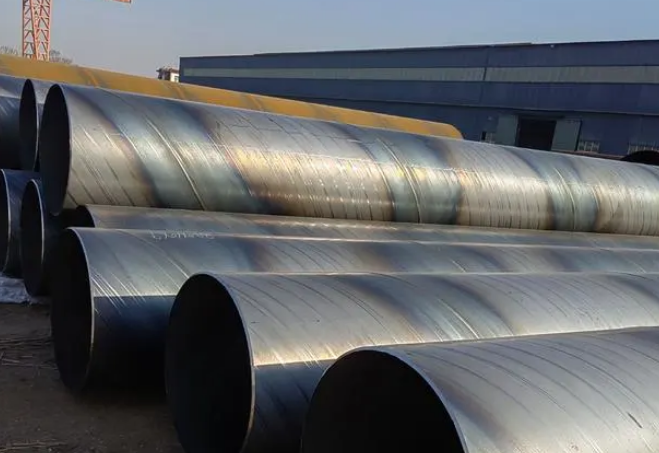
● 40-60 inches: These larger sizes are typically used for high-pressure oil and gas trunk lines and large-scale water supply and drainage projects. Larger inner diameters allow for higher flow velocities, making them ideal for transporting large volumes of fluid over long distances.
● 72-120 inches: This is the largest size range achievable with SSAW steel pipes, commonly found in large-scale water diversion projects, urban ring roads, or offshore platform jacket structures. These extra-large diameter pipes are typically custom-made to meet the specific requirements of each project.
The following is a table showing the common combinations of outer diameter and wall thickness for SSAW pipes (in mm).
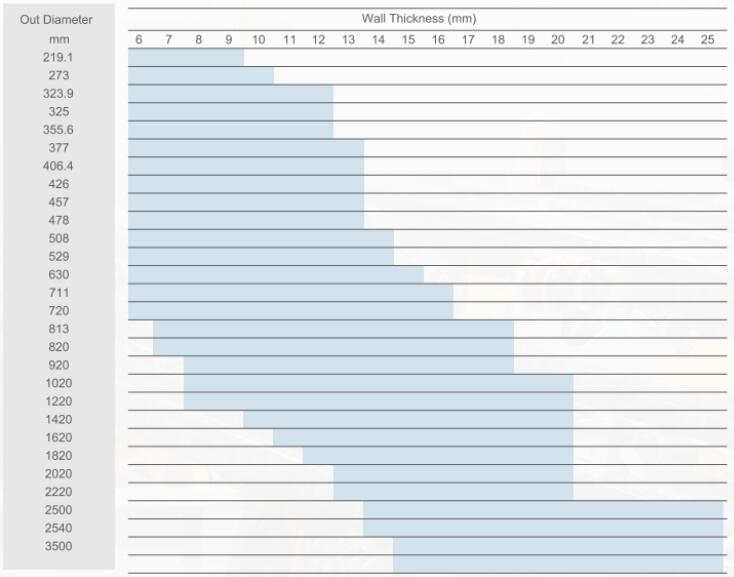
| Outer Diameter (mm) | inch | Recommended Wall Thickness Range (mm) | Common Steel Grades |
|---|---|---|---|
| 219.1 | 8 | 6.0 - 10.0 | Q235B, Q345B, L290 (X42) |
| 273.1 | 10 | 6.0 - 12.0 | Q235B, Q345B, L290 (X42) |
| 323.9 | 12 | 6.0 - 14.0 | Q235B, Q345B, L290 (X42), L320 (X46) |
| 355.6 | 14 | 6.0 - 15.0 | Q235B, Q345B, L290 (X42), L320 (X46) |
| 406.4 | 16 | 6.0 - 16.0 | Q235B, Q345B, L290-L360 (X42-X52) |
| 457.0 | 18 | 6.0 - 16.0 | Q235B, Q345B, L290-L360 (X42-X52) |
| 508.0 | 20 | 6.0 - 20.0 | Q235B, Q345B, L290-L360 (X42-X52) |
| 559.0 | 22 | 6.0 - 22.0 | Q235B, Q345B, L290-L360 (X42-X52) |
| 610.0 | 24 | 6.0 - 25.4 | Q235B, Q345B, L290-L415 (X42-X60) |
| 660.0 | 26 | 7.0 - 25.4 | Q235B, Q345B, L290-L415 (X42-X60) |
| 711.0 | 28 | 7.0 - 25.4 | Q235B, Q345B, L290-L415 (X42-X60) |
| 762.0 | 30 | 7.0 - 25.4 | Q235B, Q345B, L290-L415 (X42-X60) |
| 813.0 | 32 | 8.0 - 25.4 | Q235B, Q345B, L290-L415 (X42-X60) |
| 864.0 | 34 | 8.0 - 25.4 | Q235B, Q345B, L290-L415 (X42-X60) |
| 914.0 | 36 | 8.0 - 25.4 | Q235B, Q345B, L290-L415 (X42-X60) |
| 965.0 | 38 | 8.0 - 25.4 | Q235B, Q345B, L290-L415 (X42-X60) |
| 1016.0 | 40 | 9.0 - 25.4 | Q235B, Q345B, L290-L415 (X42-X60) |
| 1067.0 | 42 | 9.0 - 25.4 | Q235B, Q345B, L290-L415 (X42-X60) |
| 1118.0 | 44 | 9.0 - 25.4 | Q235B, Q345B, L290-L415 (X42-X60) |
| 1168.0 | 46 | 9.0 - 25.4 | Q235B, Q345B, L290-L415 (X42-X60) |
| 1219.0 | 48 | 9.5 - 30.0 | Q235B, Q345B, L290-L415 (X42-X60) |
| 1422.0 | 56 | 10.0 - 30.0 | Q235B, Q345B, L290-L415 (X42-X60) |
| 1620.0 | 64 | 12.0 - 30.0 | Q235B, Q345B (L360 and above can be customized) |
| 1820.0 | 72 | 12.0 - 30.0 | Q235B, Q345B (L360 and above can be customized) |
| 2020.0 | 80 | 14.0 - 30.0 | Q235B, Q345B (L360 and above can be customized) |
| 2220.0 | 87 | 14.0 - 35.0 | Q235B, Q345B (L360 and above can be customized) |
| 2500.0 | 98 | 14.0 - 35.0 | Q235B, Q345B (L360 and above can be customized) |
| 2540.0 | 100 | 16.0 - 35.0 | Q235B, Q345B (L360 and above can be customized) |
| 3048.0 | 120 | 16.0 - 40.0 |
Q235B (L360 and above require special customization) |
a. Q235B/Q345B: All spiral pipe manufacturers can produce this; it is a standard material suitable for water supply, structural applications, and general fluid transportation.
b. X42–X52: Mainstream manufacturers can produce this according to API 5L standards; it is a common steel grade for export markets and oil and gas projects.
c. X56–X60: Capable manufacturers can produce this; it usually requires GB/T 9711 or API 5L PSL2 certification.
d. X65: Only a limited number of manufacturers can produce this; it requires API 5L PSL2 qualification and is mainly used in high-pressure trunk pipelines.
e. X70 and above: Very few large companies can produce this; SSAW faces technical bottlenecks in the high-grade steel field, and large-diameter high-pressure pipelines increasingly use straight seam submerged arc welded pipes (LSAW).
For X65 and above, additional requirements apply:
● It typically needs to meet API 5L PSL2 standards;
● It may require special coatings such as 3PE anti-corrosion coating;
● It needs to confirm production capacity and delivery time with the manufacturer in advance.
The cost of SSAW steel pipes is a significant consideration, especially in large-scale projects. From an engineering economics perspective, while increasing the pipe diameter raises material costs, it significantly reduces energy consumption for the transported medium, requiring a comprehensive comparison.
SSAW steel pipes are also used in mining (slurry transportation), power generation (circulating water pipelines), and manufacturing. Their versatility and durability make them an ideal choice for many industrial applications.
| Application Scenarios | Recommended Outer Diameter (mm) | Recommended Wall Thickness (mm) | Recommended Steel Grade | Remarks |
|---|---|---|---|---|
| Urban Water Supply Branch Line | 219 - 406 | 6 - 8 | Q235B / L245 | Low Pressure, Small Flow |
| Urban Water Supply Main Pipeline | 508 - 1020 | 8 - 14 | L290 | Medium Pressure, Medium Flow |
| Large-scale Water Diversion Project | 1220 - 2500 | 10 - 20 | Q355B / L360 | Large Flow, Long Distance |
| Oil and Gas Gathering Pipeline | 219 - 610 | 6 - 12 | X42 - X60 | Medium and Low Pressure |
| Long-distance Oil and Gas Main Pipeline | 610 - 1219 | 10 - 25 | X65 - X80 | High Pressure, Large Flow |
| Building Structure Pile Foundation | 406 - 914 | 8 - 16 | Q355B / ASTM A252 | High Load-bearing Requirements |
| Bridge Engineering | 610 - 1220 | 10 - 20 | Q355B / X65 | High stiffness requirement |
| Offshore Wind Power Foundation | 1220 - 3048 | 16 - 40 | X70 / X80 | Extreme environment |
| Tunnel Casing | 1422 - 3500 | 14 - 30 | Q235B / L245 | Non-pressure application |
Although SSAW steel pipes are widely used, careful selection or consideration of alternative pipe types is necessary in the following scenarios:
Related information
Copyright @2017 Hunan Standard Steel Co.,Ltd and Husteel Industry Group All Rights Reserved