sales@hu-steel.com
 English
 Español

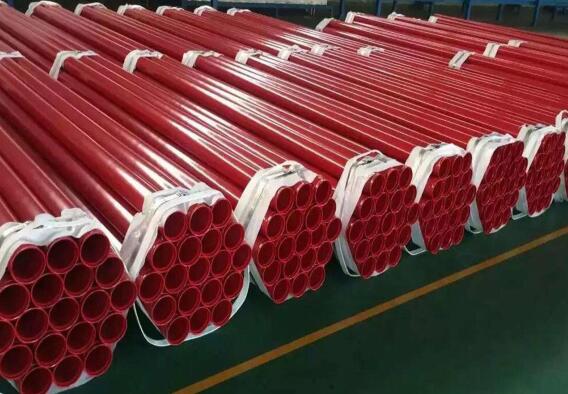
MS ERW fire line pipes refer to specialized steel pipes for fire protection systems manufactured from mild steel using an electric resistance welding (ERW) process. The following are the main MS ERW pipe specifications and standard requirements.
ASTM A53: The most common carbon steel pipe standard in the United States, covering seamless pipe (Type S) and ERW welded pipe (Type E), Grade B, widely used in fire protection systems – North America/International
BS 1387: Replaced by EN 10255, still used in some areas – United Kingdom
| Standard | Nominal Size | Outer Diameter | Wall Thickness / Schedule |
|---|---|---|---|
| EN 10255 (Medium) | DN15 – DN150 | 21.3mm – 165.1mm | 2.6mm – 5.0mm |
| EN 10255 (Heavy) | DN15 – DN150 | 21.3mm – 165.1mm | 3.2mm – 5.4mm |
| ASTM A53 Gr.B ERW | NPS 1" – 6" | 33.4mm – 168.3mm |
Commonly SCH 40; SCH 80 available |
| ASTM A795 | NPS 1" – 6" | 33.4mm – 168.3mm | SCH 10, SCH 40, SCH 80 |
| IS 1239 (Medium) | 25 NB – 150 NB | 33.7mm – 165.1mm | 3.2mm – 5.0mm |
| IS 1239 (Heavy) | 25 NB – 150 NB | 33.7mm – 165.1mm | 4.0mm – 5.4mm |
ASTM A795 Fire Fighting Pipe Wall Thickness Series Details:
● SCH 10: Thin wall, lightweight, low cost, commonly used in indoor sprinkler branches.
● SCH 40: Standard wall thickness, most commonly used, commonly used in fire risers and main pipes.
● SCH 80: Thickened, high strength, commonly used in high-pressure systems and exposed pipes.
3. Excellent cold forming performance: Steel strips can be continuously rolled into round tubes without cracking. The ERW process ensures high-speed production and guarantees the dimensional accuracy of the pipes.
2. Chemical Composition: C ≤ 0.20%, P ≤ 0.035%, S ≤ 0.030%, ensuring weldability and toughness.
3. Hydrostatic Test: ≥5.0 MPa or 1.5 times the working pressure (test each pipe individually).
4. Non-destructive Testing: Eddy current or ultrasonic testing; 100% testing is required when replacing hydrostatic testing.6. Pipe End Treatment: Plain end/Bevel/Grooved/Threaded.
Polyethylene Wrapping: Such as 3-layer PE/2-layer PE, for buried fire fighting main pipes.
Welded Connection: Applicable to all sizes
DN100-150 (4"-6"): 25 bar (2.5 MPa)
Note: Values above are for reference at ambient temperature. Actual working pressure depends on specific design codes, temperature derating, and connection types.
4. Outdoor fire hydrant systems
| Project Type | Recommended Standard | Recommended Series | Surface Treatment |
|---|---|---|---|
| Indoor Sprinkler System | ASTM A795 / EN 10255 | Medium / SCH 10-SCH 40 | Black pipe + red paint |
| Fire Riser (Exposed) | EN 10255 / IS 1239 | Heavy | Galvanized |
| Buried Fire Main Pipe | EN 10255 / API 5L ERW | Heavy | 3PE / FBE coated |
| High-pressure Fire Pump Piping | ASTM A53 Type E / A795 | SCH 80 | Black pipe |
Q1: Can ASTM A53 and ASTM A795 pipes be used interchangeably?
A: Not strictly. ASTM A53 is a general-purpose pipe standard, while ASTM A795 is dedicated to fire sprinkler systems. While both may be used in fire lines, A795 specifies exact wall thicknesses (SCH 10, 40, 80) tailored for fire protection hydraulics. For critical projects, always follow the design engineer's specified standard.
Q2: Do MS ERW fire pipes require a hydrostatic test?
A: Yes. According to standards like ASTM A795, every pipe must undergo a hydrostatic test (typically 500 psi or 1.5 times the working pressure) before leaving the factory to ensure leak-tightness. Alternatively, 100% non-destructive testing (eddy current or ultrasonic) can be performed in place of the hydrostatic test.
Q3: Are ERW welds prone to leakage in fire protection systems?
A: No, if properly manufactured. Modern high-frequency ERW pipes have strong, uniform welds. When specified under strict standards (like A795) with proper groove or thread connections, the weld is highly reliable. Routine inspections and compliance with pressure testing requirements prevent potential leaks.
Q4: Is SCH 40 or SCH 80 better for fire protection piping?
A: SCH 40 is the most common standard wall thickness for standard fire risers and mains. SCH 80 is a thicker, high-pressure series used for high-pressure fire pump piping and exposed areas requiring extra mechanical strength.
Related topics
● ERW Pipe Thickness Chart & Sizing Guide
● MS ERW Pipe Weight Chart (IS 1239) & Calculation Formula
Related information
Copyright @2017 Hunan Standard Steel Co.,Ltd and Husteel Industry Group All Rights Reserved