sales@hu-steel.com
 English
 Español
Choosing between MS pipe and GI pipe? The main difference is corrosion protection — but that's not the only thing that matters. This guide covers full forms, material properties, weldability, cost, service life, and applications, providing a comparison table and practical buying tips to help you choose the right pipe.
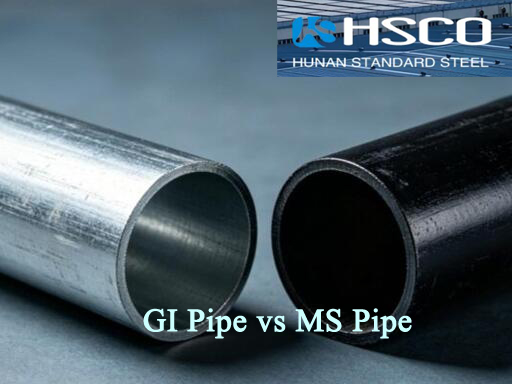
MS pipe full form stands for "Mild Steel pipe" (low-carbon steel). GI pipe full form stands for "Galvanized Iron pipe" (steel pipe coated with zinc).
|
Feature |
MS Pipe (Mild Steel) |
GI Pipe (Galvanized Iron) |
|
Full Form |
Mild Steel |
Galvanized Iron |
|
Material |
Low carbon steel (≤0.25% carbon) |
Steel pipe coated with zinc (Hot dip galvanizing) |
|
Corrosion Resistance |
Low (rusts easily) |
High (zinc coating protects against rust) |
|
Strength |
High strength and wear resistance |
Good strength, but zinc coating can be damaged |
|
Surface Appearance |
Dark gray/black, dull |
Silver-white/light gray with visible zinc spangles |
|
Cost |
Lower |
Higher (due to galvanizing process) |
|
Applications |
Structural, mechanical, oil/gas |
Water supply, fire protection, outdoor piping |
MS Pipe (mild steel pipe) refers to steel with a carbon content of less than 0.25%. Because of its low carbon content, MS pipe offers good ductility and weldability but limited corrosion resistance. It includes most ordinary carbon steel and high-quality carbon structural steel, mostly used in engineering structures without heat treatment, and in some carburized mechanical parts requiring wear resistance.
MS pipe is the most affordable type of steel pipe, suitable for structural and general fabrication where corrosion is not a primary concern.
GI Pipe full form is “Galvanized Iron” Pipe. Material MS is mild steel and GI is galvanized steel that has been hot dipped. These days the pipe will likely be made from steel rather than iron. Galvanized iron pipes commonly used on water pipe lines, it is dipped into zinc for corrosion protection.
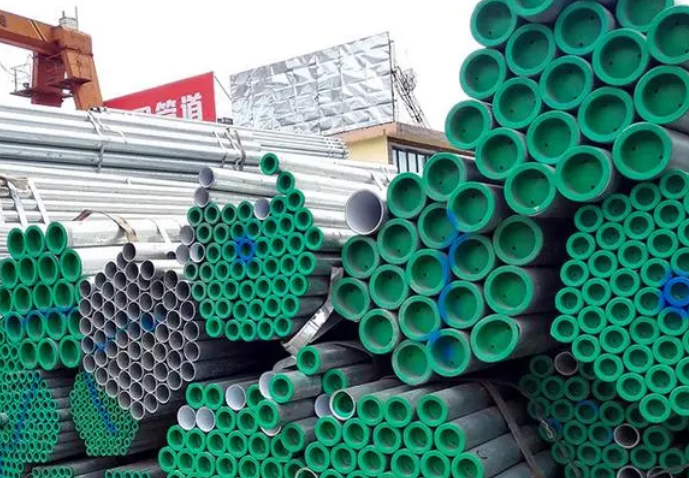
Although galvanized steel pipes and mild steel pipes (carbon steel pipes) both belong to the category of steel pipes, their materials and uses are quite different.
MS Pipe: Mild steel pipe has a carbon content of less than 0.25%. It has good strength, high malleability, and is easy to weld. However, it has low corrosion resistance and will rust when exposed to moisture. It is commonly used in structural applications, machinery parts, and general fabrication.
GI Pipe: Galvanized iron pipe is steel pipe coated with a layer of zinc through a hot-dip or electroplating process. The zinc coating provides excellent corrosion resistance, making it suitable for outdoor and water applications. The base steel provides the necessary mechanical strength.
△ What this means for your project: The low carbon content in MS pipe is what makes it easy to weld and form — but it's also the reason it rusts. If your pipe will be exposed to moisture, humidity, or outdoor conditions, MS pipe needs a protective coating (paint, epoxy, or galvanizing). Without it, rust will appear within months, not years. GI pipe solves this by adding a zinc layer, but the base steel underneath is still mild steel — if the coating is damaged, corrosion starts at the exposed area.
MS Pipe: The manufacturing of mild steel pipes includes perforating steel ingots or solid round steel to form capillary tubes, which are then hot-cold rolled and cold-drawn. This process occupies a key position in the domestic steel pipe field.
△ What this means for your project: If you need tight dimensional tolerances (for example, for threaded connections or precision fittings), confirm with the supplier whether the galvanizing process will affect the final dimensions. For standard water pipes, this is usually not an issue. For thin-walled or precision applications, it's worth asking.
The most visible difference between MS and GI pipes is their surface finish.
MS Pipe: MS pipes have a dark gray or black appearance with no metallic luster, often covered with mill scale or oil from the manufacturing process.
GI Pipe: GI pipes have a bright silver-white or light gray finish with a distinctive metallic sheen, often featuring visible zinc spangles (crystals). The zinc coating is typically 45-85μm thick for standard hot-dip galvanizing (up to 100μm+ for special heavy-duty applications). However, if the coating is scratched or damaged, the underlying steel will be exposed and prone to rusting.
△ What this means for your project: The zinc spangles you see on GI pipe are a sign of hot-dip galvanizing — they form as the zinc cools. A uniform, spangle-free surface may indicate electro-galvanizing (cold-dip), which has much lower corrosion resistance. If you're buying GI pipe for outdoor use, ask the supplier to confirm the galvanizing method.
MS Pipe: MS pipes offer excellent weldability due to their low carbon content, making them easy to weld without special procedures. They also have good workability and can be easily bent, cut, and formed into complex shapes.
● Workability: The zinc layer can crack or peel during bending or stamping, so larger bend radii or special tools may be required to avoid damaging the coating.
△ What this means for your project: If your project involves extensive field welding, MS pipe will save you time and labor. GI pipe requires extra steps: grinding off the zinc before welding, welding with proper ventilation, and re-coating the weld area with zinc-rich paint afterward. These steps add cost and time — factor them into your budget if you choose GI pipe.
MS Pipe: The production process of mild steel pipes is relatively simple and the cost is low.
GI Pipe: The production process of galvanized steel pipe is more complicated and requires galvanizing treatment, so the cost is higher.
△ What this means for your project: GI pipe typically costs 20-40% more than MS pipe of the same size. The extra cost comes from the galvanizing process itself (zinc, energy, labor) and the additional handling. However, for outdoor or humid environments, GI pipe often costs less over the project lifetime because it doesn't need frequent repainting or replacement. For indoor structural use, MS pipe with a coat of paint is usually the more economical choice.
MS Pipe: Mild steel pipes are widely used in petroleum, chemical, natural gas and construction industries due to their high strength and excellent quality characteristics.
GI Pipe: Galvanized steel pipes are mainly used in water supply, fire protection, aviation and other fields because of their good corrosion resistance.
△ What this means for your project: When making a choice, you generally need to consider only one question—will the piping be exposed to moisture? If so, galvanized steel pipe (GI pipe) is the safer choice; if not, standard carbon steel pipe (MS pipe) meets the requirements and is more cost-effective. For mixed environments (where indoor and outdoor pipe sections connect), you can use standard carbon steel pipe indoors and galvanized steel pipe outdoors, provided you ensure that proper anti-corrosion measures are applied at the connection points.
Hot-dip galvanizing produces a thick, tightly bonded zinc-iron alloy layer (45-85μm), offering excellent corrosion resistance. Cold-dip (electro-galvanizing) produces a thin, loosely adhered zinc layer (10-50g/m²) with poor corrosion resistance. Cold-dip pipes have been phased out for water and gas applications in China. For any outdoor or water-related use, specify hot-dip galvanized pipe.
Why this matters for procurement: Hot-dip galvanized pipes cost more, but they last significantly longer in outdoor and humid environments. If a supplier quotes a price that seems unusually low for GI pipe, confirm whether it's hot-dip or cold-dip — the corrosion performance difference is substantial.
3. Regional differences: China often calls it "Galvanized steel pipe", while North American plumbers may be more familiar with "Galvanized Iron Pipe".
What is a GP pipe?
GP (Galvanized Plain) pipes are lightweight, cost-effective steel tubes coated with zinc prior to being formed and welded. They are prized for their smooth surface finish, making them ideal for indoor or light-duty applications such as electrical conduits, furniture frames, and greenhouses.
Q1: What is the full form of MS pipe?
A: MS stands for Mild Steel.
Q2: What is the full form of GI pipe?
A: GI stands for Galvanized Iron.
Q3: What is the main difference between MS and GI pipe?
A: The core difference is corrosion resistance. GI pipe has a zinc coating to prevent rust, while MS pipe does not and is prone to corrosion.
Q4: Which is more expensive, MS or GI pipe?
A: GI pipe is more expensive due to the additional galvanizing process.
Q5: Can GI pipe be used for drinking water?
A: Yes, GI pipes are commonly used for water supply lines. However, in some regions, plastic or stainless steel is preferred for new construction due to concerns about zinc leaching, especially in soft water areas where the protective layer may dissolve more quickly.
Choosing between MS and GI pipe depends on your specific application.
| Your Project Need | Recommended Pipe | Reason |
|---|---|---|
| Water supply, outdoor | GI pipe | Zinc coating resists corrosion |
| Structural, indoor | MS pipe | Lower cost, sufficient strength |
| Fire protection | GI pipe | Corrosion resistance required |
| Oil & gas, high pressure | MS pipe | High strength, no coating interference |
| Drinking water (new construction) | Check local code | Some regions restrict GI due to zinc leaching |
MS pipe is suitable for structural and general fabrication where corrosion is not a primary concern. GI pipe is the better choice for outdoor, water, and corrosive environments where long-term protection is required. Evaluate your project's requirements to make the right decision.
▶ Email: sales@hu-steel.com
Related Resources:
● Carbon Steel vs Black Steel: Key Differences
● SCH 40 vs SCH 80 Pipe: A Selection Guide
● Seamless vs Welded Pipe: Process, Performance & Cost
● Guide for Selecting the Thickness of Galvanized Steel Pipe
Related information
Copyright @2017 Hunan Standard Steel Co.,Ltd and Husteel Industry Group All Rights Reserved