What is G105 Drill Pipe?
G105 Grade Drill Pipe is a high-strength alloy structural steel finished drill pipe manufactured according to
API SPEC 5DP standards. It is primarily used in drill string systems for oil and gas drilling operations. The number "105" represents a
seamless steel drill pipe with a minimum yield strength of 105,000 psi (approximately 724 MPa). It is one of the most widely used and cost-effective main steel grades in medium-deep well drilling in oil wells, transmitting surface power to the drill bit and delivering drilling fluid through the tubing string.
Features and Advantages of G105 Drill Pipe:
1. High Strength and Excellent Toughness
G105 drill pipe has a minimum yield strength of 105,000 psi, reliably withstanding the tensile, torque, and pressure forces of medium-deep wells. Through alloying and tempering heat treatment, it maintains good elongation and impact energy, exhibiting strong fatigue and overload resistance.
2. Mature Heat Treatment Structure
Utilizing a quenching and high-temperature tempering process, a uniform tempered sorbite structure is obtained. This results in a material with high strength, excellent plasticity and toughness, and stable overall mechanical properties.
3. Cost-Effectiveness
For the mainstream medium-deep well market at depths of 3000-5000 meters, G105 provides sufficient safety strength at a significantly lower cost than higher steel grades (such as S135), making it an excellent choice for project cost control.
4. Wide Applicability and Supply Assurance
G105 grade drill pipe is the primary choice for conventional and directional wells onshore. Global steel mills and OCTG dedicated pipe manufacturers produce it on a large scale, offering a complete range of specifications, convenient procurement, and easy access to spare parts.
5. Excellent Overall Drilling Efficiency
Compared to lower steel grades, its higher strength allows for the use of longer drill strings under the same load, or a reduction in tripping operations.
Compared to higher steel grades, its moderate weight helps control the total drill string weight, optimizing rig load and energy consumption.
Common G105 Drill Pipe Specifications:
Drill pipe specifications are typically expressed as "outer diameter × unit weight".
Common outer diameter sizes: 2-7/8″, 3-1/2″, 4-1/2″ (mainstay specifications for medium to deep wells), 5″ (commonly used for deep wells)
Unit weight: For example, 4-1/2″ drill pipe commonly weighs 16.60 lb/ft or 20.00 lb/ft.
Length:
Range 2: Approximately 9.5 meters (about 31 feet). This is the most common and standard drill pipe length.
Range 3: Approximately 13.5 meters (about 44 feet). Used to improve tripping efficiency, but with higher operational and transportation requirements.
Drill pipe tool joint: Typically equipped with NC series API fittings (such as NC46 for 4-1/2″ drill pipe).
End type: Mostly internally and externally thickened (IEU) to enhance connection strength.
G105 Drill Pipe Performance:
G105 grade drill pipe is a high-strength alloy structural steel drill pipe manufactured according to API SPEC 5DP standards, primarily used in drill string systems for oil and gas drilling operations. This steel grade has a yield strength range of 724-931 MPa, meeting the API 5DP standard requirements for G105. It can withstand complex loads such as tension, compression, and torsion in deep well drilling, maintaining structural stability under complex loads within a certain temperature and pressure range. Note that it is not suitable for acidic corrosive environments containing hydrogen sulfide, and its strength decreases at high temperatures.
Compared to ordinary carbon steel, G105 grade drill pipe, through the addition of alloying elements such as chromium, molybdenum, and manganese, significantly improves the material's hardenability and tempering stability, providing reliable material support for deep energy development.
G105 Material Mechanical Properties:
Yield Strength: 724 - 931 MPa (105,000 - 135,000 psi)
Tensile Strength: ≥ 793 MPa (115,000 psi)
Hardness: ≤ HB 285 (approximately HRC 30), typically more stringent (HRC 26 or below) to maintain some toughness and control the risk of sulfide stress cracking.
Elongation: ≥ 13%.
Charpy V-notch impact energy: ≥ 40 ft-lb (54 J).
G105 Seamless Drill Pipe Standards:
The production, inspection, and quality control of G105 seamless drill pipe strictly adhere to the American Petroleum Institute (API) 5DP "Drill Pipe Specification" standard. This standard clearly specifies the chemical composition range, mechanical properties, non-destructive testing requirements, and dimensional tolerances of the G105 steel grade. Compared to
API 5CT casing pipe standards or ASTM series structural steel standards, API 5DP imposes more stringent requirements on the fatigue strength, thread accuracy, and sulfur resistance of drill pipe steel, ensuring the long-term service safety of G105 seamless drill pipe under cyclic loading.
Applications of G105 Drill Pipe:
1. Conventional medium-deep wells onshore: G105 drill pipe is commonly used in vertical wells or conventional directional wells with depths between 3000 meters and 5000 meters.
2. Drilling sections below the technical casing: In multi-casing procedures, G105 drill pipe is used to drill through the technical casing to the target depth.
3. Cost-sensitive exploration or development wells: G105 drill pipe is suitable for projects with strict control over drilling material costs, provided safety is ensured.
4. As an upper component of deep well drill strings: In ultra-deep wells,
S135 drill pipe is used in the lower, high-load sections, while G105 can be used in the upper, lower-load sections to save on overall costs.
Limitations:
The advantages of G105 drill pipe depend on proper operating conditions:
a. Strictly prohibited in acidic environments containing hydrogen sulfide; sulfur-resistant steel grades such as G105S are required.
b. In ultra-deep wells (>5500 meters) or ultra-extended reach wells, its strength may be insufficient, requiring an upgrade to S135 steel grade.
c. At extreme high temperatures (typically >180°C), strength reduction calculations are required.
Frequently Asked Questions (FAQs):
What are the advantages of G105 drill pipe compared to higher grades (such as S135) or lower grades?
The core advantage of G105 lies in its excellent overall cost-effectiveness and reliability.
vs. Lower grade drill pipe (such as E75, X95): Higher strength, usable in deeper, heavier-loaded wells, reducing the risk of drill string breakage.
vs. Higher grade drill pipe (such as S135, V150): Although lower in strength, it generally has better toughness, is less sensitive to cracks, has better fatigue resistance, and is also cheaper.
For most medium-deep wells, G105 is sufficient in terms of strength, avoiding the brittleness risks and high costs associated with using higher-strength drill pipe.
What are the main failure modes of G105 drill pipe? How can they be prevented?
1. Fatigue failure: Occurs in the thickened transition zone or at the root of the joint threads, caused by cyclic loading.
Prevention: Control dogleg, use appropriate drilling fluid for lubrication, and perform regular non-destructive testing (e.g., ultrasonic, magnetic particle testing).
2. Wear: Wear on the outer wall of the pipe and joints.
Prevention: Use drill pipe clamps to control the wellbore trajectory.
3. Leakage: Failure of threaded connection seals.
Prevention: Strictly follow the torque table for thread setting, use qualified thread grease, and check for thread damage.
4. Excessive Deformation or Fracture: Caused by overload.
Prevention: Accurately design the drill string mechanically to avoid exceeding its tensile/torsional limits.
How to properly accept and store G105 drill pipe?
a. Acceptance: Verify the API 5DP certificate (including chemical analysis, mechanical properties, and non-destructive testing report), check the physical markings (steel grade, specifications, manufacturer, production date), measure key dimensions, and perform a visual inspection (no severe corrosion, dents, or cracks).
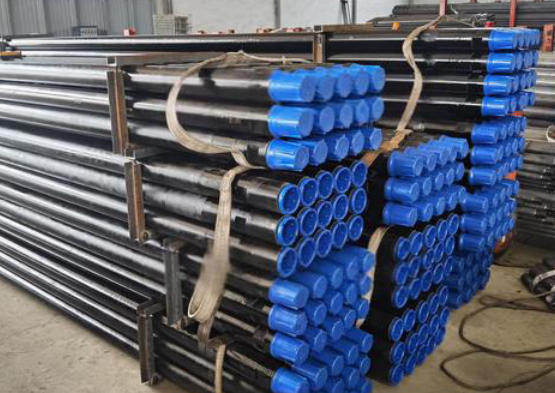
b. Storage: Should be placed horizontally on a pipe rack with at least two support points; avoid prolonged upright placement. Threads and shoulders must be coated with protective grease and fitted with thread protectors. Storage areas should be dry, and different steel grades and specifications should be stacked separately.
Can G105 drill pipe be welded or repaired?
Welding or repair of any kind on the drill pipe body is strictly prohibited. This will alter the local material microstructure and properties, creating hard spots and stress concentrations, becoming fatigue crack initiation points, and greatly increasing the risk of downhole fracture accidents. The only permitted welding is butt welding of the pipe body to the joint, performed at the manufacturing plant by qualified professionals.
What is the lifespan of G105 drill pipe?
Drill pipe does not have a fixed lifespan; its lifespan depends on cumulative pure drilling time, load history, corrosive environments, and maintenance conditions.
Read more: Difference between Casing Pipe and Drill Pipe
 sales@hu-steel.com
 English
 Español