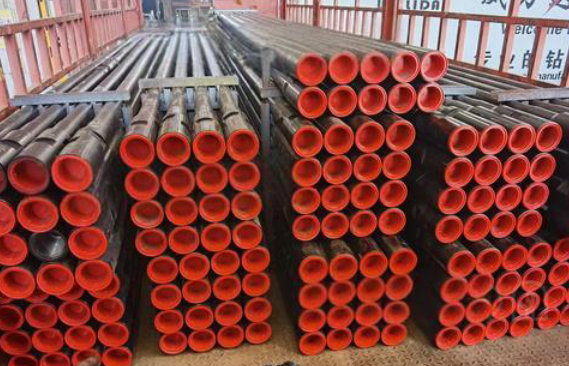
In the oil drilling industry, seamless drill pipe is the core component of the drill string. Typically made of seamless steel tubing, it comprises two key parts: the oil drill pipe body and the drill pipe tool joint. Its primary function is to transmit torque and deliver drilling fluid, and its continuously lengthening design deepens the wellbore.
Modern drill pipes commonly employ processes such as friction welding to weld the tube body and joint into a single unit. This 'threadless' design has completely replaced the old-fashioned, leak-prone, and breakage-prone fine-threaded connection method.
Importance of Seamless Drill Pipe in Oil Drilling:
Currently, seamless drill pipe is the absolute mainstream and standard form of oil drill pipe, specifically referring to drill pipes whose tube body is manufactured using seamless steel tubing technology. In the oil drilling industry, when people say "drill pipe," they implicitly mean "seamless drill pipe." Its opposite is not some other type of drill pipe, but rather "welded drill pipe," which has a completely different manufacturing process (the latter is rarely used in oil drilling because its reliability cannot meet the stringent downhole requirements).
Structural Components of A Seamless Drill Pipe:
A complete seamless drill pipe = seamless steel pipe body + high-strength alloy steel tool joints at both ends, welded together by friction.
Seamless steel pipe body: A hollow steel pipe without longitudinal welds, directly manufactured from a solid round steel billet through processes such as piercing and rolling.
Drill pipe tool joints: Made by forging or machining seamless pipe, and metallurgically bonded to the pipe body using friction welding, a solid-state welding process.
Common Materials for Seamless Drill Pipe:
The most common material for seamless drill pipe is alloy steel, accounting for over 80% of the market. Specifically:
● Oil Drilling: G105 and S135 are the most common oil drill pipe steel grades. "G" and "S" represent the strength grade, and the numbers represent the minimum yield strength.
● Geological/Engineering Drilling: R780, ZT series (ZT380-ZT740), 35CrMo, 42CrMo, 4130/4140, etc.
Among alloy steel drill pipes, chromium-molybdenum steel is the core material type. Typical grades include 35CrMo, 42CrMo, 4130, 4140, 4145H, etc. This type of material, by adding elements such as chromium (Cr) and molybdenum (Mo) and undergoing quenching and tempering, possesses excellent comprehensive mechanical properties, making it the preferred material for deep wells and complex working conditions.
● Carbon steel seamless drill pipe is only used in shallow wells (depth ≤ 2000 meters), temporary well workover operations, and low-requirement scenarios to control costs.
● Stainless steel and bimetallic composite drill pipes are used in highly corrosive and other special environments:
a. Stainless steel drill pipes are suitable for well conditions containing corrosive media such as hydrogen sulfide (H₂S) and carbon dioxide (CO₂). Common grades include 316L and 2205 duplex stainless steel.
b. Bimetallic composite drill pipes have an outer layer of G105 or other carbon steel/alloy steel to ensure strength, while an inner lining of 316L stainless steel provides corrosion resistance. This is a relatively new technology and is suitable for ultra-deep wells and ultra-high temperature corrosive environments.
Alloy Steel Seamless Drill Pipe vs. Welded Drill Pipe:
Why must seamless drill pipe be used instead of welded drill pipe in oil drilling?
This is determined by the extremely harsh working conditions of oil drilling. Seamless drill pipe offers irreplaceable advantages, specifically as follows:
1. Extremely high torsional strength: Seamless drill pipe has continuous streamlined metal lines with no weak points, capable of transmitting enormous torques of hundreds of tons per meter; while the longitudinal welds of welded drill pipes are stress concentration points and potential fracture initiation points.
2. Superior Fatigue Resistance: Seamless drill pipe has a uniform microstructure and can withstand tens of millions of alternating stress cycles caused by wellbore bending; while welded drill pipe welds and heat-affected zones are highly susceptible to fatigue cracking under alternating loads.
3. Uniform Mechanical Properties: Seamless drill pipe exhibits consistent strength and toughness throughout its circumference during operation, making its pressure-bearing capacity predictable; welded drill pipe welds show differences in properties from the base material, resulting in poor overall uniformity.
4. Reliable Sealing: Seamless drill pipe is a complete sealed body used for transporting high-pressure drilling fluid; welded drill pipe welds pose a risk of leakage, especially under high pressure.
5. Withstands Complex Composite Loads: Seamless drill pipe can simultaneously withstand enormous tensile forces, internal pressure, external extrusion, and bending; while the risk of weld failure in welded drill pipe increases exponentially under composite loads.
Seamless Drill Pipe Manufacturing Process:
1. Steelmaking and Continuous Casting: Producing high-purity alloy steel round billets.
2. Hot rolling and piercing: The heated round billet is rolled into a hollow tube (a key step in seamless manufacturing).
3. Rolling and sizing: Further rolling is performed to form a tube body close to the final dimensions.
4. Heat treatment: Quenching and tempering (quenching + tempering) is carried out to obtain the required strength and toughness.
5. Machining and welding: Both ends of the tube body are machined, and tool joints are welded on using friction welding.
6. Threading: High-precision threads (such as API NC series) are machined on the tool joints.
7. Non-destructive testing and coating: 100% ultrasonic and eddy current testing is performed, and finally, an anti-corrosion coating is applied.
Note: In the manufacturing process of seamless drill pipes, the seamless steel pipe body and tool joint are welded together using processes such as friction welding, completely eliminating the old-fashioned fine thread connection method. Currently, both newly manufactured drill pipes and repaired old drill pipes adhere to the "no fine threads" technical standard.
Common Standards and Specifications:
Seamless drill pipes are manufactured strictly in accordance with
API SPEC 5DP standards.
Common seamless drill pipe sizes (outer diameter):
3-1/2″, 4″, 4-1/2″, 5″, 5-1/2″, 5-7/8″, etc.
Among them, 5 inches is the most widely used size in deep well drilling worldwide.
Common seamless drill pipe steel grades:
E-75, X-95, G-105, S-135, V-150. The numbers represent the minimum yield strength (unit: kilopounds per square inch).
Among them, S-135 is the main steel grade used in modern deep and ultra-deep wells.
Conclusion:
Seamless drill pipe for oil drilling is a high-performance power transmission shaft designed by human engineering to cope with extreme underground working conditions. Its seamless tube body provides unparalleled reliability and safety, which is the fundamental guarantee for the safe and efficient transmission of power and fluids in drill strings thousands of meters long. In the oil industry, choosing drill pipe means choosing seamless drill pipe; this is an ironclad rule determined by industry safety standards and technical and economic considerations.
Read more: Casing Pipe and Drill Pipe Differences
 sales@hu-steel.com
 English
 Español