Seamless Steel Casing & Tubing refers to oilfield-specific casing and tubing manufactured using seamless steel pipe technology. They are the core pipe materials for constructing oil and gas wellbores, ensuring safety, and enabling production.
What is seamless steel pipe?
"Seamless" steel pipe means that there are no longitudinal welds throughout the entire manufacturing process. Seamless steel casing and tubing are made by piercing solid steel billets and then rolling and extending them into a complete, continuous hollow tube. This is fundamentally different from "welded pipe," which is made by welding rolled plates.
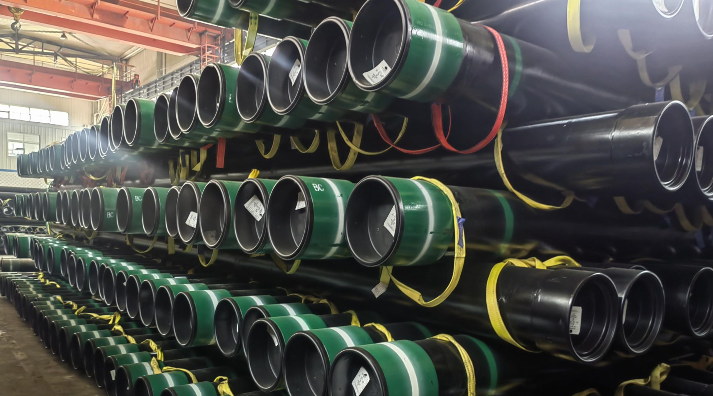
Differences between Seamless Steel Casing and Tubing:
Casing:
In oil drilling engineering, seamless steel casing serves as the permanent load-bearing framework for constructing the wellbore. It is installed in layers to isolate the formation, prevent collapse, control pressure, and provide a safe passage for drilling and production.
Location: From the wellhead to the target depth, after cementing, it bonds with the formation and is a permanent structure.
Tubing:
Seamless steel API tubing is used in drilling operations as an oil and gas production channel. It is installed inside the production casing to transport oil and gas from the production formation to the surface, and can also be used for water injection, production enhancement, and other measures.
Location: Inside the production casing, replaceable, it is the pipeline used to transport oil and gas in the wellbore.
Why Must Seamless Steel Pipes be Used Instead of Welded Pipes in the Oil Industry?
Oil pipes bear extremely complex loads downhole (enormous tension, compression, torsion, bending, and internal and external pressure). Seamless steel pipes, due to their inherent advantage of having no weld seams, are the only choice that can meet the following requirements:
1. Structural integrity and high strength: The seamless pipe body has continuous metal flow lines, uniform performance throughout the circumference, and no weak points like weld seams, enabling it to withstand complex loads.
2. Excellent pressure-bearing capacity: Uniform wall thickness and material ensure stable and predictable resistance to internal pressure and external extrusion.
3. Excellent fatigue and corrosion resistance: The non-uniform microstructure and stress concentration in the weld-free area result in a longer service life and greater reliability in corrosive environments.
Welded steel pipes are made by rolling and welding steel plates/strips. They have straight weld seams, and their pressure resistance is greatly affected by the weld quality, being far lower than that of seamless pipes. They are rarely used in oil drilling projects, and may only be used in some low-pressure shallow conduits or water/gas pipelines.
Standards and Grades:
Globally, they follow the
API SPEC 5CT standard, using
casing and tubing steel grades to identify their strength (the number represents the minimum yield strength, unit: kilopsis per square inch).
Common seamless casing steel grades: H-40, J-55, K-55, N-80, L-80, C-90, T-95, P-110, Q-125, etc.
Common seamless tubing steel grades: J-55, N-80, L-80, P-110, etc.
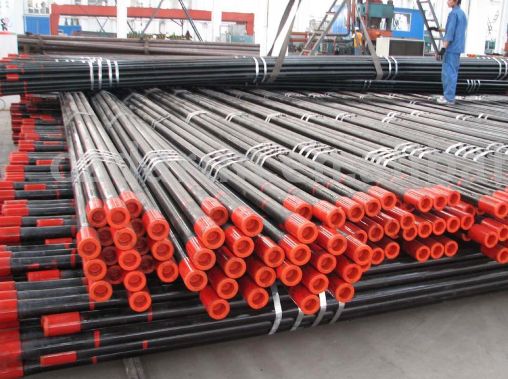
How to distinguish between seamless steel casing and tubing?
Generally, it is very difficult to distinguish between "casing" and "tubing" with the naked eye, as they both appear to be a single large steel pipe. In factories or well sites, visual inspection alone is almost insufficient for differentiation; a comprehensive judgment must be made based on location, size, markings, and function.
1. Steel Stamp Markings: Directly checking the steel stamps on the pipe (including specifications, steel grade, standard, manufacturer, etc.) is the most reliable method.
2. Thread Type: Casing typically has tapered male threads at both ends, requiring a separate coupling for connection; the joint appears short and thick. Tubing, on the other hand, has a male thread at one end and a female thread at the other, allowing for direct screwing; the joint is relatively slender, and the threads are more precise.
3. Size Differences: Casing typically has a larger diameter (commonly 9-5/8″, 13-3/8″, etc.) and very thick walls, resembling a load-bearing column. Tubing, however, has a smaller diameter (commonly 2-3/8″, 2-7/8″, etc.). 3-1/2″, etc.), with relatively thin walls, appearing as internal tubing.
4. Stacking Location and Condition: At the well site, new casing is often stacked horizontally, with individual lengths consistent (~12 meters), without couplings (couplings are packed separately); tubing may be connected into longer "stands" (three in a group) leaning vertically against the derrick, or stacked horizontally.
5. Surface Coating: Casing commonly uses varnish or asphalt coatings, primarily for storage and rust prevention. Tubing more commonly uses complete anti-corrosion coatings (such as epoxy resin), in various colors (green, red, blue, etc.), due to long-term contact with corrosive fluids.
Frequently Asked Questions:
1. What is the fundamental difference between casing and tubing?
This is the difference between a structural component and a delivery pipe. Casing is a permanent load-bearing structure that forms the wellbore, extending directly from the wellhead to the underground. After cementing, it is used to isolate the formation. Tubing is a replaceable production pipeline suspended inside the casing, specifically used to transport oil and gas from the bottom of the well to the surface.
2. Why can tubing be replaced, but casing cannot?
Tubing is suspended through a tubing hanger at the wellhead and does not require cementing; it can be retrieved and replaced as a whole. Casing is permanently cemented between the formation and the upper casing layer; replacing it is equivalent to re-drilling. 1. A single well is technically infeasible and economically unsustainable.
3. Why are the threads of tubing and casing different?
Due to different functional requirements.
Casing threads: Prioritize connection strength and sealing pressure. Mostly API trapezoidal threads or high-performance special threads.
Tubing threads: Prioritize reliability and gas tightness during repeated assembly and disassembly. Mostly
API round threads or special threads with metal seals.
4. How to select the steel grade and size for casing and tubing for a well?
Size: Determined by the "casing program," nested from largest to smallest (e.g., 13-3/8″ casing inside 9-5/8″ casing).
Steel Grade and Wall Thickness: Calculated and selected based on the maximum external compressive stress, internal pressure, and tensile force required for each casing/tubing layer, according to API standards, seeking the economically optimal solution while ensuring safety (common steel grades: N80, L80, P110).
Read more: Specifications and Dimensions of Drilling Casing Pipe
 sales@hu-steel.com
 English
 Español