What is S135 Drill Pipe?
S135 Drill pipe is a high-strength
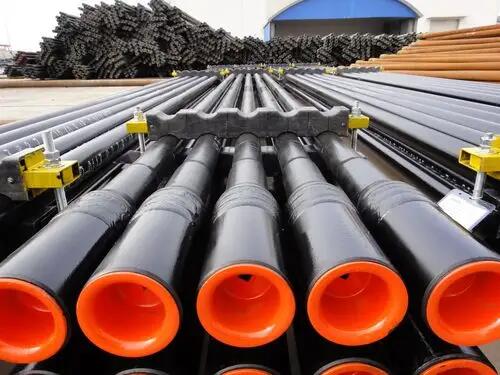
seamless steel drill pipe designed specifically for oil drilling, conforming to API SPEC 5DP standards. Its core advantage lies in the balance between high strength (yield strength ≥ 135 ksi/931 MPa) and good toughness, effectively coping with the extreme pressure and corrosive environments of deep well drilling. It is the most widely used and representative mainstream steel grade drill pipe globally in modern deep well, ultra-deep well, and complex structure well drilling operations.
Features and Advantages of S135 Oil Drill Pipe:
1. Ultra-high strength: A yield strength of 135 ksi enables it to withstand the enormous tensile forces of deep wells and the ultra-high torque of ultra-deep wells.
2. High-strength thin-walled design: Thanks to its high material properties, S135 oil drill pipe allows for optimized wall thickness while meeting strength requirements, reducing the overall weight of the drill string, thereby improving drilling efficiency and reducing overall operating costs.
3. Mature Technology and Performance: Its alloy composition, heat treatment (quenching + tempering), and friction welding process are highly standardized, ensuring stable quality across the global supply chain.
4. Optimal Performance-Price Ratio: Achieving the best balance between strength and cost, it is an economical and efficient solution for complex deep well conditions.
S135 Oil Drill Pipe Specifications:
S135 oil drill pipe specifications follow the
API SPEC 5DP standard, covering a variety of sizes from standard to ultra-deep wells:
Parameter
|
Specifications/Values
|
Remarks
|
Common Outer Diameters
|
3-1/2″, 4″, 4-1/2″, 5″, 5-1/2″, 5-7/8″
|
Covers requirements ranging from standard to ultra-deep wells
|
Nominal Weights
|
19.50 lb/ft (standard), 22.32 lb/ft, 24.70 lb/ft
|
Options available for the same outer diameter; affects wall thickness and strength
|
Wall Thickness
|
Increases with weight
|
Greater wall thickness results in higher tensile/torsional strength and reduced inner diameter
|
Length Ranges
|
R1, R2 (most common), R3
|
R2 length (approx. 9.5 meters / 31 feet) is the most common in the field
|
Example of complete specification markings:
Outer Diameter × Weight × Steel Grade × Length Range — Thread Type
S135 Drill Pipe Material Properties:
Chemical Composition: Primarily alloyed with carbon (C), manganese (Mn), chromium (Cr), molybdenum (Mo), and nickel (Ni). The low-carbon design ensures weldability and toughness.
Physical Properties: Optimized combination of high strength and toughness achieved through heat treatment and microalloying technology.
Application Advantages: Fatigue resistant, wear resistant, suitable for deep and ultra-deep well drilling, and downhole tool manufacturing.
Key Performance Indicators of S135 Drill Pipe Material:
a. Mechanical Properties: Yield Strength: 135,000 - 165,000 psi; Tensile Strength: ≥ 145,000 psi.
b. High Toughness: Excellent impact resistance, preventing brittle fracture downhole.
c. Fatigue Performance: Superior resistance to alternating stress, capable of withstanding millions of stress cycles, suitable for high cyclic loads in extended reach wells and horizontal wells.
d. Weldability: Perfectly compatible with friction welding processes, ensuring the
tool joint connection strength is no less than that of the pipe body.
Application:
S135 oil drill pipe is the preferred tool for meeting modern drilling challenges:
1. Deep and Ultra-Deep Wells: Used for drilling depths exceeding 4500 meters, it is the benchmark configuration for withstanding enormous tensile and torque forces.
2. Extended Reach Wells and Horizontal Wells: Its high torsional and fatigue resistance effectively copes with the friction and bending stresses brought about by long horizontal sections.
3. High-Difficulty Offshore Drilling: Offshore platform operations are extremely costly; the reliability and high strength of S135 are key to ensuring safety and efficiency.
4. High-Density Drilling Fluid Environments: Provides a higher safety margin in high-pressure formations requiring heavy drilling fluids.
Limitations:
S135 drill pipe does not resist hydrogen sulfide stress corrosion cracking. Its use is strictly prohibited in acidic environments containing hydrogen sulfide; its sulfur-resistant variants, S135G (limited hardness) or S135S (special sulfur resistance), must be used instead.
G105 vs. S135 Steel Grade Comparison:
G105 and S135 are two of the most commonly used high-strength steel grades for oil drill pipe. Their core differences lie in strength, cost, and application scenarios.
Comparison Dimensions
|
G105 Drill Pipe
|
S135 Drill Pipe
|
Minimum Yield Strength
|
105,000 psi
|
135,000 psi
|
|
Strength
|
High strength, economical mainstay
|
Ultra-high strength, performance mainstay
|
Core Features
|
Optimal balance between strength and cost
|
High-strength thin-walled design, thinner wall thickness for equivalent strength
|
Recommended Well Depth
|
Medium-deep wells (approx. 3,000–5,000 meters)
|
Deep and ultra-deep wells (>4,500 meters)
|
Procurement Cost
|
Lower
|
Higher, but better life-cycle cost in deep wells
|
Sulfur Resistance
|
Standard grade not sulfur-resistant (requires G105S variant)
|
Standard grade not sulfur-resistant (requires S135G/S135S variant)
|
G105 vs. S135 Steel Grade: How to Choose?
The choice between G105 and S135 mainly depends on well depth and cost.
1. Decision Based on Well Depth
If the design depth and load calculations for a well indicate that
G105 drill pipe (which may require increased wall thickness) is sufficient to meet all safety requirements, then G-105 is the most economical choice.
When the well depth reaches a certain level, using G105 will result in an excessively heavy drill string (increased wall thickness), leading to excessive load on the upper drill pipe or exceeding the drilling rig's load-bearing capacity. In this case, switching to S-135, utilizing its higher material strength to reduce wall thickness and overall weight, becomes the technically necessary and economically superior solution.
2. Decision Based on Operating Conditions
Extended reach wells and horizontal wells: Due to the enormous friction between the drill string and the wellbore, high torque and high tensile strength are required, making S135 significantly advantageous.
Hydrogen sulfide-containing environments: Neither standard grade is suitable; sulfur-resistant variants (such as G-105S, S135G/S135S) must be selected.
Read more: Casing Pipe vs. Drill Pipe or Friction Welding Drill Pipe
 sales@hu-steel.com
 English
 Español